
Author Archives: Mr. Turtle
San Francisco, California – San Francisco Museum of Modern Art
Hamilton, Ontario – McMaster Museum of Art
Public Art and Slow Art Day in Orlando
[In this series, we interview hosts for Slow Art Day and get their thoughts on hosting, the art of looking, and the slow art community. Today we interview Terry Olson, host of Orlando Public Art Slow Art Day.]
Slow Art Day: Tell us about yourself, Terry.
Terry Olson: I’m the Director of Arts & Cultural Affairs for Orange County Florida – which includes Orlando and a dozen other municipalities, Walt Disney World, Universal Orlando Resort, Sea World, etc. I call myself an “arts instigator.” I’m out at arts events all the time and oversee funding, public art and our Arts Learning for Life program. I love bringing people together for new experiences and for building relationships.
Slow Art Day: Tell us a bit more about Orange County Arts & Cultural Affairs. It sounds like a government agency that’s doing a great job.
Terry Olson: Twelve years ago Orange County decided to take a pro-active approach to supporting arts and culture befitting our world class community. Our office administers the County’s investment in the arts through several different review programs (general operating, cultural tourism, facilities).
Slow Art Day: And you seem to be quite passionate about public art. Public art does remove the intimidation that some people feel when entering a museum – something we are trying to counteract with Slow Art Day.
Terry Olson: Although my background was in the theatre, I have concentrated more on the visual arts and especially public art since we formed this office. I love to be out in various communities and love to be delighted by some art or other aesthetic feature in a public space. I have become the president of the Florida Association of Public Art Professionals. I’ve always been a “populist” kind of guy, and Public Art is probably the easiest entry point for appreciation of art for many people.
Slow Art Day: How did you hear about Slow Art Day?
Terry Olson: One of the FAPAP Board members suggested that we all host a Slow Art Day related to public art in our city.
Slow Art Day: You have been promoting Slow Art Day to other public arts professionals. Why?
Terry Olson: I sent a notice to all the public arts professionals in our state because I think it would be very exciting if public art were being looked at this way all over the state.
Slow Art Day: Tell us about the design of your Slow Art Day event there in Orlando.
Terry Olson: There about 10 sculptures, murals, and media installations within a few blocks of the restaurant where our Slow Art Day will take place. I can provide a map so that people can spend time that morning walking to any/all of those sculptures and taking time to really look at them. I also have an exercise about “How to Look At Art” that is a series of 5 questions. It is best to do that while the person is looking at the art, but it might be interesting to explore those questions after people have looked at the art and met at the restaurant, answering from memory.
Slow Art Day: That sounds like a great design. You have been really thoughtful about what people need – including a map. Tell us in your “How to Look at Art” exercise – what are the five questions you are asking people to consider?
Terry Olson: First, just stand/sit quietly – and I mean without your mind whirring – and let the art make an emotional impression on you. What feeling do you have (not related to intellectual analysis or cognizant of content, but of the more subjective overall feeling)? Second, describe what it actually is – dimensions, materials, i.e. a 4’X4’ canvas with acrylic paint applied in big globs and bits of organic matter stuck into it. Third, now, finally, you can describe what it “depicts”. Even if it is abstract you can talk about what shapes you see and any associations that it brings to mind. Fourthly, describe how your eye moves about the space. Does the composition bring you around in a circle, or are there lines, triangles, divisions, etc. Lastly, how does this relate to you and what you are thinking about or what you are going through in life? Does it bring up a theme or idea that resonates with you or with which you disagree?
Slow Art Day: Anything else we should have asked about?
Terry Olson: We might see if there could be some pop-up performances around the city that morning to add extra surprise to any participants.
If you’re going to be in the Orlando area, join Terry in his exciting Slow Art Day event.
Dallas, Texas – Public Art in Dallas Arts District
Lost in the Galapagos: Looking Slowly with Michael Bogin
Slow Art Day has asked its 2013 college interns to write short summaries of their own experiences looking slowly at artworks of their choosing.
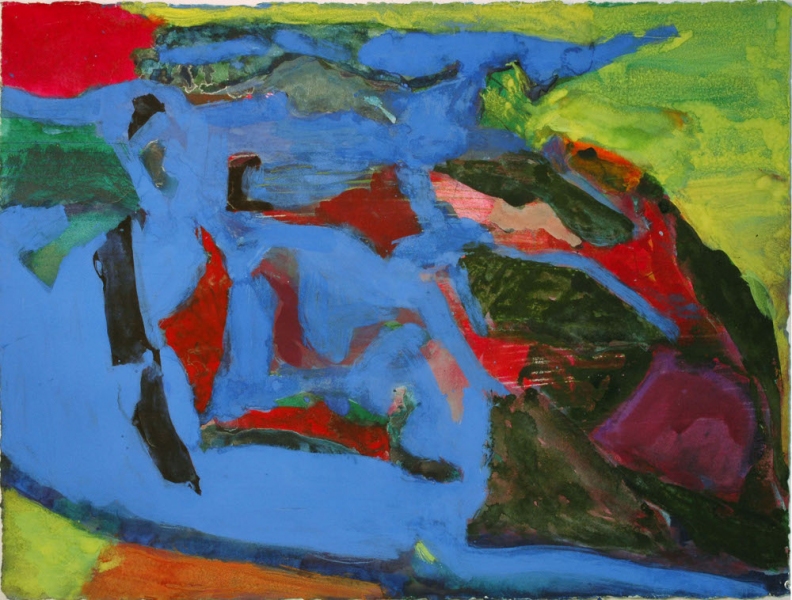
Last week I decided to spend some time looking at the work of Michael Bogin at the Davis Gallery here on my school campus.
After wandering the rooms of the gallery, scanning the walls in search of one of Bogin’s pieces that speaks to me, I notice a pattern. While at first seeming overtly simplistic, upon closer inspection his pieces start to formulate individual stories. Scanning the room, I am immediately struck by the stunning color schemes that run across the walls. His use of color varies in each piece despite their overall similar structure and as the works progress, a tale forms.
Upon closely looking at Galapagos #157, its shapes come to life and a story emerges. A koi fish whizzes past with a mermaid trailing behind; an underwater flower opens its blossom to say a few words; fish of every size decide to come investigate the scene; a coral reef arises from the abyss; bubbles float to the surface like fizz; and light begins to reflect off the ocean’s crystalline surface.
As I continue looking, I realize that I have just reached the Ecuador archipelago. As I gaze into the depths of the Pacific, I see something dart by. With the face of a woman and the tail of a fish I deem her a mermaid. Here things get strange. I fall into a kind of dreamlike state and the creatures gain the gift of gab. The koi fish tells me of the mermaid’s high status amongst the sea creatures as the mermaid playfully chases him away. The coral reef begins to tell me of her tremendous beauty and suddenly the fish that reside in the reef come out to confirm her allure. The sudden commotion causes water bubbles to lift to the surface and as the bright reflection of the water hits my eyes, I snap out of my delusion and once again I am standing in the gallery.
The process of slowly looking at Bogin’s painting proved a surprising experience. The more I look, the more I see. I now notice Bogin’s use of color and forms. The piece now opens up to me in a different way and I begin to see the intricacies of what Bogin has created.
Done in gouache, watercolor, and colored pencil, the multi-medium quality gives the piece a depth that mimics that of the ocean. Looking at the center of the painting, it becomes difficult to tell if the water sits in the foreground or background. The sea creatures seem to remain in limbo undulating back and forth between the different layers of the painting and it is this confusion that leads to my intrigue. The more I look at the painting, the less sure I am of where all the shapes sit in space. The reds and oranges seem to float to the surface in some areas while they seem to recede into the cloudy blue expanse in other sections. After a while I begin to see the intentionality behind Bogin’s every mark. I can see, upon closer inspection, where he has laid down a block of color, taken most of it away, and then put down more paint in order to achieve the illusion of depth. The blues overlap the greens in the top portion and leave behind a shadow of what once was, thereby furthering the magic of his artifice. It is this ambiguity that endows the painting with such power.
There seems to be an extreme intentionality that lies behind every mark in the painting. Simple shapes are transformed into sea life with Bogin’s poignant mark making and the scene comes alive with his innovative use of overlapping color. While there is a broad expanse of green and purple shapes conglomerated on the right side of the painting, this mass is offset with the smaller blocks of reds and greens that sit at the center of the scene. A large stretch of blue evolves into ocean in the areas where the watercolor pools into dark waves of indigo. Color merges and submerges in a playful coalition of paint and story. Just as your eye begins to follow a stream of red, you are pushed into a puddle of green; and just as you begin to circle around the green, your eye is slung into the neighboring pool of purple. This diversity of shape and color employed by Bogin is what gives the painting such life and allowed me to conjure up a story while exploring the piece’s nuances.
Had I left the gallery after a brief browse, I would not have taken notice of the intention that lies within Bogin’s work. I would not have formed the connection to the painting that still remains. The practice of looking slowly at art requires no expert nor expertise; art speaks and I learned again that if I am willing to slow down and listen, then I will hear its story in all its dimensions.
Mary Nyiri, Hobart and William Smith
[Michael Bogin’s Galapagos #157 (2009) was viewed at the Davis Gallery at Hobart and William Smith in Geneva, NY]