
Author Archives: Mr. Turtle
Dover, Delaware – Biggs Museum of American
Dublin, Ireland – Royal Hibernian Academy
Getting Lost in El Anatsui’s Black River
Slow Art Day has asked its 2013 college interns to write short summaries of their own experiences looking slowly at artworks of their choosing.
I was a little nervous about my practice run of looking slowly at a single piece of art. I have never been able to focus on an artwork for more than 2 minutes without fidgeting and I can’t even spend time sitting in a room full of friends without doodling or making crafts to occupy my hands and wandering mind. Standing still for ten minutes absorbed in a single work of art seemed very daunting.
However, armed with the task of my Slow Art Day homework assignment and my choice of El Anatsui’s undulating sculpture Black River, I had no problem spending fifteen minutes admiring the textile constructed out of recycled metal.
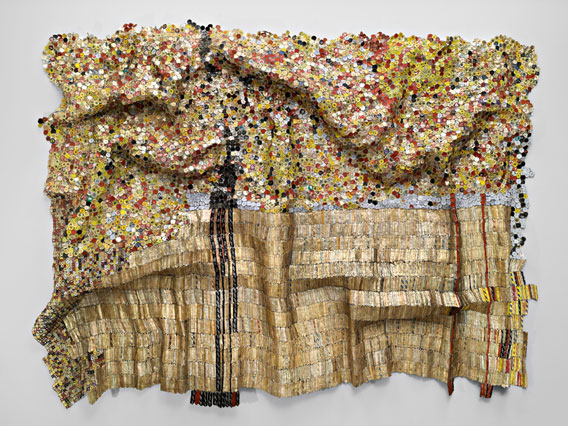
I had noticed the piece before working with Slow Art Day but I had never taken the time to see how many different types of recycled caps were used, how the light filtered through the negative space between the pieces of metal and how the curators had strategically pinned the sculpture against the wall so that it appeared like a cascade of gold. I admired it from numerous angles and different distances for its texture, and after reading the museum plaque, for its meaning.
And the experience didn’t just change how I saw that artwork. After leaving the museum I was able to focus more than I had ever before. I generally appreciate the beautiful and interesting aspects of my environment as an artist and an art history major, but I rarely take the time to actually stop and stare at something I find intriguing. After my slow encounter with Black River, I noticed a gaggle of geese and stopped to stare at them for over ten minutes. I took in the texture of their webbed feet, noting how it compared nicely with their fluffy feathers, and gawked at the striking contrast between their black necks and the white patches underneath their eyes. Slow Art Day has taught me that art is everywhere and anything can be beautiful as long as you take long enough to sit and appreciate it.
– Gabrielle Peck, Boston University
[El Anatsui’s Black River (2009) was viewed in the Museum of Fine Arts, Boston Linde Family Wing for Contemporary Art.]
Owen Sound, Ontario – Tom Thomson Art Gallery
Limerick, Ireland – The Hunt Museum
Connecting the Dots: Slow Looking with Roy Lichtenstein
Slow Art Day has asked its 2013 college interns to write short summaries of their own experiences looking slowly at artworks of their choosing.
While spending some time at home in Virginia over the holidays, I headed into Washington DC to check out the National Gallery of Art’s retrospective of Roy Lichtenstein, one of my favorite artists. Lichtenstein’s mechanical, removed style has always intrigued me, as most of his paintings are void of any painterly brushstrokes. The retrospective was truly spectacular, displaying not only Lichtenstein’s cartoon style, but also some truly stunning landscape paintings made near the end of his life. These landscapes managed to combine Lichtenstein’s trademark ben day dots with traditional Chinese landscape painting, two styles I wouldn’t have expected to mesh well together. I had never seen these works before, and spent over 10 minutes in front of this painting, Landscape in Fog, created in 1996, a year before Lichtenstein’s death.
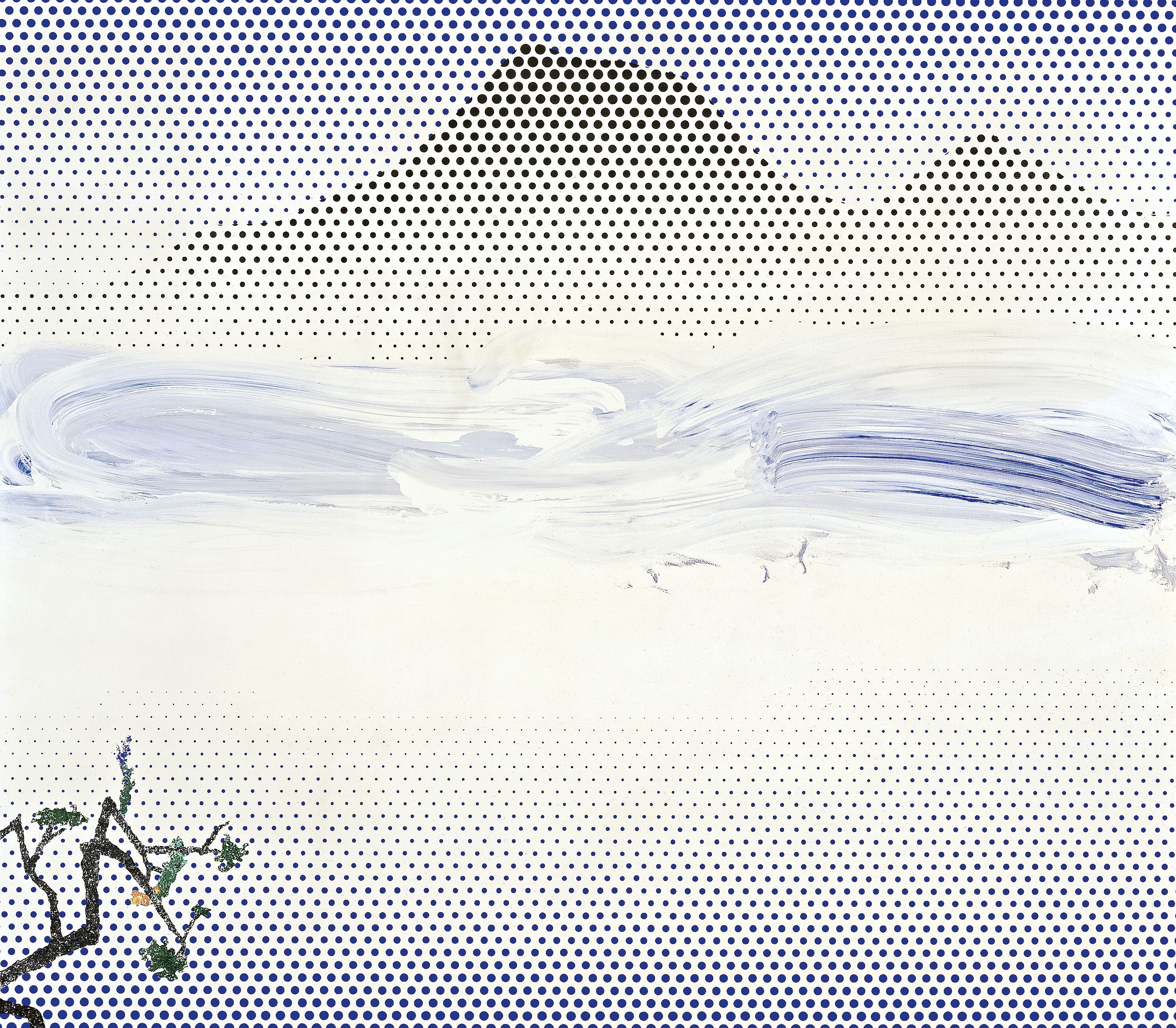
Roy Lichtenstein, Landscape in Fog, 1996, Oil and Magna on canvas, 71 x 81 3/4 inches (180.3 x 207.6 cm).
Both painterly and mechanical, this late, almost minimalistic work seems to layer dots behind and under a more abstract expressionist brushstroke. Looking at the ben day dots receding into the white background towards the center of the canvas was difficult on the eyes; it was almost impossible to tell whether the dots were covered by the white background, or whether Lichtenstein’s virtuosity with circles produced a gradient effect. Looking at the dots up close was mesmerizing; each dot is painted individually, and the subtle flaws in the imperfect circles reminded you that the artist painstakingly filled in, by hand, every single dot. The black dots used to give the effect of mountains were equally as fascinating, as Lichtenstein included slivers of individual dots to help define the outline of the mountain peaks.
Without careful observation and slow looking, these incredible details would have been lost. Not only did I get to see a series of paintings that I had no idea even existed, I interacted with this piece in a way that helped increase my awe and fascination with Lichtenstein. As I spent more time than the other visitors in front of this piece, I felt almost a kinship with Lichtenstein, who must have taken ages to carefully paint in each individual dot; the art of slow looking connected the artist and the viewer in a meaningful way that I won’t soon forget.
Alie Cline, University of Texas at Austin
Slow Art Day Social Media Manager
[Roy Lichtenstein’s Landscape in Fog (1996) was viewed at the National Gallery of Art in Washington DC at the exhibition: Roy Lichtenstein: A Retrospective.]