Jeremy Deller: A Cross-Cultural Experience to be Taken in Slowly

Ben Meyer’s  review of British artist Jeremy Deller’s mid-carrer show at the University of Pennsylvania Institute of Contemporary Art emphasizes that the cross-cultural experience needs to be absorbed and enjoyed slowly. We agree. It takes time to step into other times and places.
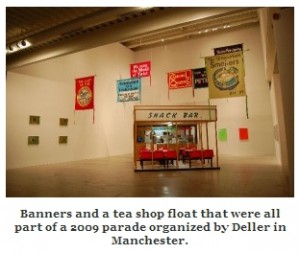
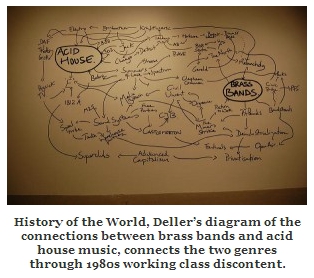
Many of Deller’s pieces are about his native Manchester and the 1984-5 miner’s strike that occurred there. No doubt he had to take multiple slow looks at his culture to engage with it in a unique way and make creative connections. For example, in one project he joins a brass band to acid house music, linking the two conceptually through the unrest of the 1980s.
Whether you are British, American, or of another nationality, taking time to really see and understand works like Deller’s can help you to make your own meaningful connections to other cultures.

Thanks to Ben Meyer and theartblog.org for pointing us to this show. Be sure to visit and take a nice slow look if you are in the Philadelphia area.

– Naomi Kuo, Slow Art Day Intern
 

Looking Slowly Means a Workout For Your Eyes

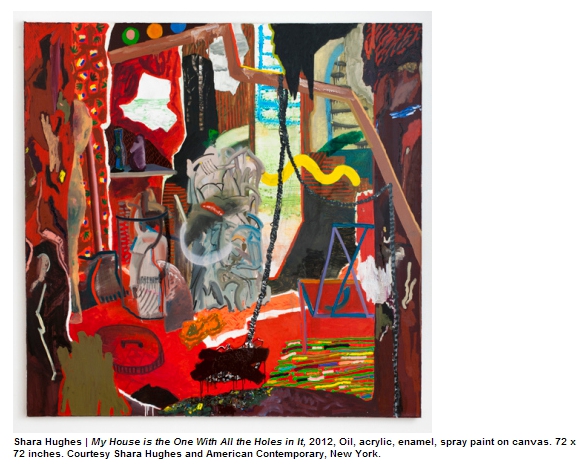
Some works of art seem to inherently invite a slower, more involved viewing experience. New American Painting contributor Brian Fee would agree in regards to Shara Hughes’ richly colored paintings currently exhibited at the American Contemporary in New York.

In his review of her work, Fee takes the idea of looking slowly to the next level. The word “slow” can make us think of being lethargic, but looking and engaging with a work of art, as Fee suggests, is a lot like physical exercise. He describes visually exploring Hughe’s paintings as “giving your oculars a calisthenic workout,” and warns against an un-energetic approach (“Go into this half-heartedly and you’ll leave with soft-scrambled brains”).

Hughes’ bold and adventurous paintings certainly do exude energy and invigorate the viewer. Take a slow (but intense) look at her paintings through Lee’s eyes in his review or through your own at the American Contemporary and get in a visual and imaginative workout.

– Naomi Kuo, Slow Art Day Intern

Bentonville, Arkansas- Crystal Bridges Museum of American Art

Austin, Texas- Blanton Museum of Art

San Francisco, California- Legion of Honor

Doylestown, Pennsylvania- Michener Art Museum

Bloomington, Indiana- Indiana University Art Museum

Drawing Some Slow Conclusions at the Frick

Reading Karen Rosenberg’s review of the Frick Collection’s show, “Mantegna to Mattise: Master Drawings From the Courtauld Gallery,” reminded me that large time-spanning exhibits need several slow looks.   

Rosenberg writes that “the installation… is roughly chronological. But it’s also dialogical, encouraging much back-and-forth between works of similar subject or virtuosity. At times the viewer may feel like a moderator, which in this case is a good thing.”

She herself makes several connections for us, playfully exploring the narrative possibilities and interesting quirks of several pairs of drawings. Her article speaks to how anyone can make his or her own unique connections and observations of art, especially if they take the time to look slowly.

Read on to catch onto her lighthearted approach to the art of looking, and if you are in New York, be sure to make one, two or three visits to the Frick Collection for a slow enjoyment of these drawings.

– Naomi Kuo, Slow Art Day Intern

Slow Art on the Streets

I loved this interview with Adam Niklewicz, by Two Coats of Paint writer Joe Bun Keo, about Niklewicz’ latest mural on an out-of-the-way wall in Hartford, Connecticut.

I particularly liked the exchange between Joe Bun Keo and Nicklewicz regarding the relatively obscure location of the mural.

Keo notes that without billboard lights “[y]ou’d have to be a little more observant than usual…to notice [Niklewicz’s mural].” And Niklewicz responds that he doesn’t think it’s a problem – that, in fact, “public art is not an advertising campaign.”

Agreed. Public art, or art of any kind, is not advertising. And, unlike advertising, it’s worth spending the time to really see it – rather than quickly look and move on.

I hope some Slow Art Day readers get a chance to go look at some of this new public art in Connecticut. The state has spent $1 million to commission murals in multiple cities.

– Naomi Kuo, Slow Art Day intern; edited by Phil Terry

New Video: “Erin Shirreff Takes Her Time”

The Art:21 New York Close Up documentary series just released a video on Erin Shirreff.

Shirreff transforms the experience of looking at photos. She invites viewers to linger on a single photo. Each photo has multiple still images – each image a different perspective or manipulation – and all placed into a video stream.

What do I mean?

Watch the above video to learn more and to get inspired to really look.

– Naomi Kuo, Slow Art Day Intern