
Author Archives: Mr. Turtle
Gargrave, England – The Art Depot
Slow Art Day with Natalie Iturbe at the Melrose Trading Post
[In this series, we interview hosts for Slow Art Day and get their thoughts on hosting, the art of looking, and the slow art community. Today we interview Natalie Iturbe, who is hosting a Slow Art Day event at the Melrose Trading Post in Los Angeles.]
Slow Art Day: Tell us about yourself and your passion, Natalie.
Natalie: My passion is art! I am a visual artist and somewhat of a curator. I express my passion through my job and through my artwork. At my job I bring in various local vendors to sell in our weekly community market. It is a particular selection process, and I aim to keep a good balance of original artwork, vintage and antique items, fun collectibles and fashion-related items. Through my art I am able to release my inner thought processes and energies onto a canvas or a piece of paper. It is absolutely necessary for me to create art in order to maintain a balanced and happy life.
Slow Art Day: And what is Melrose Trading Post?
Natalie: The Melrose Trading Post is the weekly nonprofit community market I manage every Sunday. We are located in the heart of Los Angeles at Fairfax and Melrose Avenues in the parking lot of Fairfax High School. We are sandwiched between two of LA’s artistic communities, Fairfax Village and the Street Art District. The vendors that come in range from local artists, craftspeople, entrepreneurs, collectors, antique buffs, historians and more. The money raised through our $2 admission fee and the vendor booth rentals benefit programs for Fairfax High School students. These programs include club fulfillment requests, Greenway Arts Education Programs, teacher supply requests, school beautification projects and more.
Slow Art Day: You have hosted Slow Art Day before. How’d you first hear about it?
Natalie: I saw an article about it online last year. I volunteer at the county museum (LACMA) and I noticed that many people only look at individual pieces of art for a few seconds. The artist may have taken years to create the piece, but it only gets a few seconds of a patron’s time. By bringing Slow Art Day to the Melrose Trading Post, I saw it as a way to slow Angelenos’ hasty life pace down long enough to look at the local artists’ work that we feature.
Slow Art Day: At your Slow Art Day – the artists are there to interact directly with the public, yes?
Natalie: Yes – the Melrose Trading Post is a very interactive experience. We have over 240 artists and vendors who you can talk to, haggle with, and pick their minds about their various topics of expertise. Our Slow Art Day is unique because you can actually speak with the artist. You can ask them questions, make a direct purchase and follow their creative journey. We like Slow Art Day here because it is yet another way to bring patrons and local artists together to engage and inspire each other.
Slow Art Day: What is one of your favorite art works?
Natalie: I love the work of Remedios Varo. Her paintings are so mystical and haunting. I also love Henri Matisse’s artwork, especially his more colorful pieces before World War 1.
[Make sure to check out Natalie’s Slow Art Day event at the Melrose Trading Post in Los Angeles, California.]
Corning, New York – Exhibit A Contemporary Art
Toronto, Ontario – Art Gallery of Ontario
‘Fair go’ and Slow Art Day – An Interview with Elle Credlin
[In this series, we interview hosts for Slow Art Day and get their thoughts on hosting, the art of looking, and the slow art community. Today we interview Elle Credlin, the Public Programs officer for Bayside City Council in Sandringham, Victoria, Australia.]
Slow Art Day: Tell us about yourself and about Bayside City Council’s Art and Heritage Collections.
Elle Credlin: I’m Bayside City Council’s Art and Heritage Collections and Public Programs Officer. I have a Bachelor of Arts (History) and a Postgraduate Diploma in Cultural Heritage/Museum Studies. My role is to manage Council’s art and heritage collection and also run public programs for the Gallery @ BACC. Council’s art and heritage collection is comprised of over 2000 items including municipal records, plans, maps, textiles, photographs, mayoral regalia and a range of visual arts.
Slow Art Day: That’s great. Tell us more about your role as Public Programs Officer.
Elle: I develop and manage the range of public programs and outreach services to accompany and enrich the exhibition program. These include things like curator’s talks, workshops, tours, art appreciation evenings and now Slow Art Day! We also run an Art and Dementia program titled Connections. Through discussion based tours of art work, the program provides a unique opportunity for people living with dementia to connect, interpret and express experiences through a work of art.
Slow Art Day: Please tell us more about the Dementia program. Do many other programs like that exist in Australia?
Elle: Connections is based on the National Gallery of Australia’s award winning Art and Alzheimer’s program. In 2012, gallery staff received training from NGA educators in how to deliver the program. Each program runs over a four week period and three works of art are discussed each week amongst the four participants. The program employs specialised forms of communication and strategies to encourage participation and support inclusiveness. These strategies include hand gestures, smiling, leaning forward and allowing for silence. It is run during normal gallery opening hours to prevent the marginalising of participants. We are really proud of Connections because it extends beyond many activities commonly available to people with dementia. Participants are able to engage in meaningful activity in an environment where their intellect is respect and valued. As far as I’m aware, we are the only local municipal gallery that runs this particular type of program in the state of Victoria, but that may have changed.
Slow Art Day: Why are you so passionate about making art more accessible?
Elle: I absolutely hate the idea that people could be intimidated or frightened by visiting a gallery or find themselves plagued by the ‘white box syndrome’. Galleries should be inclusive and welcoming. Every single person should have the opportunity to experience the richness of the arts. More broadly, as we are based within a local government context, we also need to align ourselves with the broader organisational mission of inclusivity, accessibility and facilitating opportunities for people of all abilities to participate in community life.
Slow Art Day: We obviously agree. Switching gears – Slow Art Day has really taken off in Australia. There are 13 venues in Australia making it more than 5% of the total worldwide venues yet Australia has only about .3% of world population. Why do you think Slow Art Day is such a big hit there?
Elle: I’m not sure, that is a really interesting question. Melbourne, in particular, has a thriving artistic and cultural scene so that could have something to do with it. Maybe the fact that Slow Art Day is an accessible and affordable activity mirrors the ‘fair go’, non-elitist attitude of many aspects of Australian culture and life i.e. that everyone should have access to the same opportunities and experiences.
Slow Art Day: Say more about ‘fair go’ – is that Australian lingo?
Elle: ‘Fair go’ is a very Australian term. Although it has many different meanings, I think it is fundamentally a commitment to egalitarianism in all aspects of culture and life; that we are all given every reasonable opportunity to access to the same opportunities and rewards. That is how I see it anyway.
Slow Art Day: What more can you tell us about your event? Have you chosen your art?
Elle: For Slow Art Day, we will be celebrating the works of a number of significant early 20th century Australian artists, including Tom Roberts, Frederick McCubbin and Arthur Streeton. We will be having lunch in the municipal chambers. If it’s a nice day, we might sit out in the rose garden.
Slow Art Day: You plan to make Slow Art Day a regular fixture in your public programs. Does that mean you plan to do regular events throughout the year based on slow looking?
Elle: Yes, Slow Art Day will now be a regular feature in our program. Our Art and Dementia program, as mentioned, is very much aligned with the idea of slow looking. We also host ‘soiree’ type evenings with wine and cheese, which are very popular. These evenings are very relaxed and people are encouraged to take their time with the works.
Slow Art Day: Let’s finish by asking what’s one of your favourite pieces of art? And why?
Elle: That is a hard question! I love Ben Quilty’s work. I think he’s amazing.
[Make sure to check out Elle’s Slow Art Day event at The Gallery at BACC in Brighton, Victoria.]
‘Face’ to Face with Dorian Gray
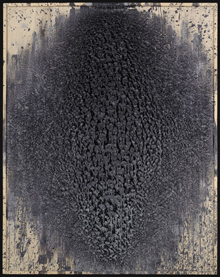
Martin Kline, Dorian Gray, 2011. Image Courtesy of the Harvard Art Museums.
Slow Art Day has asked its 2013 college interns to write short summaries of their own experiences looking slowly at artworks of their choosing.
Out of the corner of my eye, I can feel Dorian Gray digging into the back of my neck, his carbonized tendrils reaching outward with a foreboding aura.
Martin Kline’s Dorian Gray (2011) is currently situated on the fourth floor of the Sackler Museum (one of the Harvard Art Museums). The encaustic on panel work resides in a tucked-away enclave to the left, and I might have passed it by, if not for the incredible breathtaking presence of the piece quickly enveloping me. The odd fact that this very contemporary work is being displayed on a floor usually reserved for historical European works from Middle Ages to Modern Art is jarring. And yet, it seems completely appropriate. Its uniqueness demands its own votive-like shrine. It shouts loudly for your attention in order to simmer to a boil before your stolen attention.
This ‘portrait’ does not portray the Oscar Wilde character in his eternal youth. Instead, the spellbinding work showcases the blistering and decaying remains of the bewitched painting. Miraculously the work still carries the same devilish, enigmatic force that you would expect from a depiction of Dorian’s debaucherous descent in his perpetual youth.
As I gaze at Kline’s work, however, I temporarily forget all literary references. Regardless of intent or allusion, this piece literally feels timeless. From all directions and perspectives it becomes reminiscent of so many worldly forms. I feel as if I need to mentally map the pulsating topography of the piece inch by inch. A gigantic festering blister at direct view morphs slowly into a singed old growth forest to bubbling, oozing lava, to a hearty crop of stalagmites as my gaze traverses the panel. I am able to visually trace the peaks and valleys, following them down into the crevasses created by the dripped wax terrain. The technique used by Kline, curiously one of addition and growth instead of the destruction that you would assume of the corrupted portrait, adds to the oddly lively artwork.

Martin Kline, Dorian Gray (detail), 2011.
I realize something while looking horizontally from the right at the Martian landscape (after exhausting all of my other viewing options, museum etiquette-wise). Stepping back a few feet, I see that the wax used is a variety of colors, not the monotone mound it appears to be. Light gray, dark gray, even a sickly shade of green is intermixed to add depth and shading to the work. I was so close and drawn into the work that I didn’t realize this core component. What else did I miss?
I draw back, not in retreat, but in pursuit. The optical feat created both by the layers of wax and its pigmentation is still enchanting and intoxicating. As I’m across the gallery, however, I realize that I’ve made a crucial mistake in my original viewing of the work. This is not a remnant of past events, or a passively brewing force.
This work has a life of its own and it’s still spreading.
-Karen Trop, Bennington College.
Martin Kline’s Dorian Gray among other great works is available to view at the Arthur M. Sackler Museum in Cambridge, MA. The Harvard Art Museums are not currently hosting a Slow Art Day event. Inspired? Sign up as a host today!
Corning, New York – 171 Cedar Arts Center
Oakland, California – Gray Loft Gallery
Amherst, Massachusetts – Mead Art Museum at Amherst College