
Author Archives: Mr. Turtle
Turin Point: My Face-off with Franz Kline
Slow Art Day has asked its 2013 college interns to write short summaries of their own experiences looking slowly at artworks of their choosing.
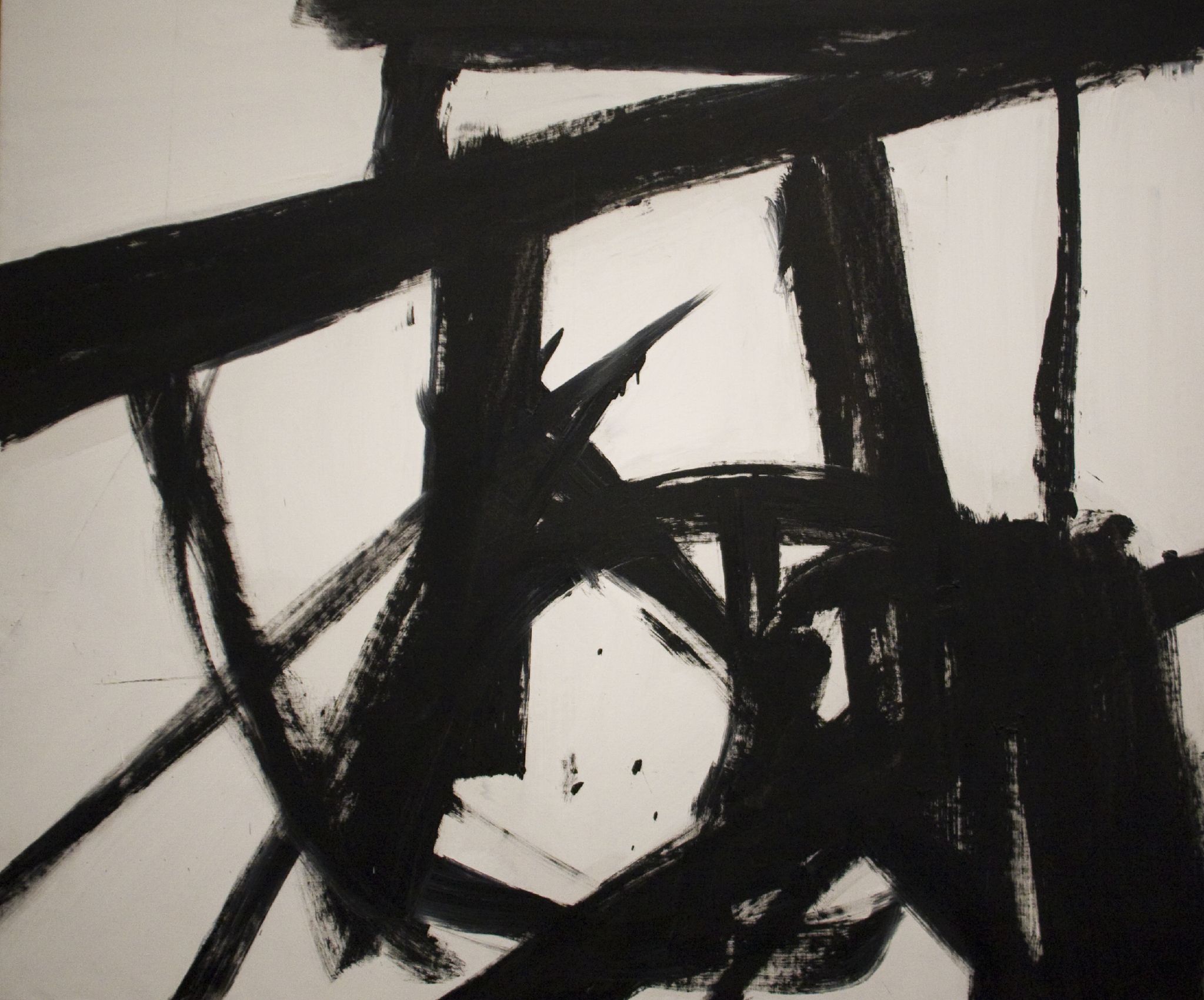
Meandering the sparsely populated gallery on a normal Tuesday afternoon, it is nearly impossible to not be transfixed towards Franz Kline’s Turin (1960). As I draw closer to the magnetic canvas, it’s massive presence causes Turin to loom over, dwarfing me with impressive size. My first instinct in the face of such a monolithic painting is to scatter to any corner of the exhibit. Instead, I decide to stand my ground in the front of the gallery. This bolstering of will initiated by the intimidating strokes anchors my legs directly in front of the canvas. Perhaps my initial reaction can be distilled with a measured and slow look.
Within the first minute I am already wavering. The raw, impressive energy of Turin is overwhelming head on. I am used to standing off on the side, not facing a work so directly. I cannot afford to be passive, however, I have to engage with what I am staring down before me. Instead of an impartial sweeping glance across the room, I find myself fixated. Here, I am held captive.
I am drawn first towards the thick, heavy vortex of black paint. All I see is black, as my eyes are downcast towards the frenetic yet firm grip of the brushstrokes. The distracting murmurs of the gallery’s other inhabitants echoing in the spacious gallery begin to dissipate. As far as I am concerned, I am in solitude with Turin.
I become more preoccupied with trying to discern how brooding columns of pigment can pair so well with fibrous sweeping gestures. I follow the strong, deliberate beams outward until I must step back and shift my weight in order to follow their lead. As the concentrated black swirl leads out in angular, cantilevered bars, I exit the vortex that had first captured me, my eyes watching the articulate arching reaching outward. I soon realize that Turin, in fact, has an abundance of white space.
By standing my ground, I have the revelation that Turin exists in a state of contradictions. It appears both dark and light, crowded and sparse, belabored and spontaneous. I realize that there is a wealth of information behind it’s initial intimidating stature. With this reveal, it becomes obvious that Kline’s abstraction is a well-crafted process revealing a plethora of competing elements.
I step away with satisfaction, having spent a good deal of time exploring the varied and numbered passageways within Turin. Without stopping and looking unflinchingly at the canvas, I doubt I would have been able to fully appreciate Turin’s dynamism, or been able to see the fluidity in his taut lines.
-Karen Trop, Bennington College
[Franz Kline’s Turin (1960) was viewed at the Allentown Art Museum’s exhibition: Franz Kline: Coal and Steel. The Allentown Art Museum is a participating venue for Slow Art Day in 2013.]
Philadelphia, Pennsylvania – Vox Populi
Canberra, Australia – National Portrait Gallery
Dallas, Texas – Nasher Sculpture Center
Carlisle, England – Tullie House Museum and Art Gallery Trust
Chicago, Illinois – Thomas Robertello Gallery
Seattle, Washington – Form/Space Atelier
Williamstown, Massachusetts -The Sterling and Francine Clark Art Institute
Experiencing the Slow Art Day Movement
Slow Art Day has asked its 2013 college interns to write short summaries of their own experiences looking slowly at artworks of their choosing.
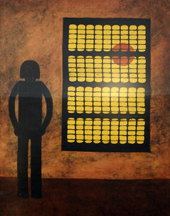
One afternoon, I spend 20 minutes looking at Rufino Tamayo’s El Hombre En La Ventana (1980). At first glance, it appears that the man is only momentarily looking outside the window. But after further observation, I come to believe that this man is not just casually looking but staring as if looking out into the distance, out into the future.
As I look more, I reflect on how the style of the piece is important. The style is Mexican – I know because of the style and materials of the blinds. These are traditional Mexican wooden blinds, not conventional American plastic ones. I also begin to think about this Mexican man. Perhaps he is looking to the future because he is a father and has a family that he needs to support. This piece is very simple but seems to suggest a deep topic in a very simple yet impactful way.
I stand back and also think about where I am seeing this painting. The Vincent Price Art Museum, in partnership with the East Los Angeles Community College, seeks to serve the culture and history of the Mexican community both in Los Angeles and in Mexico. Through a motif of modernism, this museum and its varying collections offers a new view of modernism that reflects the local community. So maybe this Mexican man is at a window at his home in Mexico or maybe he is here in East LA.
As the minutes tick by, I begin to reflect on the moment the painting was created: 1980. The U.S. and many other parts of the world are in recession. Many people, including perhaps this man in the painting, were thinking of moving for jobs. Even within the U.S. a big migration was beginning from the rust belt to the sun belt. I think more about the body language of the man. He has his hands on his hips. I think he is ambitious. He wants control of his future for himself and his family. He is very similar to many other men at this time because they all wanted something better for themselves.
I’m amazed at what I’ve seen in 20 minutes. In really looking slowly at this piece of artwork, I have thought about much that would have gone unnoticed. Looking slowly is a great way to truly evaluate and appreciate any artwork and was certainly true for this Tamayo. Next time you are in Los Angeles, I recommend you visit not just the big museums but come to the Vincent Prince and take some time to really see.
[Rufino Tamayo’s Hombre en la ventana (1980) was viewed in the Vincent Price Art Museum’s exhibition: The Views of Mexican Modernism.]
-Cristina Gonzalez, UCLA