
Author Archives: Phyl Terry
Recovering from Slow Art Day 2014
We had a great Slow Art Day 2014 in 238+ venues around the world.
The volunteer team that runs Slow Art Day is recovering and will soon be updating this site with the date for Slow Art Day 2015 (by the way, it’s Saturday, April 11, 2015).
Thanks,
The exhausted but happy team
Today is Slow Art Day 2014
Have a *good* Slow Art Day 2014 wherever you are in the world.
If just one more person in the world today learns that they have the innate ability to look at and and to love art, then we will have all reached our mission.
Best,
Phil
Founder, Slow Art Day
P.S. Tweet about your experiences today. Use #slowartday2014
Thank you
Two days ago on Saturday, April 27 we celebrated Slow Art Day 2013 in 272 museums in 207 cites across six continents.
We – the volunteer team who runs Slow Art Day – have much to be thankful for.
I started Slow Art Day with four participants at the Museum of Modern Art in 2009. Four years later – and without any money invested at all – we have built a global movement with thousands of participants and hundreds of hosts.
How did Slow Art Day grow like this?
For me answering that question means acknowledging that we have just barely begun.
Even in the United States, with the largest economy in the world by far, only 23% of adults visit art museums each year. That means 77% stay away.
Why do so many people stay away from these important cultural institutions?
There are many varied and complex reasons but at Slow Art Day we believe that at least one reason is that many people do not feel welcome. This is true despite the genuine hard work and creativity that most museums put into welcoming the public.
I started Slow Art Day because I myself finally discovered that if I stood in front of a piece of art for an extended time that I saw much more and felt included in the art experience. Most importantly, I felt that way not because someone told me what to see or feel but because I included myself. If thousands, indeed millions, of people took the time to look slowly, then they might discover for themselves that they have the capacity to look at and participate fully in art.
The art on the walls and galleries of public institutions around the world is owned by all of humanity. This is our art. It is for us and by us. And Slow Art Day creates the possibility for millions of people to realize that simple but profound truth.
So, yes, we give thanks to the:
– 272 volunteer hosts around the world who created and ran their own powerful and unique events for Slow Art Day;
– 20 members of the global coordinating team, many of them art history college students, who brought their passion, creativity and energy to building Slow Art Day 2013;
– thousands of museums and galleries around the world who work so hard to make art available and whose staffs inspire us everyday;
– many thousands of artists who give their gifts to all of humanity;
– many, many thousands of people who took two hours on Saturday to look slowly and discover for themselves the joy of including themselves in this thing called art.
Thank you!
Phil Terry
Founder, Slow Art Day
Slow Art Day at LACMA with Monika Del Bosque
[Slow Art Day Founder Phil Terry recently interviewed Monika De Bosque, three-time host of Slow Art Day at the Los Angeles County Museum of Art.]
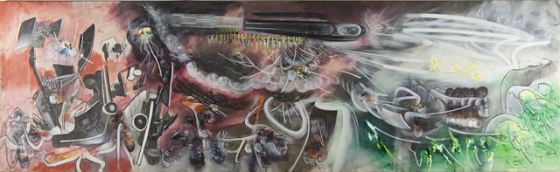
Robert Matta – Burn, Baby Burn
Slow Art Day: You’ve been a Slow Art Day host since the beginning. Why?
Monika: Art has the power to move us, and there is a certain potency in knowing that we’re all participating at the same time (give or take). There’s something special about that.
Slow Art Day: You have 100 people coming to LACMA on Saturday and 10 moderators. Tell us more about the design of your Slow Art Day.
Monika: It started out that my co-host and I took students from our respective classes at Pierce College in Woodland Hills, CA. Melanie McQuitty teaches Aesthetics and Philosophy of Art in the Sociology/Philosophy Department and I teach Studio Art courses and direct the college Art Gallery.
Slow Art Day: Do professors from different departments there typically team up like that?
Monika: It is actually rather unusual for faculty at our college to do interdisciplinary activities such as this, but we saw the correlation between our classes and really enjoy collaborating together. Our first year co-hosting it was really a student event with about 60 students.
Slow Art Day: But, now you have an interesting mix of students and the public, right?
Monika: Yes. I really enjoy the fact that there is a mixture of both students and people from all over Los Angeles.
Slow Art Day: What art did you pick for Slow Art Day this year?
Monika: We have some great art selected! We are looking at Gego’s Column, Squared Reticularia, 1972; Roberto Matta’s Burn, Baby, Burn, 1965-66; Charles Howard’s Double Circle, 1950; Edward Biberman’s The White Firescape, 1956; Marc Chagall’s Violinist on a Bench, 1920; and finally George Segal’s, Old Woman in a Window, 1965.
Slow Art Day: And what about your unique approach to moderators?
Monika: We recruit about eight other moderators besides ourselves because with such a huge turnout, we break into groups of ten or so for our discussion time. Our moderators are students who have taken our courses and attended past Slow Art Day events, faculty members from other colleges, museum educators, and artists. It helps that we know people within the field of art and art education, but we are actually pretty selective about who we ask because we want the discussions to be engaging and interesting.
Slow Art Day: How do you determine the topics for the moderators?
Monika: Instead of choosing one piece or topic to discuss, we allow our moderators to pick a piece they want to lead a discussion on and then let our attendees to self select their discussion group based upon these discussion topics. Within reason. We will move people around if we see that a group has twenty people and another has only three. Because we allow our moderators this level of autonomy, this is why we are very selective in who we ask to lead a discussion.
Slow Art Day: What do you do during the discussions?
Monika: I generally lead a group on the museum experience as this relates to a particular piece, or a group on the elements and principles of design in a particular work since I teach 2D Design. In order to keep a sense of continuity with our large group, we stay at our venue for discussion, and we keep our small discussion groups within proximity to each other. This does prove challenging at a large, busy museum like LACMA! This year we have begun to work more closely with their staff, and have found a location for our discussion that we think will work really well for this (stay tuned). It can be hotter than blazes by April in LA (two years ago it was a 100 degree day), so we’re always looking for shade. Next year we hope to secure an indoor space by working with the museum staff.
Slow Art Day: You yourself are both an artist and a teacher. Tell us more.
Monika: Well yes, I am one of those people fortunate enough to make a living doing what I love. I have an MFA in Studio Art, and studied Museum Collections Management—both at John F. Kennedy University. I actually first heard about Slow Art Day from a colleague at JFKU, Susan Spero, who posted the very first announcement back in 2010 on her Facebook page. Seems I was destined to be an educator because I love teaching and I love art and I love museums. So, I am very happy getting to teach art and run a gallery and teach exhibition design. For me, it’s the perfect combination. When I’m not teaching, my art revolves around exploring identity. I’m a painter and in my paintings I like to push boundaries with my materials. I draw and mix media and incorporate collage and handwritten text into my work. I have a deep love of color, line, design, and geometric forms and structures. My students tell me I am a fun instructor and people often mistake me for my students. When I’m not in my studio, I can often be found mucking about in my garden or kitchen getting inspiration for my art.
[Make sure to check out Slow Art Day at the LACMA in Los Angeles.]