Slow Art on the Streets

I loved this interview with Adam Niklewicz, by Two Coats of Paint writer Joe Bun Keo, about Niklewicz’ latest mural on an out-of-the-way wall in Hartford, Connecticut.

I particularly liked the exchange between Joe Bun Keo and Nicklewicz regarding the relatively obscure location of the mural.

Keo notes that without billboard lights “[y]ou’d have to be a little more observant than usual…to notice [Niklewicz’s mural].” And Niklewicz responds that he doesn’t think it’s a problem – that, in fact, “public art is not an advertising campaign.”

Agreed. Public art, or art of any kind, is not advertising. And, unlike advertising, it’s worth spending the time to really see it – rather than quickly look and move on.

I hope some Slow Art Day readers get a chance to go look at some of this new public art in Connecticut. The state has spent $1 million to commission murals in multiple cities.

– Naomi Kuo, Slow Art Day intern; edited by Phil Terry

Slow Forest Year

You think looking at an individual painting or sculpture for 10 minutes seems long? How about a year?

James Gorman reviews a new book, The Forest Unseen: A Year’s Watch in Nature, in the New York Times Science Times today. It turns out the author, David Haskell, spent a year slowly watching a patch of nature.

Haskell, a scientist, “did no experiments and no research…He sat, and watched, and listened” for this yearlong meditative study.

For example, one day he spent an hour slowly observing squirrels. That simple activity helped him realize something obvious and profound. Like a Slow Art Day participant who discovers a color, texture or other seemingly hidden element, Haskell joyfully discovered that “squirrels appear to enjoy the sun, a phenomenon that occurs nowhere in the curriculum of modern biology.”

I’m getting the book today. I recommend you do the same.

– Phil Terry, Slow Art Day Founder

New Video: “Erin Shirreff Takes Her Time”

The Art:21 New York Close Up documentary series just released a video on Erin Shirreff.

Shirreff transforms the experience of looking at photos. She invites viewers to linger on a single photo. Each photo has multiple still images – each image a different perspective or manipulation – and all placed into a video stream.

What do I mean?

Watch the above video to learn more and to get inspired to really look.

– Naomi Kuo, Slow Art Day Intern

A New Look at the Old

Think you know the works of old masters? You might have to think again after you see the work of artist Bence Hajdu, profiled in this article on Hyperallergic and this article on Hypenotice. Hajdu digitally removes the figures from a series of paintings and turns the focus on the environment, the backgrounds, and the interior spaces.

The digital removal of figures forces viewers to notice things they may have missed before – like the patterns on a floor or the perspective of the picture plane. His unique approach is a good reminder that in a work of art there are always many details to take in slowly.

Thanks again to Hrag Vartanian at Hyperallergic and Boogie at Hypenotice for the great articles that originally brought this artist to our attention.

– Naomi Kuo, Slow Art Day Intern

It Takes Multiple Visits To Be A Lady

I liked Thomas Micchelli’s review of To Be A Ladya new show in Manhattan, for many reasons including that he begins the article by describing something we in the Slow Art Day movement often experience: it takes a few visits to really see an exhibit.

In his opening paragraphs, he takes pains to go into detail about why the review itself is based on his second visit.

I specify my second visit because my first was preoccupied with the show’s startling scale, ambition and quality.

I also often find that the first visit to an exhibit is preoccupying. It’s hard to see the individual pieces of art.

And this is an especially important consideration with a show like this one, which aims to make visible what’s been too-much hidden from public view: the contribution and impact of many women artists.

The review is worth reading – and the show reviewed is certainly worth seeing slowly at least twice.

For more on the show, which is open until January 2013, click here.

– Phil Terry, Slow Art Day Founder

LACMA’s Laquered Boxes – Worth Some Time

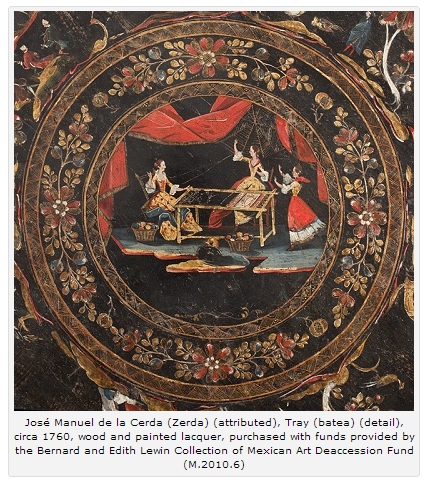
Kathryn Santner at LACMA posted an in-depth analysis of Mexican laquered sewing boxes, which are part of the museum’s growing collection of Latin American decorative arts. Her article is worth a slow read – and the objects are certainly worth a slow look the next time you visit LACMA.

Thanks to Tyler Green’s Wednesday Links for pointing us to this great post.

The art of looking at art – Met Director Thomas Campbell

Metropolitan Museum of Art Director, Thomas P. Campbell, talks about the art of asking basic questions and of really looking at art.

Of interest, he refers to an Italian art professor, a passionate teacher, who reminded him that “all art was once contemporary” and implored him not to get caught up in art world jargon but rather to use his eyes, to really look, to ask basic questions and to try to *see* the art.

Fairly Slow Art on Governors Island, New York

It may be interesting enough that a former military barracks turns into a showcase for art each September on Governors Island in New York, but this year’s fair features a real first for the slow movement: the inaugural Slow Art Day art fair exhibit.

The idea to bring Slow Art Day to Governor’s Island began last spring, when one of the founders of the fair, Nix Laemmle, attended the 2012 Slow Art Day Chelsea gallery tour hosted by Alison Pierz. Excited by the concept of Slow Art, Nix told Alison that bringing it to the fair could add a new dimension. After brainstorming with Slow Art Day founder Phil Terry, Alison and Nix then decided to not only promote the concept of looking slowly but to create a Slow Art Day room at the fair that would feature artists focused on slow working.

As a result, Slow Art Day’s first-ever art fair exhibit features six artists who create slowly.

Estonian artist Jaanika Peerna is particularly invested in the slow movement, and her complex graphite drawings express that.
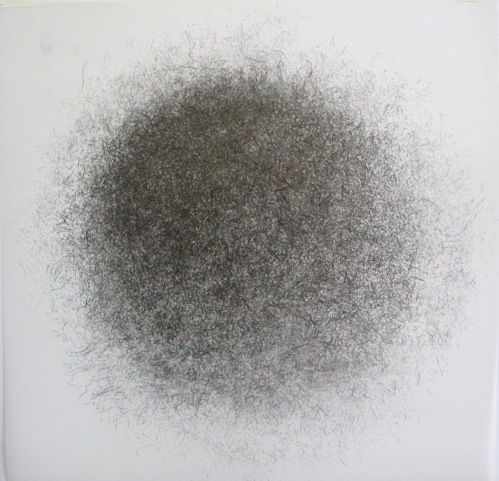
Graphite drawing by Jaanika Peerna

In addition to her slowly-made graphite drawings, Peerna created a maze on the floor of the Slow Art Day exhibit, which has succeeded in slowing visitors down as they enter the room.
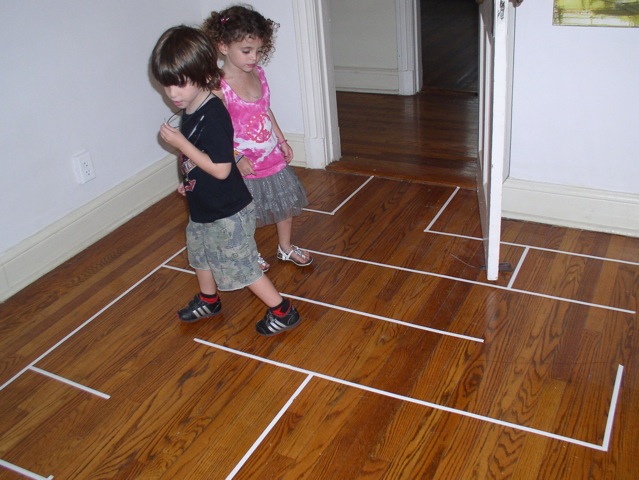
A maze along the floor of the Slow Art Day room helps viewers literally slow down to view the art featured there.

Hong Seon Jang, the second featured artist, works with Scotch tape. The overlapping tape creates opaque lines to form a wooded landscape. According to exhibit organizer Pierz, the Scotch tape art intrigues and engages visitors.
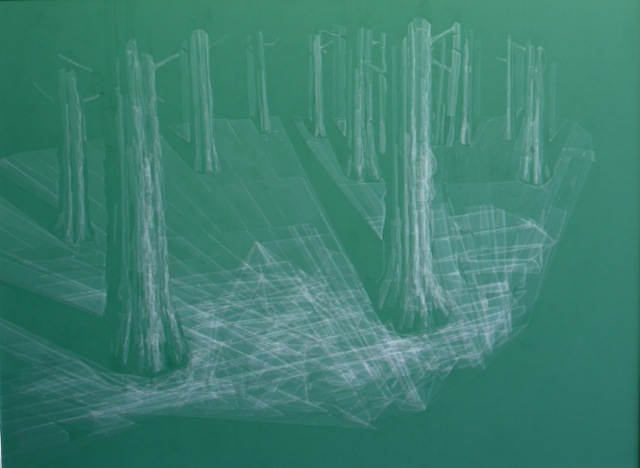
Scotch tape art piece by Hong Seon Jang

Other works in the Slow Art Day room include a more traditional landscape oil painting and two abstract works.
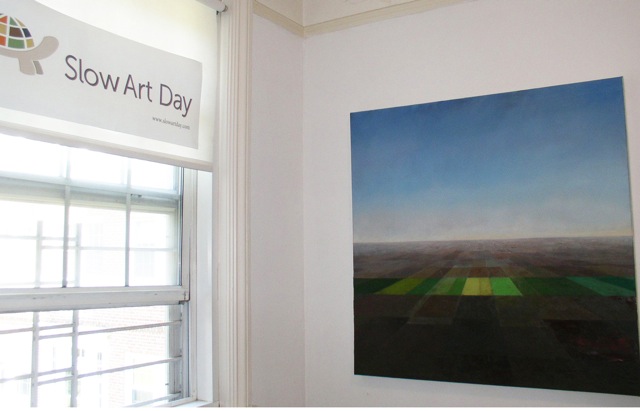
Oil painting by Emily Adams

The two abstract works share an interesting connection. While one is a painting and the other is made up of coffee stains, each creator made their respective pieces via a slow process where they worked out personal issues while slowly creating their art over many days.
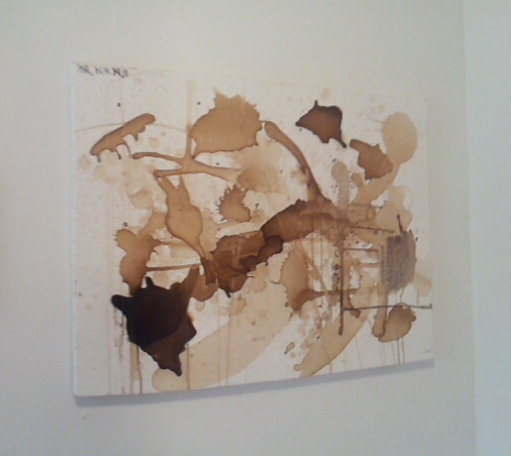
Abstract piece made from coffee stains by Maude Martins
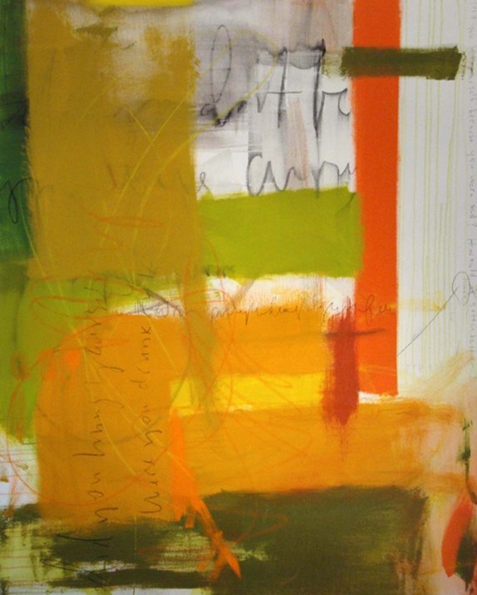
Abstract painting by Dana Crossan

The final artwork featured is by newcomer Colleen Blackard, who creates densely rendered, representational works in ball point pen. The piece selected for the Slow Art Day room is from her newest body of work where she covers the drawing with vellum to abstract the image. The viewer is then invited to press the vellum down to reveal the image underneath. The interactivity of the piece is appealing to slow viewers, most of whom are surprised by the fact that they get to touch art.
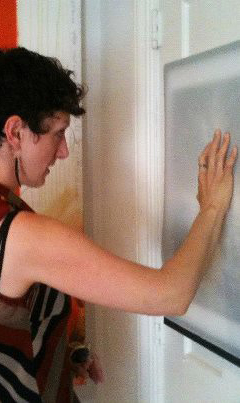
Touchable vellum art piece by Colleen Blackard


This well-attended art fair runs on Governor’s Island in New York City throughout weekends in the month of September. If you’re in the area, stop by for a unique experience—and make sure you slowly visit the Slow Art Day exhibit.

-Report by Alison Pierz, Slow Art Day host; edited by Jennafer Martin and Phil Terry

 

Slow Art Day 2012 Report: Schneider Art Museum in Ashland, Oregon

Ashland, Oregon host Anne Ashbey—one of the founding hosts of Slow Art Day—was pleased that the Schneider Art Museum’s spring show offered the opportunity to challenge participants in a new way. She knew that many museum visitors come with a pre-conceived idea that art means landscapes and watercolors and some mid-20th century classics like Picasso. So, for 2012, she chose three works by ultra-modern, technology-inspired mixed media artist, Jenny Vogel.

Participants told Ashbey they were challenged by her selections but the experience of slowly gazing at them made a difference. It really helped them to see multiple dimensions of Vogel’s work and then have a lively discussion about what they saw and about the role of technology in society.

Several students from Rogue Community College were part of the group—including one student who had never been to a museum before. Not only did that student learn how to look at art, but the whole group was electrified by their experience of seeing the art and the museum from that first-time museumgoer’s perspective.

Each year Ashbey is surprised anew by the impact of Slow Art Day. While each event has been different, she notes that “each Slow Art Day has helped all of us involved here in Ashland develop our passion for art, gain new perspectives on what we are seeing and create a sense of community and shared experience.”

Ashbey is already looking forward to Slow Art Day 2013 and is considering adding an additional venue in Medford, fifteen miles north of Ashland.

-Report by Anne Ashbey, host of Schneider Art Museum Slow Art Day. Edited by Slow Art Day blog writer Dana-Marie Lemmer.

ARTInfo: Slow Art Day Fights Visual Grazing With a Deep Dive Into Museums

by Kyle Chayka
Published in ARTInfo: August 17, 2012

2001 study showed that visitors to the Metropolitan Museum looked at individual works of art for an average of just 17 seconds at a time, a visual habit called “grazing.” Even the most iconic artworks in the world can’t seem to hold our attention: The Louvre discovered that visitors look at the Mona Lisa for just 15 seconds on average. In the age of the moving image and endlessly updated World Wide Web, works of art in more traditional media don’t get the focus they deserve. Slow Art Day, a three-year-old initiative currently ramping up for its 2013 event, is looking to change all that with an orchestrated long art-viewing session at museums around the world.

Read the full feature article on ARTInfo