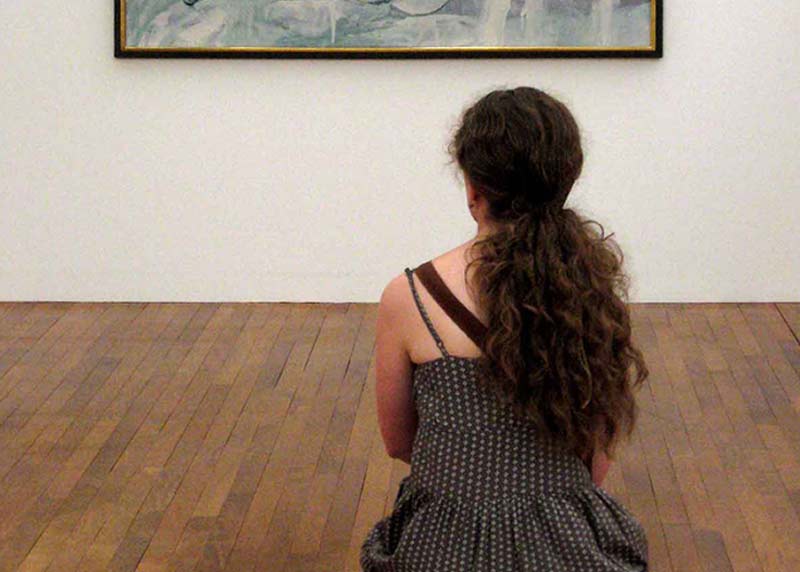
The annual event celebrating art.
Slow Art Day is Saturday, April 11, 2026 Join Us!
Photo by Greg Neville

Slow Art Day 2026 is almost here.
It will begin Saturday, April 11, 2026 in Hong Kong in just a few hours and then move slowly west across the globe, ending nearly 24 hours later in Los Angeles.
At Slow Art Day HQ, we believe this cross-border, collaborative movement is exactly what this divisive world needs today.
And I’m proud to say that this year we have about 240 locations participating including a growing citywide movement: Mexico City with 50+ museums and galleries, Central Illinois hosting 20+ galleries, Saltillo, Mexico with 6 venues and Bogotá, Colombia celebrating Slow Art in its San Felipe Creative District.
There is so much happening everywhere – from the citywide noted above, to the Metropolitan Museum of Art in New York, to M+ in Hong Kong, to locations on every continent except Antarctica.
Here are just a few of the 240 or so locations:
– Basílica de la Sagrada Família, Barcelona, Spain — A global icon and especially meaningful in 2026 marking the 100th anniversary of Antoni Gaudí’s death.
– Royal Museum of Fine Arts Antwerp, Antwerp, Belgium — One of Europe’s great museums with Rubens and Flemish masters.
– Wellcome Collection, London, United Kingdom — A fascinating blend of art, science, and medicine.
– Ashmolean Museum, Oxford University, United Kingdom — The oldest public museum in the UK with encyclopedic global collections.
– Musée de Cluny, Paris, France — A medieval masterpiece museum, home to the Lady and the Unicorn tapestries.
– Frac Île-de-France, Le Plateau, Paris, France — A contemporary art platform offering a sharp contrast to Paris’s historic institutions.
– Nationalmuseum, Stockholm, Sweden — Sweden’s premier fine arts museum with a broad European collection.
– MART Museum of Modern and Contemporary Art of Trento and Rovereto, Rovereto, Italy — A major Italian institution focused on modern and contemporary art.
– Rossocinabro, Rome, Italy — A contemporary gallery representing emerging artists from around the world.
– National Museum of Decorative Arts of Ukraine, Kyiv, Ukraine — A powerful cultural institution preserving Ukrainian identity and heritage during wartime.
– Centro Cultural Rojas, Buenos Aires, Argentina — A vibrant, experimental cultural center deeply embedded in Argentina’s intellectual and artistic life.
– Museum of Fine Arts, Boston, Boston, United States — One of the largest and most comprehensive museums in the Americas.
– The Barnes Foundation, Philadelphia, United States — A legendary collection with a unique, highly influential approach to displaying art.
– MASS MoCA, North Adams, United States — One of the world’s largest centers for contemporary and installation art.
– National Gallery of Canada, Ottawa, Canada — The country’s premier national collection with global and Indigenous works.
– Art Gallery of Ontario, Toronto, Canada — A major international museum with a diverse and expansive collection.
– Museo de Arte Popular, Mexico City, Mexico — A vibrant celebration of Mexican folk art and cultural traditions.
– M+, Hong Kong, China — One of the most important new contemporary art museums in the world.
– MAAT Museum of Art, Architecture and Technology, Lisbon, Portugal — A striking architectural landmark blending art, technology, and design.
– Walyalup Fremantle Arts Centre, Fremantle, Australia — A major Australian cultural hub housed in a historic building.
– Clare Gallery at the Franciscan Center for Urban Ministry, Hartford, United States — A powerful example of art connected to social justice and community engagement.
– Z33 House for Contemporary Art, Design & Architecture, Hasselt, Belgium — A forward-looking institution known for bold contemporary exhibitions and architecture.
This list doesn’t include hundreds of large and small spaces celebrating Slow Art Day like the small museum tucked away in the Basque region that has been celebrating slow art for more than a decade with a daylong festival of art, food, music, and dance.
Wherever you are in the world, let us wish you a happy, joyful, art- and community-filled Slow Art Day 2026.
Best,
Phyl, Ashley, Maggie, Johanna, Jessica, and Richard (the Slow Art Day HQ team of volunteers)
P.S. If your museum, gallery, sculpture park, church, library or other institution is celebrating and you have not yet registered, then please register!
P.P.S. Read our comprehensive 2025 Annual Report providing details and descriptions (as well as artifacts) of more than 76 events (out of about 200) from around the world last year.
Slow Art Day 2026 is just a few days away — and I have more good news to share: Saltillo, Mexico is joining the growing global citywide movement.
The capital of Coahuila in northeastern Mexico, Saltillo has long been a vibrant cultural center. This year, it launches its first-ever citywide Slow Art Day, led by Ana Lucía Aguilar — an art enthusiast and expert with the Tec de Monterrey School of Humanities and Education. Lucía Aguilar is bringing together a coalition of cultural institutions across the city including Centro Cultural Casa Purcell, Museo Rubén Herrera, Museo de Artes Gráficas, Sala Coca, Centro Cultural La Besana, and Tecnológico de Monterrey Campus Saltillo.
These six venues represent a cross-section of Saltillo’s cultural ecosystem — from a traditional fine arts museum to contemporary exhibition spaces, community cultural centers, and an academic institution — and this year they are working together to create a shared day of programming centered on slow looking, reflection, and community engagement (see below).
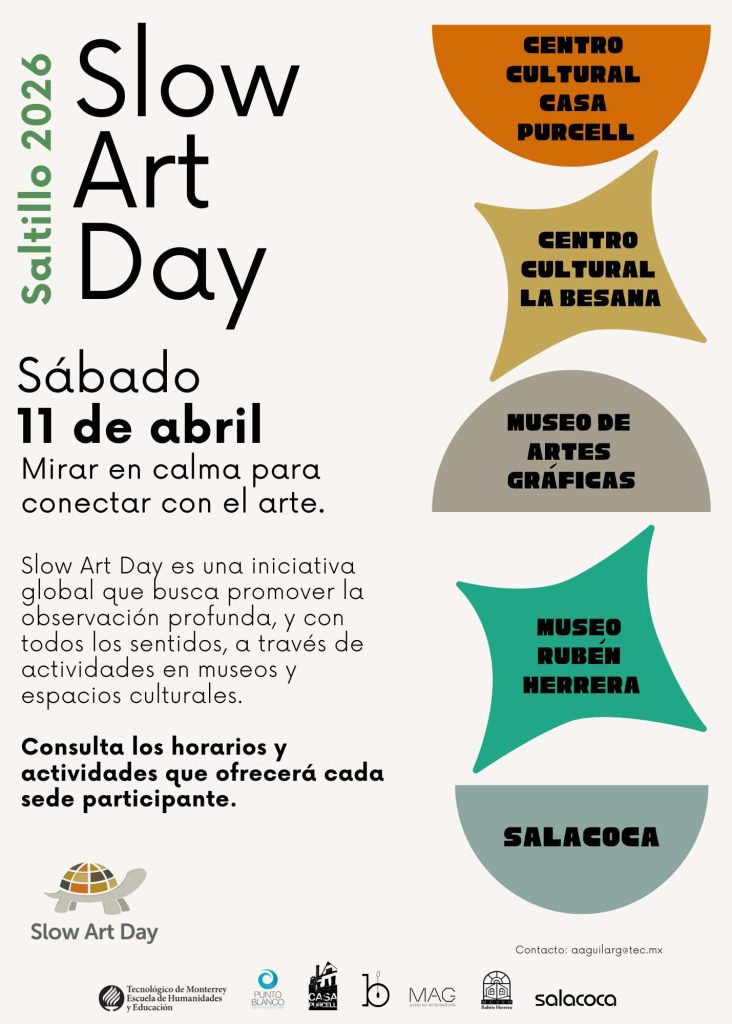
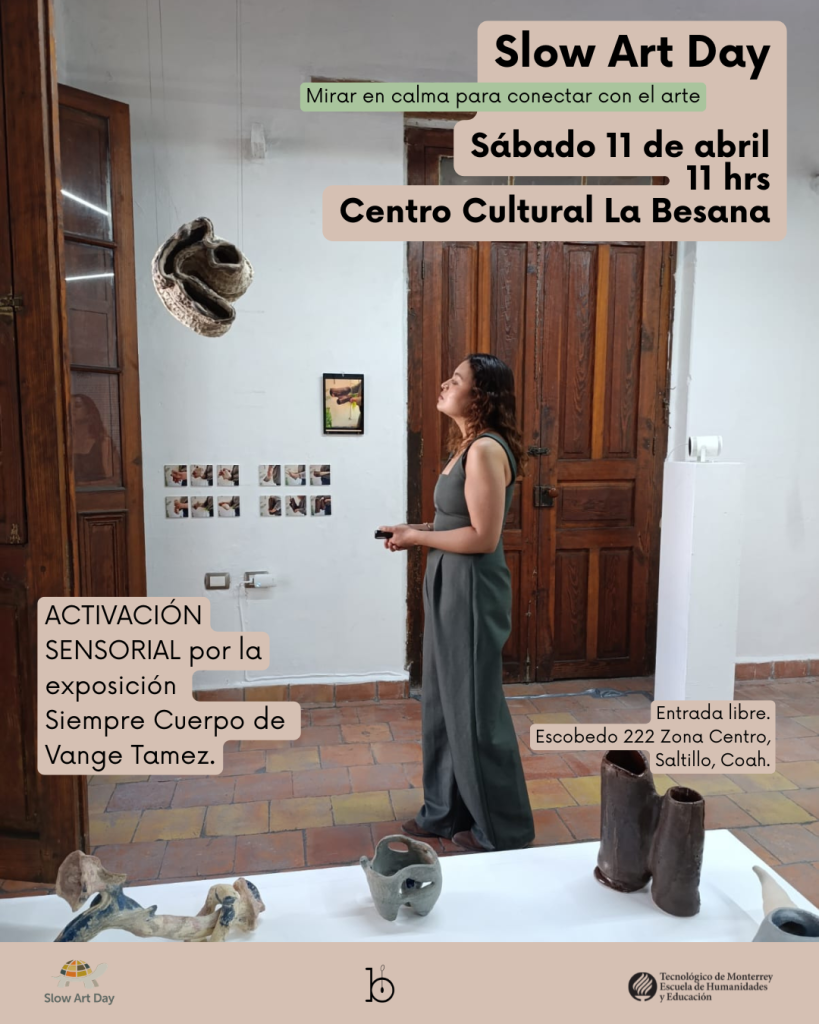
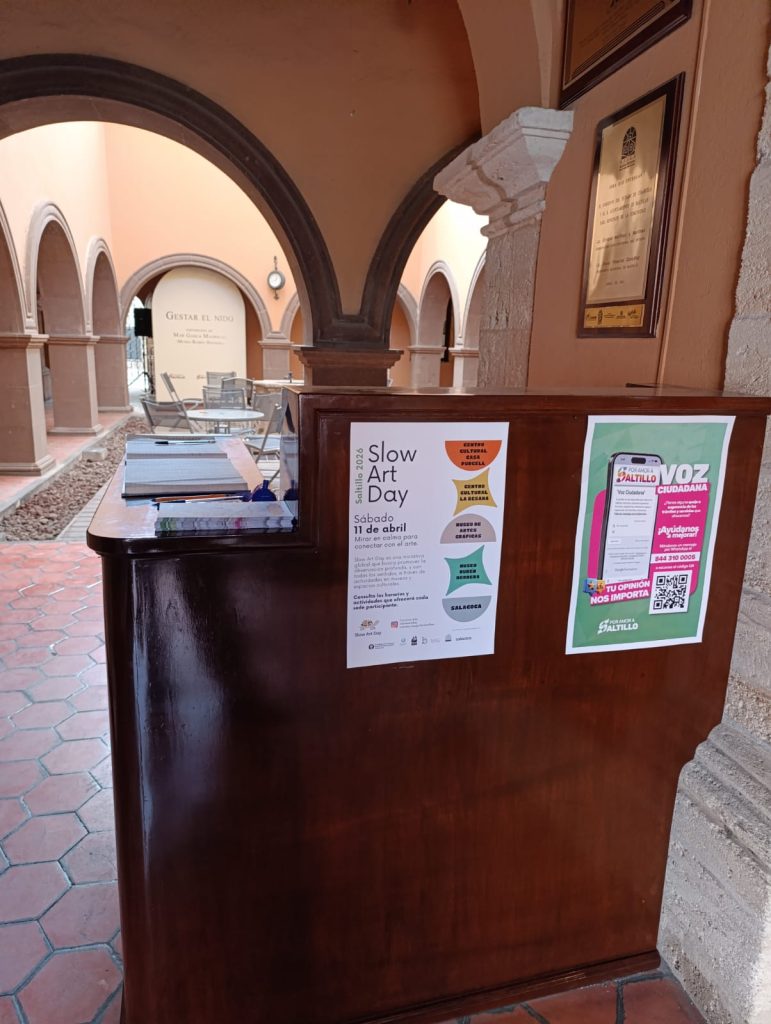
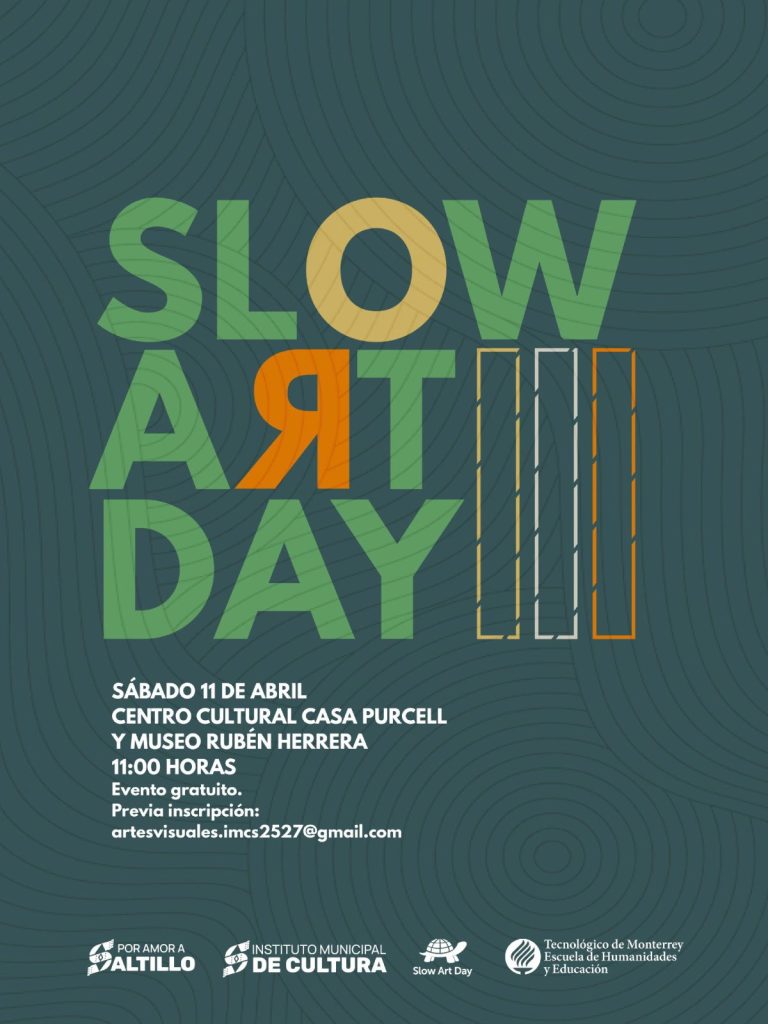
Further, specials activities will be held for students April 9 and 10. There will be a visit and activity for the final projects exhibition of the Prepa Tec Art course at the Saltillo Campus Library, with high school students. In addition, university students will be invited for a special slow viewing of the exhibition Siempre Cuerpo by Vange Tamez at Centro Cultural La Besana.
As the Saltillo Slow Art Day coalition noted in a press statement, “La observación lenta convierte al museo en un espacio de autodescubrimiento y conexión humana…” In English – “Slow looking transforms the museum into a space for self-discovery and human connection, rather than just a repository of objects for experts.”
Yes — well said.
And this is exactly the deeper promise of Slow Art Day. At its heart, it is an inclusive act — an opening of spaces that have too often felt exclusive, expert-driven, or intimidating. By inviting anyone, regardless of background or training, to simply look slowly and share what they see, Slow Art Day helps transform museums and cultural institutions into places of inclusion, belonging, and shared human experience.
I’ll note that Lucía Aguilar first found out about Slow Art Day in 2025 when Constanza Ontiveros Valdés led Mexico City’s first citywide. She then organized a single event in 2025 at Tecnológico de Monterrey Campus Saltillo. This year, taking a leaf from Ontiveros Valdés, she expanded into a citywide and is doing amazing work bringing together institutions across the city.
We at Slow Art Day HQ are excited to watch the citywide movement spread. As noted in other reports, Ontiveros Valdés in Mexico City was first inspired by Pamala Eaton and the BN Artists in Illinois who were the first anywhere to launch a citywide Slow Art Day. Their momentum continues to build. Their original citywide has now expanded into a celebration across Central Illinois — making that the first region-wide Slow Art Day in the world. Meanwhile, the 2025 Mexico City effort proved so successful that Ontiveros Valdés has since built a volunteer team, launched a dedicated website, and organized a coalition of more than 50 museums, galleries, and cultural venues for 2026.
Wow. Wow. Wow.
This deepening of our Slow Art Day movement could not come at a more important time in our divisive, topsy-turvy world. We need more art, we need more global cooperation, and we need more community — and thanks to many of you we will have all that again with this year’s Slow Art Day.
Best,
Phyl
P.S. As you know, Slow Art Day 2026 is coming up April 11 — register your museum, gallery, church, sculpture park or movie theater for 2026, if you have not yet done so. And maybe start thinking about a citywide celebration next year.
P.P.S. Get inspired by reading our comprehensive 2025 Annual Report providing details and descriptions (as well as artifacts) of more than 76 events from around the world last year.
Happy to report that Slow Art Day 2026 is coming up in 1 week – Sat, Apr 11, 2026 – around the world.
And I’m delighted to welcome another new host to our movement: Nathalie Krall and her organization ArtVenture Club e.V. from Düsseldorf, Germany.
ArtVenture Club e.V. is a global, digitally native nonprofit network that connects freelance and self-employed art professionals, scholars, and creatives. Their mission is to foster a more fair, diverse, and sustainable art world by bringing together practitioners and the public in thoughtful dialogue and shared experiences. Their work has been recognized in Germany’s UNESCO State Report on cultural diversity.
On April 11, 2026, they will host their first Slow Art Day event — a fully online session via Zoom, open to participants around the world. They are calling the event “Die Kunst des langsamen Sehens” (The Art of slow Seeing).
It’s free to attend with registration via Eventbrite (note: this session will be in German).
During the pandemic, many museums, galleries, and community groups experimented with virtual formats, expanding access during a time of global isolation. What makes this event notable is not simply that it is digital — but that it comes from an organization built natively for digital cultural engagement, with a clear and thoughtful philosophy behind it.
Krall explained to me that she sees online slow looking as a meaningful expansion of access and engagement, as it will:
– increase accessibility for people who cannot attend in person
– create inclusive spaces across geographic and social boundaries
– function as an independent mode of engagement with art.
I’ll add that Krall has designed it so that participants will chose three artworks for everyone to look at via a live poll at the beginning of the session. The selected works — high-resolution digital images drawn from among ArtVenture Club’s past 50 programs — will then be shared on screen and via links for deeper individual exploration.
As noted, this first Slow Art Day will be conducted in German, though they have plans to add English-language sessions in the future.
Please help us welcome Nathalie Krall and ArtVenture Club e.V. to the global Slow Art Day community.
Happy almost Slow Art Day!
– Phyl
P.S. As you know, Slow Art Day 2026 is coming up April 11 — register your museum, gallery, church, sculpture park or movie theater for 2026, if you have not yet done so.
P.P.S. Get inspired by reading our comprehensive 2025 Annual Report providing details and descriptions (as well as artifacts) of more than 76 events from around the world last year.
Slow Art Day 2026 is just over a week away – and more big news: Bogotá, Colombia joins the growing global movement toward citywide Slow Art Day celebrations.
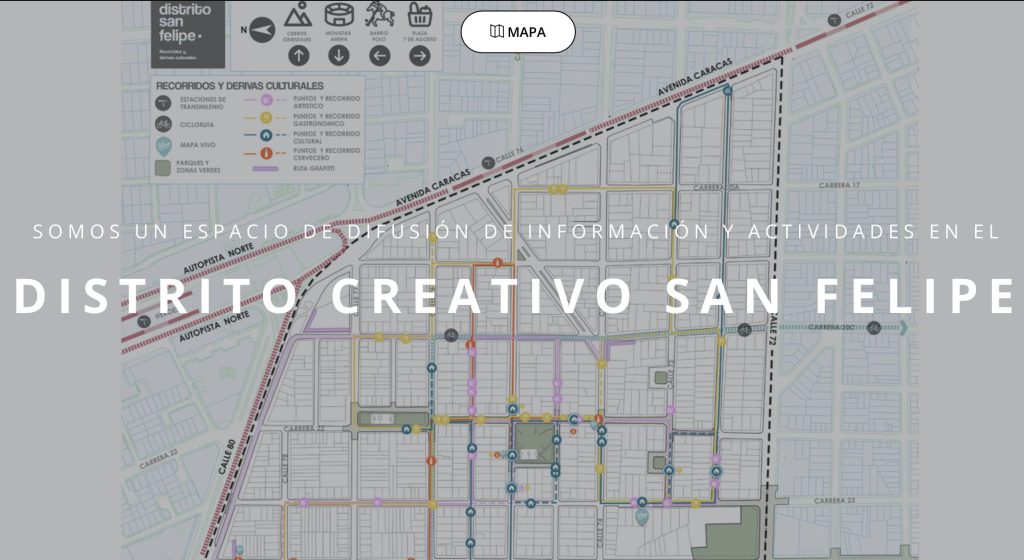
This inaugural citywide in Bogotá is led by Mauricio Ávila, Consejero Distrital de Infraestructura Cultural (District Advisor for Cultural Infrastructure), and centered in San Felipe Distrito Creativo (SF), which is Bogotá’s leading arts district. Often referred to simply as “SF,” the district brings together a dense network of contemporary galleries, artist studios, and creative venues, making it a natural anchor for Bogotá’s citywide Slow Art Day (see map image below).
As part of his role as District Advisor, Ávila decided to launch this first citywide in Bogotá. He was initially inspired by Constanza Ontiveros Valdés — an art writer and cultural project leader – who launched the first citywide Slow Art Day in Mexico City in 2025 and has expanded it in 2026 (more below). As you’ll see below, Ontiveros Valdés was in turn inspired by Pamala Eaton, Janean Baird and the whole team in Bloomington, Illinois who launched the first citywide anywhere.
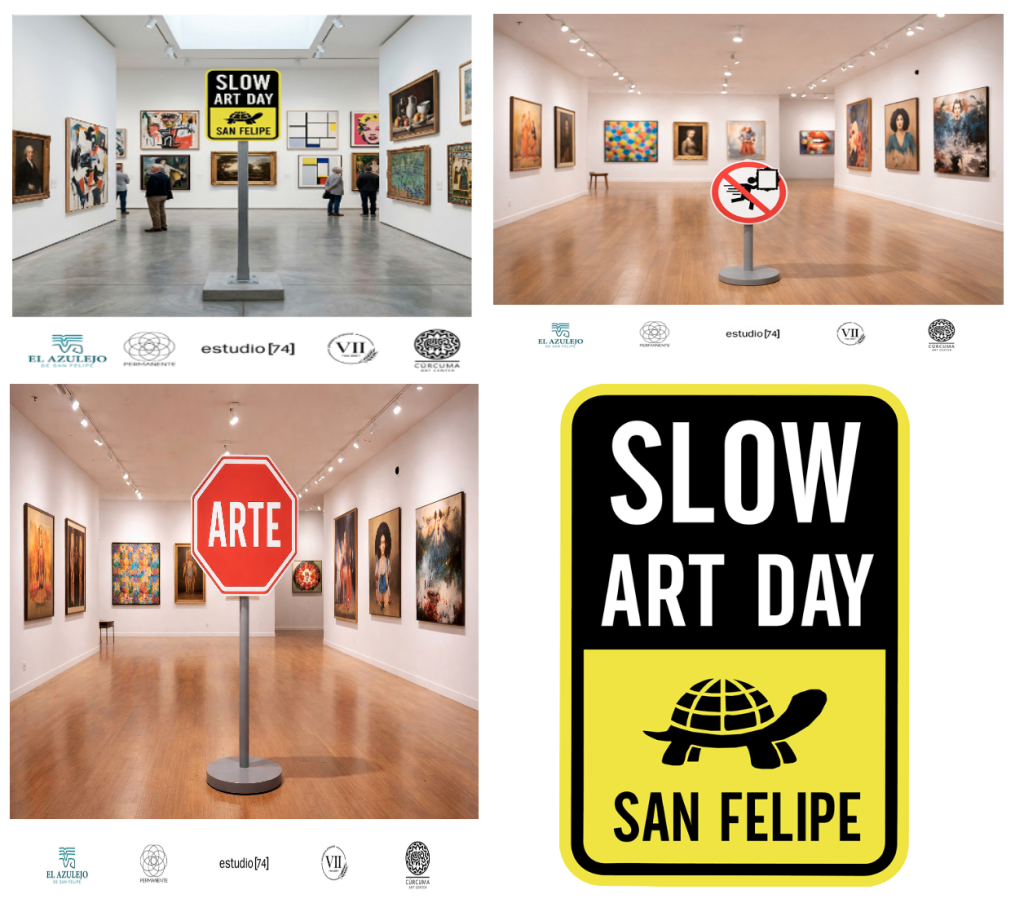
Building on those examples, Ávila has organized five galleries and art spaces to pilot the Bogotá edition:
Together, these venues represent a cross-section of the contemporary art scene in SF — from independent galleries to artist-run spaces (see photos below).
We at Slow Art Day HQ are excited to watch the citywide movement spread organically around the world. As noted above, Constanza Ontiveros Valdés in Mexico City was inspired by Pamala Eaton and the BN Artists in Illinois who were the first anywhere to launch a citywide Slow Art Day. Their momentum continues to build. Their original citywide has now expanded into a celebration across Central Illinois — making that the first region-wide Slow Art Day in the world. Meanwhile, the 2025 Mexico City effort proved so successful that Ontiveros Valdés has since built a volunteer team, launched a dedicated website, and organized a coalition of more than 55 museums, galleries, and cultural venues for 2026.
Wow. Wow. Wow.
This deepening of our Slow Art Day movement could not come at a more important time in our divisive, topsy-turvy world. We need more art, we more global cooperation, and we need more community – and thanks to many of you we will have all that again with this year’s Slow Art Day.
Best,
Phyl
P.S. As you know, Slow Art Day 2026 is coming up April 11 — register your museum, gallery, church, sculpture park or movie theater for 2026, if you have not yet done so. And maybe start thinking about a citywide celebration next year.