Lost in the Galapagos: Looking Slowly with Michael Bogin

Slow Art Day has asked its 2013 college interns to write short summaries of their own experiences looking slowly at artworks of their choosing.
Last week I decided to spend some time looking at the work of Michael Bogin at the Davis Gallery here on my school campus.

After wandering the rooms of the gallery, scanning the walls in search of one of Bogin’s pieces that speaks to me, I notice a pattern. While at first seeming overtly simplistic, upon closer inspection his pieces start to formulate individual stories. Scanning the room, I am immediately struck by the stunning color schemes that run across the walls. His use of color varies in each piece despite their overall similar structure and as the works progress, a tale forms.

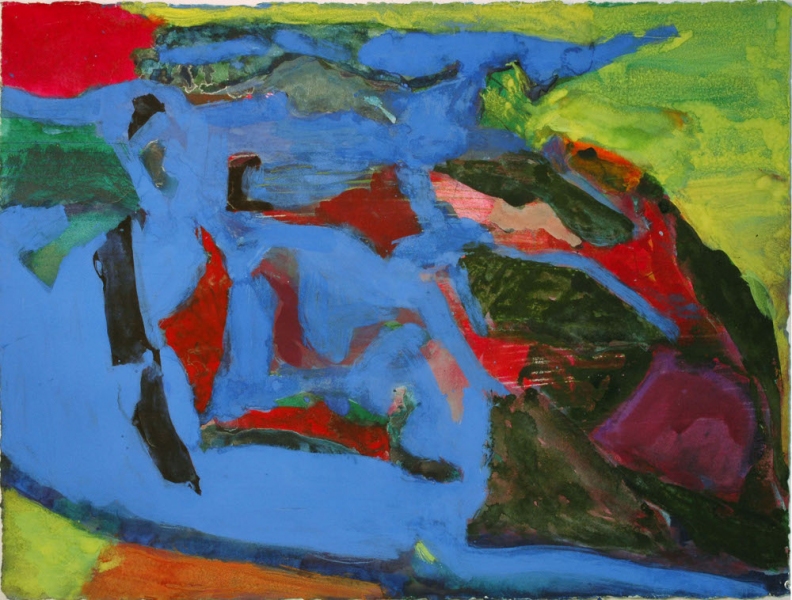
Upon closely looking at Galapagos #157, its shapes come to life and a story emerges. A koi fish whizzes past with a mermaid trailing behind; an underwater flower opens its blossom to say a few words; fish of every size decide to come investigate the scene; a coral reef arises from the abyss; bubbles float to the surface like fizz; and light begins to reflect off the ocean’s crystalline surface.

As I continue looking, I realize that I have just reached the Ecuador archipelago. As I gaze into the depths of the Pacific, I see something dart by. With the face of a woman and the tail of a fish I deem her a mermaid. Here things get strange. I fall into a kind of dreamlike state and the creatures gain the gift of gab. The koi fish tells me of the mermaid’s high status amongst the sea creatures as the mermaid playfully chases him away. The coral reef begins to tell me of her tremendous beauty and suddenly the fish that reside in the reef come out to confirm her allure. The sudden commotion causes water bubbles to lift to the surface and as the bright reflection of the water hits my eyes, I snap out of my delusion and once again I am standing in the gallery.

The process of slowly looking at Bogin’s painting proved a surprising experience. The more I look, the more I see. I now notice Bogin’s use of color and forms. The piece now opens up to me in a different way and I begin to see the intricacies of what Bogin has created.

Done in gouache, watercolor, and colored pencil, the multi-medium quality gives the piece a depth that mimics that of the ocean. Looking at the center of the painting, it becomes difficult to tell if the water sits in the foreground or background. The sea creatures seem to remain in limbo undulating back and forth between the different layers of the painting and it is this confusion that leads to my intrigue. The more I look at the painting, the less sure I am of where all the shapes sit in space. The reds and oranges seem to float to the surface in some areas while they seem to recede into the cloudy blue expanse in other sections. After a while I begin to see the intentionality behind Bogin’s every mark. I can see, upon closer inspection, where he has laid down a block of color, taken most of it away, and then put down more paint in order to achieve the illusion of depth. The blues overlap the greens in the top portion and leave behind a shadow of what once was, thereby furthering the magic of his artifice. It is this ambiguity that endows the painting with such power.

There seems to be an extreme intentionality that lies behind every mark in the painting. Simple shapes are transformed into sea life with Bogin’s poignant mark making and the scene comes alive with his innovative use of overlapping color. While there is a broad expanse of green and purple shapes conglomerated on the right side of the painting, this mass is offset with the smaller blocks of reds and greens that sit at the center of the scene. A large stretch of blue evolves into ocean in the areas where the watercolor pools into dark waves of indigo. Color merges and submerges in a playful coalition of paint and story. Just as your eye begins to follow a stream of red, you are pushed into a puddle of green; and just as you begin to circle around the green, your eye is slung into the neighboring pool of purple. This diversity of shape and color employed by Bogin is what gives the painting such life and allowed me to conjure up a story while exploring the piece’s nuances.

Had I left the gallery after a brief browse, I would not have taken notice of the intention that lies within Bogin’s work. I would not have formed the connection to the painting that still remains. The practice of looking slowly at art requires no expert nor expertise; art speaks and I learned again that if I am willing to slow down and listen, then I will hear its story in all its dimensions.

Mary Nyiri, Hobart and William Smith

[Michael Bogin’s Galapagos #157 (2009) was viewed at the Davis Gallery at Hobart and William Smith in Geneva, NY]
Slow Art Day makes the Tumblr Radar

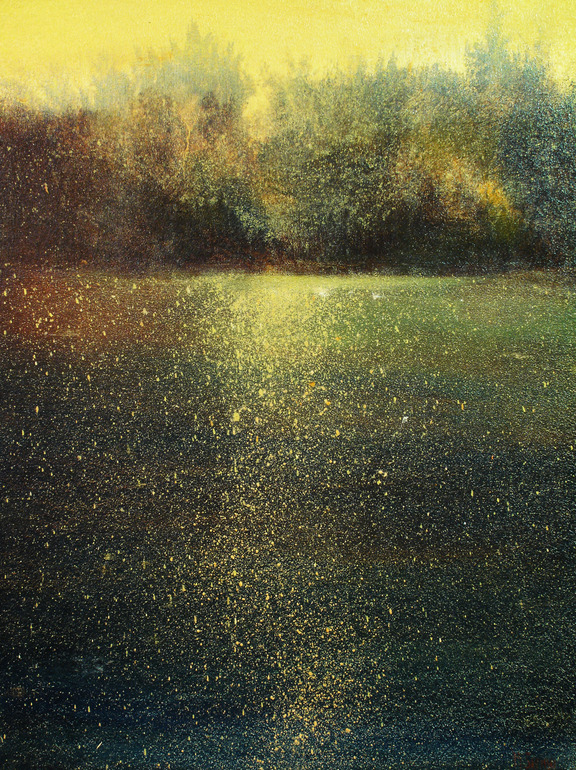
Today the tumblr staff selected a post from the Slow Art Day tumblr to be featured on their radar, a big honor! The work chosen was Maurice Sapiro’s “Gold on the Water.”

Maurice Sapiro, Gold on the Water, 2012

Check out the post on the Slow Art Day tumblr here, and see other works by Sapiro on his Saatchi Online profile.

– Alie Cline, Social Media Manager

Slow Art Lunch and Learn – Interview with Rika Nelson

Rika Nelson runs Slow Art Day and Lunch and Learn, among other programs, at the Crocker Art Museum in Sacramento and recently agreed to sit down with us and talk about her passion for art and helping the public learn how to look at and love art.

Slow Art Day: Tell us about yourself, Rika.

Rika Nelson: I am the Manager of Public Programs at the Crocker Art Museum in Sacramento, CA. It’s my job to plan and present all of our adult educational programming including concerts, lectures, films, dance, tours and more. We present an average of 8-10 Public Programs for adults each month. The programs range in size from a 10-20 person gallery program like Lunch and Learn, which we’ll talk about in a moment, to an 800 person museum-wide evening event we call Art Mix.

Slow Art Day: It sounds like a great job.

Rika: I love my job. I sometimes tell people that I feel like I hit the job lottery. We have 10 or so exhibitions per year in addition to our permanent collection and I get to work with our curators to pull out the themes and deeper meaning from each exhibition and translate it into programming that is educational, meaningful and entertaining for our visitors. I like when attendees at our programs see an exhibition from a new perspective; I also love it when our programs cause them to connect with each other.

I have wanted to work in museums since I was a kid. I studied History and American Indian Studies at the University of Washington and went on to get an MA in Museum Studies and an MBA in Non-profit Administration from John F. Kennedy University in Berkeley. I started at the Crocker three years ago right as I was finishing grad school. It was an exciting time to be working here as we were just months away from opening our new 125,000 sq. ft. Teel Family Pavilion on 10.10.2010.

Slow Art Day: Tell us about the Lunch and Learn program. How did it start?

Rika: Lunch and Learn was started through a collaboration between our museum docents and our education department. The Docents went through a VTS (visual thinking strategies) training as part of their continuing education. There were a particular group of docents who really developed a passion for this touring style and we worked with them to design a monthly tour where visitors would examine one work of art over a 30 minute period and then were invited to have lunch in the café following the program. We started with 3 or 4 visitors that would come on the tour, now we are up to about 20 or 30 per tour!

Slow Art Day: Say more – it’s monthly and has regular attendees? What is the design of the event and how does it work?

Rika: My favorite thing about the Crocker Lunch and Learn are the regular attendees we’ve started to notice. There are even a group of City Employees who come over to the Museum to spend a half hour with a work of art in our collection on their lunch breaks.  The regular attendees have gotten to the point where they are familiar with each other and give encouragement to each other during the discussions.

Lunch and Learn starts with about 3-5 minutes of silent looking.  We then ask the visitors in the group to talk about specific things they are seeing within the work.  Next we ask people to tell us what they think the things they are seeing might mean and we ask them what they wonder.  I have seen some incredible meanings pulled out of paintings by our visitors; things that never would have occurred to me.  The other fascinating thing is the diverse backgrounds our visitors bring to the discussion and how that gets the whole group to have a broader understanding of the work of art we are seeing.

Slow Art Day: What do you think helps make the program work so well?

Rika: I think the program works well because it is consistent. It happens the first Tuesday of every month and people have made it a routine. I can’t think of a better routine than setting aside 30 minutes on a weekday for Art, can you?

Slow Art Day: No – we couldn’t agree more. What do you see as the relationship between your Slow Art Day event and Lunch & Learn?

Rika: I like to think that Slow Art is a way for us to introduce people to the concept so that they can join in on our ongoing Lunch and Learn series. We get a lot of visitors who hear about the Slow Art Movement and come for Slow Art at the Crocker, but they had no clue that we do a Slow Art style format every month.

Slow Art Day: The Crocker has been hosting Slow Art Day for more than four years. Can you tell us more about why the museum has been a supporter since the beginning?

Rika: I can’t take the credit for that, my predecessor at the Crocker, Christian Adame, who is now at the Phoenix Art Museum, was the early adopter. I think, however, that it is a no-brainer for us to be involved with Slow Art. All art museums should get on board.  Slow Art is a way of teaching people how to look at works of art in your galleries, it gives them a tool to get more out of their visit. That kind of engagement is what keeps art museum’s relevant to their communities and that’s why we think it’s important.

Slow Art Day: We agree! Thanks for hosting Slow Art Day and for your time today and for your longtime commitment to helping more people learn how to look at and love art.
Next time you are in Sacramento near a first Tuesday, drop by a Lunch and Learn. You can also sign-up here for Slow Art Day 2013 at the Crocker Art Museum.

Lisa Jameson on art education, Henri Matisse, and discovering Slow Art Day through google

[In this series, we interview hosts for Slow Art Day and get their thoughts on hosting, the art of looking, and the slow art community.]

Lisa Jameson, an Associate Professor of Art Education in the Department of Visual Arts at Northern Kentucky University, recently signed up to host a Slow Art Day event at the Cincinnati Art Museum in Cincinnati, Ohio. After she sent a great introductory note to the host community, we got in touch to find out more about her thoughts on art, art education and of course, Slow Art Day.

Slow Art Day: First, tell us a little more about what you do – how are you involved in the arts?

Lisa: I teach Art Education at Northern Kentucky University, near Cincinnati, OH. There I train future art educators and teach classes in art integration to Elementary Education majors who will be general classroom teachers. I am also a visual artist with an MFA in Drawing as well as a Certified Zentangle Teacher.

I taught children’s art classes for many years and continue to do so. It intrigues me that children are naturally curious and eager to delve into art making at least until they reach about 11. At that point they stop, either because their interests turn to other things, or because they become self critical.

Many of my Elementary Education students have not taken art since that age. And it has been through these non-art majors that I have learned how satisfying it is to enable adults who think they “can’t” make art re-discover the joys of the creative process. I hope in turn they will give their students the same opportunities.

Slow Art Day: What is one of your favorite artworks? What do you enjoy about it?

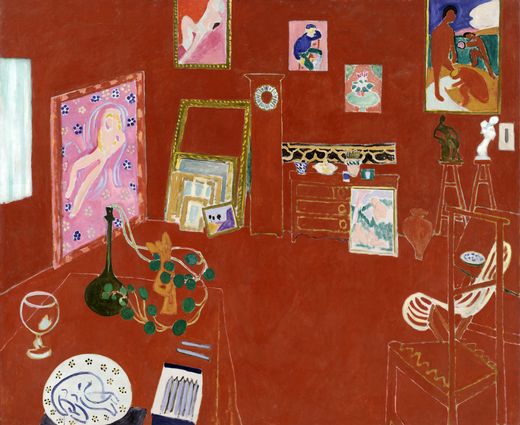
Lisa: One of my all-time favorites works of art is “The Red Studio” by Henri Matisse. There is something so engaging about how he plays with space, line and color-all enveloped in that gorgeous red.

Henri Matisse, The Red Studio, 1911. Oil on canvas, 71 1/4″ x 7′ 2 1/4″ (181 x 219.1 cm). Mrs. Simon Guggenheim Fund. © 2013 Succession H. Matisse, Paris / Artists Rights Society (ARS), New York. Image courtesy of the Museum of Modern Art, New York.

Slow Art Day: How did you first hear of Slow Art Day?

Lisa: I found out about Slow Art Day by chance. I was thinking one day, out of the blue,  that there must be a “slow art” movement akin to the slow food movement. I did a Google search for “slow art” and found Slow Art Day! Very exciting!

Slow Art Day: Why did you decide to become a host?

Lisa: Cincinnati did not have anyone hosting, which surprised me. I signed up immediately. Who wouldn’t want to be a part of an international art event that encourages taking one’s time while viewing works of art and shares my passion for helping adults discover that they can relate to and understand (and make) art.

How often do we really get to be part of something like that?

Slow Art Day: Have you started thinking yet about the design of your Slow Art Day event?

Lisa: I have been thinking about it but have not yet made my choices. They will likely be some of the “hidden gems” vs. the “greatest hits” of the collection.

Slow Art Day: Thank you, Lisa, for taking the time out of your busy schedule to talk to us – and for being one of 150+ volunteer hosts around the world.

If you’re in the Cincinnati area, make sure to check out her Slow Art Day event at the Cincinnati Art Museum.

Viewing Art, Being Present

From time to time, we post short articles from Slow Art Day hosts. The article below is by veteran Slow Art Day host, Paul Langton.

A rainy day. I am early for an appointment. An opportunity to go to a gallery for forty or fifty minutes, without expectations? I realise don’t actually know what is currently on at the gallery.

Fortunately I listen to my intuitive self, and a few moments later find myself in the Whitechapel Gallery, exploring Mel Bochner’s fascinating work. But, I become aware that his exhibition would need more time than I feel I can allow. I then go into a room with a single sculpture. A tree. Immediately fascinated I walk around the sculpture. I notice the materials used – gold leaf, bronze. I feel at home in the space and decide to spend some time in this room.

Spazio di Luce by Giuseppe Penone at the Whitechapel Gallery (image from the Whitechapel Gallery website – click the image to visit)

A well-placed bench allows for some slow art thinking. Who is this by? What is it doing here? I walk around, I sit down. I walk around again. I go and read the information about the sculpture. I ask the attendant if I can I touch it.

The exhibition is very peaceful. Occasionally people come in and I notice their reactions to the piece, yet I am pre-occupied by my own thoughts. I feel I am in the right place at the right time, as though I was meant to see this piece today. I love the way each time I view the tree it look different and I love the light further illuminating the gold leaf, shining light on this wintry day. I walk alongside it and see it from different angles. I don’t hug but I do touch.

The sculpture, I find out, is Spazio di Luce (Space of Light) by the Italian artist Giuseppe Penone and is a Bloomberg Commission, in the Whitechpael Gallery until September 2013. Space and light, they seem ideal words. It’s good to find out it will be here for a few months, and another visit will be possible. I realise I may have seen some of Penone’s work before as part of Arte Povera at Tate Modern, but I couldn’t be specific.

I have been thinking of trees in the last few weeks and the importance of trees – there was a fascinating discussion on the radio the previous month about trees with James Aldred and Mark Tully – and this sculpture adds an extra dimension to my current feelings and thoughts. I reflect on nature, art, myself, others, and art as part of life.

The light in the title becomes so appropriate as I leave the gallery, literally feeling lightened and uplifted. I then wonder on how something so beautiful and fascinating just appeared in my day without notice. In my head I thank the artist and the gallery, for being presented with and for being present, for some time, with this wonderful sculpture. Please visit if you can.

(If you are not able to visit a video of the artist talking about the work is on line: http://www.whitechapelgallery.org/exhibitions/the-bloomberg-commission-giuseppe-penone-spazio-di-luce).

The Whitechapel Gallery is one of 160+ Slow Art Day venues for 2013. Click here to find out more or register.

– Paul Langton

Note: An earlier version of this piece first appeared in Paul’s blog: http://artsandmoresw4.wordpress.com    

MOCA Jacksonville Urges Patrons to Look Slowly

The Museum of Contemporary Art Jacksonville, a new host for Slow Art Day 2013, is exploring the concept of slow looking in an exhibition SLOW: Marking Time in Photography and Film that runs through April 7, 2013. Exploring the work of seven internationally known artists- Eve Sussman, Kota Ezawa, Sam Taylor-Johnson, Chris McCaw, Idris Khan, James Nares and David Claerbout- the museum challenges visitors to engage with the works for an extended period of time.

The exhibition features work that explores topics of time and duration through the fields of photography, film and video. In an age of mass production and instant gratification, the works in SLOW compliment and challenge one another as they confront typical perceptions of photography and the time-based restraints of a work of art.

Artists such as Eve Sussman and Sam Taylor-Wood give life to paintings past. Sussman, in 89 Seconds at Alcazar, animates the famous painting by Diego Velasquez, giving the viewer a look into the life of the painting’s characters before and after the composition. Along the same lines, Taylor-Wood, in Still Life, explores the work of the 17th century Dutch paintings by filming the decay of fruit plates, altering the viewer’s perception of time.

Other iconic videos that speak to one another are that of James Nares and David Claerbout. Nares’ Street, is a video work in which passersby seem to be frozen in time as the viewer moves along in real time whereas Claerbout’s work explores the relationships between the still photograph and the moving image, forcing the two to co-exist in his large, video installations.

The exhibition SLOW, also showcases the work of artists who explore different processes in photography such as Idris Khan’s appropriative work that consist of multiple layers, created the illusion of extended gestures and moments in time.  And, yet, the viewer’s sense of time continues to be affected with Chris McCaw’s sun-etched photographs that track the sun and Kota Ezawa’s cut paper assemblages of iconic photographs.

Curated by MOCA Jacksonville director, Marcelle Polednik, Ph.D. SLOW is the museum’s landmark exhibition for 2013. Of the exhibition, Polednik says, “Time is not only the conceptual thread that binds all the works in the exhibition together, but also the real dimension that connects us to these explorations, providing we devote the seconds, minutes, or even hours to see them unfold. In taking the time to fully engage with these photographs, films and video works, we gain infinitely more than the minutes we spend.”

If you are in the Jacksonville area, be sure to stop by the Museum of Contemporary Art Jacksonville to see this exhibition for yourself. And don’t forget to take your time. We look forward to seeing what MOCA does on Slow Art Day to continue the dialogue they have started with SLOW: Marking Time in Photography and Film.

-Dana-Marie Lemmer, Global Coordinator

150+ venues registered for Slow Art Day 2013

Now in its fourth year, Slow Art Day 2013 is on track to be our biggest in the movement’s short history! We want to take a moment to highlight some of the milestones that Slow Art Day has reached this year due to the work of our dedicated group of volunteers and college interns (if you want to intern with us, click here to find out more).

Slow Art Day 2013 is taking place in:

  • 150+ venues
  • 128 different participating cities
  • 20 countries, including Canada, Mexico, England, Scotland, Ireland, Australia, Italy, France, the Netherlands, South Africa, Switzerland, Poland, Turkey, Lithuania and many more.
  • 5 continents

Over the past year, our team has grown from 5 core volunteers to a team of over 15 people, strongly helped by the internship program that global coordinator Dana-Marie Lemmer created. Our team has been hard at work helping to raise awareness about Slow Art Day 2013. We now have 7,000+ followers on Tumblr, an active and growing Facebook and Twitter presence, and regular updates to this blog. We also built a global database of galleries and museums and are in constant communication with all of those institutions.

Of course, Slow Art Day would be nothing without our vast network of hosts from around the globe; from museum coordinators to art-lovers, our hosts have enthusiastically responded to the Slow Art movement, registering to host their own Slow Art Day events at their local museum or gallery.

There’s only three months left until Slow Art Day 2013. If you want to connect with other art lovers, enjoy the art of looking, and take a break from the hustle and bustle of our fast-paced world, then sign up to host in your city and become a part of this rapidly growing global movement.

– Alie Cline, Social Media Manager

The Nationalmuseum Showcases Artists That Slow Down

Featuring contemporary art and design made by artists using a slow creative process, the Slow Art exhibition launched recently at The Nationalmuseum in Stockholm and continues for another week. We know about this exhibit thanks to Slow Art Day host, Nadin Mai. She is running the Slow Art Day event at the The McManus Art Gallery & Museum.

Slow Art at the Nationalmuseum highlights thirty works from the Nationalmuseum’s permanent collections, including examples of silver, textile, glass and ceramic objects. Showcasing the work of artists such as Helena Hörstedt, Eva Hild and Jane Reumert, the exhibition features items that have been meticulously crafted, through a slow, and painstaking process.

The art ranges from Eva Hild’s ceramic sculptures to Helena Hörstedt’s handcrafted garnets, which emphasize structure and technique, to Jane Reumert’s work in porcelain and salt-glazed vessels.If you are in Stockholm, then be sure to stop by and appreciate the work slowly. If you can’t make it to the Nationalmuseum, download their free app for a virtual tour here.
-Dana-Marie Lemmer, Global Coordinator

Getting Lost in El Anatsui’s Black River

Slow Art Day has asked its 2013 college interns to write short summaries of their own experiences looking slowly at artworks of their choosing.

I was a little nervous about my practice run of looking slowly at a single piece of art. I have never been able to focus on an artwork for more than 2 minutes without fidgeting and I can’t even spend time sitting in a room full of friends without doodling or making crafts to occupy my hands and wandering mind. Standing still for ten minutes absorbed in a single work of art seemed very daunting.

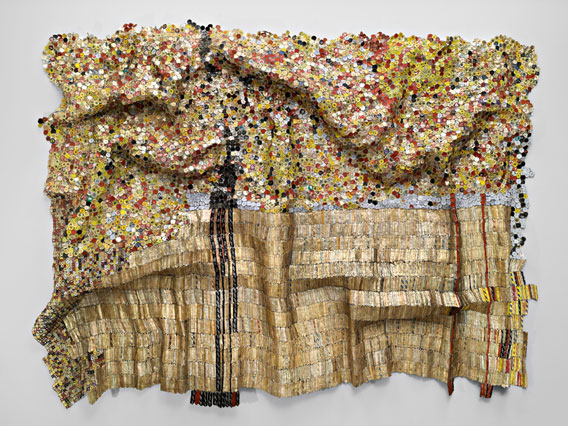
However, armed with the task of my Slow Art Day homework assignment and my choice of El Anatsui’s undulating sculpture Black River, I had no problem spending fifteen minutes admiring the textile constructed out of recycled metal.

I had noticed the piece before working with Slow Art Day but I had never taken the time to see how many different types of recycled caps were used, how the light filtered through the negative space between the pieces of metal and how the curators had strategically pinned the sculpture against the wall so that it appeared like a cascade of gold. I admired it from numerous angles and different distances for its texture, and after reading the museum plaque, for its meaning.

And the experience didn’t just change how I saw that artwork. After leaving the museum I was able to focus more than I had ever before. I generally appreciate the beautiful and interesting aspects of my environment as an artist and an art history major, but I rarely take the time to actually stop and stare at something I find intriguing. After my slow encounter with Black River, I noticed a gaggle of geese and stopped to stare at them for over ten minutes. I took in the texture of their webbed feet, noting how it compared nicely with their fluffy feathers, and gawked at the striking contrast between their black necks and the white patches underneath their eyes. Slow Art Day has taught me that art is everywhere and anything can be beautiful as long as you take long enough to sit and appreciate it.
– Gabrielle Peck, Boston University
[El Anatsui’s Black River (2009) was viewed in the Museum of Fine Arts, Boston Linde Family Wing for Contemporary Art.] 

Connecting the Dots: Slow Looking with Roy Lichtenstein

Slow Art Day has asked its 2013 college interns to write short summaries of their own experiences looking slowly at artworks of their choosing.

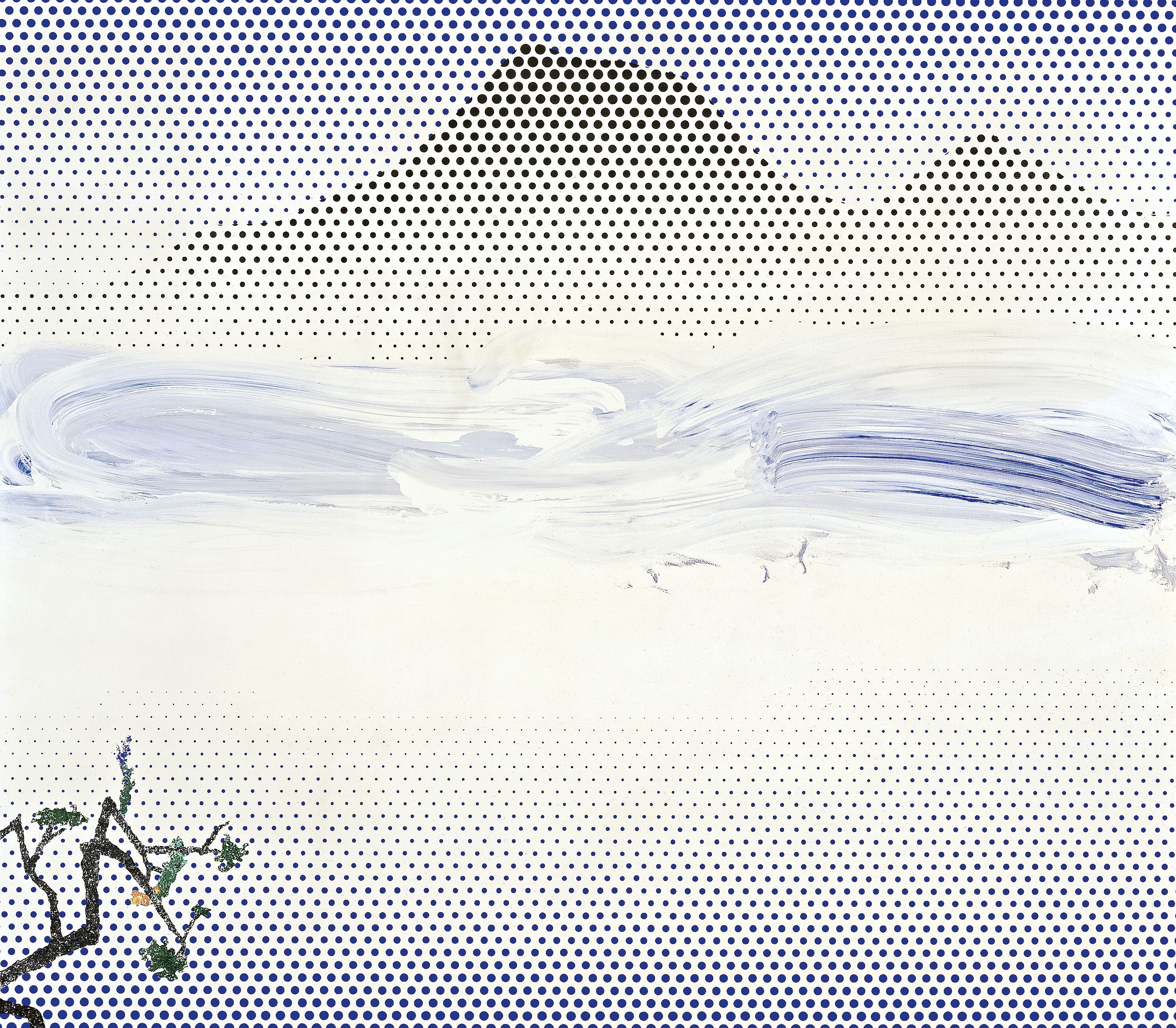
While spending some time at home in Virginia over the holidays, I headed into Washington DC to check out the National Gallery of Art’s retrospective of Roy Lichtenstein, one of my favorite artists. Lichtenstein’s mechanical, removed style has always intrigued me, as most of his paintings are void of any painterly brushstrokes. The retrospective was truly spectacular, displaying not only Lichtenstein’s cartoon style, but also some truly stunning landscape paintings made near the end of his life. These landscapes managed to combine Lichtenstein’s trademark ben day dots with traditional Chinese landscape painting, two styles I wouldn’t have expected to mesh well together.  I had never seen these works before, and spent over 10 minutes in front of this painting, Landscape in Fog, created in 1996, a year before Lichtenstein’s death.


Roy Lichtenstein, Landscape in Fog, 1996, Oil and Magna on canvas, 71 x 81 3/4 inches (180.3 x 207.6 cm).

Both painterly and mechanical, this late, almost minimalistic work seems to layer dots behind and under a more abstract expressionist brushstroke. Looking at the ben day dots receding into the white background towards the center of the canvas was difficult on the eyes; it was almost impossible to tell whether the dots were covered by the white background, or whether Lichtenstein’s virtuosity with circles produced a gradient effect. Looking at the dots up close was mesmerizing; each dot is painted individually, and the subtle flaws in the imperfect circles reminded you that the artist painstakingly filled in, by hand, every single dot. The black dots used to give the effect of mountains were equally as fascinating, as Lichtenstein included slivers of individual dots to help define the outline of the mountain peaks.

Without careful observation and slow looking, these incredible details would have been lost. Not only did I get to see a series of paintings that I had no idea even existed, I interacted with this piece in a way that helped increase my awe and fascination with Lichtenstein. As I spent more time than the other visitors in front of this piece, I felt almost a kinship with Lichtenstein, who must have taken ages to carefully paint in each individual dot; the art of slow looking connected the artist and the viewer in a meaningful way that I won’t soon forget.

Alie Cline, University of Texas at Austin
Slow Art Day Social Media Manager

[Roy Lichtenstein’s Landscape in Fog (1996) was viewed at the National Gallery of Art in Washington DC at the exhibition: Roy Lichtenstein: A Retrospective.]