Slowing Down at Museo MARCO

[Slow Art Day has asked its 2013 hosts and volunteers to write short summaries of their own experiences looking slowly at artworks of their choosing.]

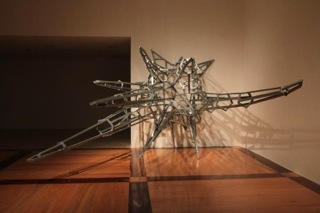
After looking around the Museo Marco, I chose the artwork The Fuck Off Project by Daniel Ruanova to examine patiently as part of the initiative of Slow Art Day. There were, no doubt, other pieces that called my attention, but the idea of examining this particular piece interested me the most. This artwork consists of a series of metallic rods that are assembled into a set of pointy extrusions. It almost looks like a “wire frame” (like those seen in animation programs) of the back of a porcupine.


Daniel Ruanova. The Fuck Off Project. 1976

At first glance the work certainly seemed aggressive. Although not insulting (at least until you read the title), I initially did not want to get near it. Each of the protrusions appear to be directed toward the viewer, independent of the viewing angle. Judging by the name, I thought that this was precisely the motive of the artist – i.e. to portray aggression.  That made me think of similar shaped things in nature that convey the exact same defensive idea, like pufferfish or the porcupine, and I concluded that the artist may have been inspired by such animals.

Despite my apprehension, I decided to slowly approach the piece. As I got nearer, I noticed that the feeling of aggression became stronger.  I decided to actually walk into it and that changed my experience of the piece completely. There, inside it, I felt protected. The metallic arms were no longer pointed towards me but towards everyone else. It’s as if now their sole purpose was my defense. I sat down to be able to immerse myself deeper, and, as expected, the sense of security was intensified. There, in the midst of all those metal rods, I felt comfortable.

The next thing I noticed was the facial expressions of the people in the museum when they noticed me there. Assuming they shared the feeling I had felt while looking at the sculpture from the outside, I could understand why. I sat there for awhile, watching people pass looking bewildered.

I now understand the Slow Art Day initiative in a better way and can see how slow looking can really transform the experience.  Looking slowly and taking the time to move in and around this artwork completely changed my perception – and – this insightful episode reaffirmed my decision to be a host during the Slow Art Day for Museo Marco in Monterrey on April 27.

– David Zambrano Reyes, Volunteer at MARCO

[Make sure to check out Museo MARCO’s Slow Art Day event in Monterrey, Mexico.]

Take a Slow Look, Canada

Slow Art Day has asked its 2013 hosts and volunteers to write short summaries of their own experiences looking slowly at artworks of their choosing.

The day of my assignment, I strode into the gallery with purpose; J.E.H. MacDonald’s October Shower Gleam, 1922, was the only work I was going to spend time with that day.  This work did not initially outwardly appeal to me – I felt like I was up for a challenge to see what it would be like to look at it slowly.

J.E.H. MacDonald, October Shower Gleam, 1922. Image courtesy of WikiPaintings.

I set my alarm for the proscribed 10 minutes, and set my eyes (and mind) to work. What initially made the painting unattractive to me, the garish 70s mix of close-to-neon colours with earthy greens and browns, I set my eye to first. Looking closely at what I read as autumnal trees and brush, I soon discovered a graceful patterning of organic shapes in the entirely unnatural colours of bright pink and teal, outlined in ultramarine blue, with a ground of gessoed and textured canvas showing through. As my eye traveled downwards, towards the reflection of the landscape in the still lake, I realized that MacDonald’s depiction of water consisted solely of a reflection of the patterning I had been closely studying.

What I read as “water”, in fact, didn’t contain something normally characteristic in depictions of water; namely the colour blue. MacDonald actually had painted a ground of light orange onto which he had then transcribed his reflected scenery. Sandwiching this mirrored landscape was a mass of roiling clouds, done in wavy lines of lavender and deep purple, as well as a rocky outcropping of land containing a few windswept trees in the foreground. They squished me into the landscape in such a way that I felt like my only escape was forward, toward the rolling hills and the two small “V’s” of clear sky – away from the October shower that was imminent, seen in the shiny wetness of the purple clouds.

My “introduction” to the work lasted a mere minute or two. After that, I was lost in the landscape, its patterns, shapes, colours, and texture, until my alarm rudely interrupted. Ten minutes felt like two; I could have easily spent another ten or twenty minutes immersed in the work.

Though not initially appealing to me, I grew, through this exercise, to appreciate aspects of the work that weren’t immediately apparent. Practicing slow looking with a work I wasn’t immediately attracted to in a positive way helped me remember that to “like” and “dislike” are fluid categories (and don’t always include “appreciate”). I was also reminded not to always take other people’s word for it – it is always more rewarding to see for yourself.

-Tori McNish, Slow Art Day volunteer

Slow Art Day with Natalie Iturbe at the Melrose Trading Post

[In this series, we interview hosts for Slow Art Day and get their thoughts on hosting, the art of looking, and the slow art community. Today we interview Natalie Iturbe, who is hosting a Slow Art Day event at the Melrose Trading Post in Los Angeles.]

Slow Art Day: Tell us about yourself and your passion, Natalie.

Natalie: My passion is art! I am a visual artist and somewhat of a curator. I express my passion through my job and through my artwork. At my job I bring in various local vendors to sell in our weekly community market. It is a particular selection process, and I aim to keep a good balance of original artwork, vintage and antique items, fun collectibles and fashion-related items. Through my art I am able to release my inner thought processes and energies onto a canvas or a piece of paper. It is absolutely necessary for me to create art in order to maintain a balanced and happy life.

Slow Art Day: And what is Melrose Trading Post?

Natalie: The Melrose Trading Post is the weekly nonprofit community market I manage every Sunday. We are located in the heart of Los Angeles at Fairfax and Melrose Avenues in the parking lot of Fairfax High School. We are sandwiched between two of LA’s artistic communities, Fairfax Village and the Street Art District. The vendors that come in range from local artists, craftspeople, entrepreneurs, collectors, antique buffs, historians and more. The money raised through our $2 admission fee and the vendor booth rentals benefit programs for Fairfax High School students. These programs include club fulfillment requests, Greenway Arts Education Programs, teacher supply requests, school beautification projects and more.

Slow Art Day: You have hosted Slow Art Day before. How’d you first hear about it?

Natalie: I saw an article about it online last year. I volunteer at the county museum (LACMA) and I noticed that many people only look at individual pieces of art for a few seconds. The artist may have taken years to create the piece, but it only gets a few seconds of a patron’s time. By bringing Slow Art Day to the Melrose Trading Post, I saw it as a way to slow Angelenos’ hasty life pace down long enough to look at the local artists’ work that we feature.

Slow Art Day: At your Slow Art Day – the artists are there to interact directly with the public, yes?

Natalie: Yes – the Melrose Trading Post is a very interactive experience. We have over 240 artists and vendors who you can talk to, haggle with, and pick their minds about their various topics of expertise. Our Slow Art Day is unique because you can actually speak with the artist. You can ask them questions, make a direct purchase and follow their creative journey. We like Slow Art Day here because it is yet another way to bring patrons and local artists together to engage and inspire each other.

Slow Art Day: What is one of your favorite art works?

Natalie: I love the work of Remedios Varo. Her paintings are so mystical and haunting. I also love Henri Matisse’s artwork, especially his more colorful pieces before World War 1.

[Make sure to check out Natalie’s Slow Art Day event at the Melrose Trading Post in Los Angeles, California.]

‘Fair go’ and Slow Art Day – An Interview with Elle Credlin

[In this series, we interview hosts for Slow Art Day and get their thoughts on hosting, the art of looking, and the slow art community. Today we interview Elle Credlin, the Public Programs officer for Bayside City Council in Sandringham, Victoria, Australia.]

Slow Art Day: Tell us about yourself and about Bayside City Council’s Art and Heritage Collections.

Elle Credlin: I’m Bayside City Council’s Art and Heritage Collections and Public Programs Officer. I have a Bachelor of Arts (History) and a Postgraduate Diploma in Cultural Heritage/Museum Studies. My role is to manage Council’s art and heritage collection and also run public programs for the Gallery @ BACC. Council’s art and heritage collection is comprised of over 2000 items including municipal records, plans, maps, textiles, photographs, mayoral regalia and a range of visual arts.

Slow Art Day: That’s great. Tell us more about your role as Public Programs Officer.

Elle: I develop and manage the range of public programs and outreach services to accompany and enrich the exhibition program. These include things like curator’s talks, workshops, tours, art appreciation evenings and now Slow Art Day! We also run an Art and Dementia program titled Connections. Through discussion based tours of art work, the program provides a unique opportunity for people living with dementia to connect, interpret and express experiences through a work of art.

Slow Art Day: Please tell us more about the Dementia program. Do many other programs like that exist in Australia?

Elle: Connections is based on the National Gallery of Australia’s award winning Art and Alzheimer’s program. In 2012, gallery staff received training from NGA educators in how to deliver the program. Each program runs over a four week period and three works of art are discussed each week amongst the four participants. The program employs specialised forms of communication and strategies to encourage participation and support inclusiveness. These strategies include hand gestures, smiling, leaning forward and allowing for silence. It is run during normal gallery opening hours to prevent the marginalising of participants. We are really proud of Connections because it extends beyond many activities commonly available to people with dementia. Participants are able to engage in meaningful activity in an environment where their intellect is respect and valued. As far as I’m aware, we are the only local municipal gallery that runs this particular type of program in the state of Victoria, but that may have changed.

Slow Art Day: Why are you so passionate about making art more accessible?

Elle: I absolutely hate the idea that people could be intimidated or frightened by visiting a gallery or find themselves plagued by the ‘white box syndrome’. Galleries should be inclusive and welcoming. Every single person should have the opportunity to experience the richness of the arts. More broadly, as we are based within a local government context, we also need to align ourselves with the broader organisational mission of inclusivity, accessibility and facilitating opportunities for people of all abilities to participate in community life.

Slow Art Day: We obviously agree. Switching gears – Slow Art Day has really taken off in Australia. There are 13 venues in Australia making it more than 5% of the total worldwide venues yet Australia has only about .3% of world population.  Why do you think Slow Art Day is such a big hit there?

Elle: I’m not sure, that is a really interesting question. Melbourne, in particular, has a thriving artistic and cultural scene so that could have something to do with it. Maybe the fact that Slow Art Day is an accessible and affordable activity mirrors the ‘fair go’, non-elitist attitude of many aspects of Australian culture and life i.e. that everyone should have access to the same opportunities and experiences.

Slow Art Day: Say more about ‘fair go’ – is that Australian lingo?

Elle:  ‘Fair go’ is a very Australian term.  Although it has many different meanings, I think it is fundamentally a commitment to egalitarianism in all aspects of culture and life; that we are all given every reasonable opportunity to access to the same opportunities and rewards. That is how I see it anyway.

Slow Art Day: What more can you tell us about your event? Have you chosen your art?

Elle: For Slow Art Day, we will be celebrating the works of a number of significant early 20th century Australian artists, including Tom Roberts, Frederick McCubbin and Arthur Streeton. We will be having lunch in the municipal chambers. If it’s a nice day, we might sit out in the rose garden.

Slow Art Day: You plan to make Slow Art Day a regular fixture in your public programs. Does that mean you plan to do regular events throughout the year based on slow looking?

Elle: Yes, Slow Art Day will now be a regular feature in our program. Our Art and Dementia program, as mentioned, is very much aligned with the idea of slow looking. We also host ‘soiree’ type evenings with wine and cheese, which are very popular. These evenings are very relaxed and people are encouraged to take their time with the works.

Slow Art Day: Let’s finish by asking what’s one of your favourite pieces of art? And why?

Elle: That is a hard question! I love Ben Quilty’s work. I think he’s amazing.

[Make sure to check out Elle’s Slow Art Day event at The Gallery at BACC in Brighton, Victoria.]

‘Face’ to Face with Dorian Gray

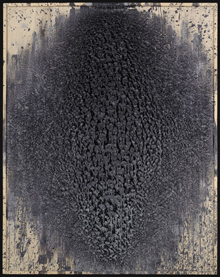
Martin Kline, Dorian Gray, 2011. Image Courtesy of the Harvard Art Museums.

Slow Art Day has asked its 2013 college interns to write short summaries of their own experiences looking slowly at artworks of their choosing.

Out of the corner of my eye, I can feel Dorian Gray digging into the back of my neck, his carbonized tendrils reaching outward with a foreboding aura.

Martin Kline’s Dorian Gray (2011) is currently situated on the fourth floor of the Sackler Museum (one of the Harvard Art Museums). The encaustic on panel work resides in a tucked-away enclave to the left, and I might have passed it by, if not for the incredible breathtaking presence of the piece quickly enveloping me. The odd fact that this very contemporary work is being displayed on a floor usually reserved for historical European works from Middle Ages to Modern Art is jarring. And yet, it seems completely appropriate.  Its uniqueness demands its own votive-like shrine. It shouts loudly for your attention in order to simmer to a boil before your stolen attention.

This ‘portrait’ does not portray the Oscar Wilde character in his eternal youth. Instead, the spellbinding work showcases the blistering and decaying remains of the bewitched painting. Miraculously the work still carries the same devilish, enigmatic force that you would expect from a depiction of Dorian’s debaucherous descent in his perpetual youth.

As I gaze at Kline’s work, however, I temporarily forget all literary references. Regardless of intent or allusion, this piece literally feels timeless. From all directions and perspectives it becomes reminiscent of so many worldly forms. I feel as if I need to mentally map the pulsating topography of the piece inch by inch. A gigantic festering blister at direct view morphs slowly into a singed old growth forest to bubbling, oozing lava, to a hearty crop of stalagmites as my gaze traverses the panel. I am able to visually trace the peaks and valleys, following them down into the crevasses created by the dripped wax terrain. The technique used by Kline, curiously one of addition and growth instead of the destruction that you would assume of the corrupted portrait, adds to the oddly lively artwork.

Martin Kline, Dorian Gray (detail), 2011.

Martin Kline, Dorian Gray (detail), 2011.

I realize something while looking horizontally from the right at the Martian landscape (after exhausting all of my other viewing options, museum etiquette-wise). Stepping back a few feet, I see that the wax used is a variety of colors, not the monotone mound it appears to be. Light gray, dark gray, even a sickly shade of green is intermixed to add depth and shading to the work. I was so close and drawn into the work that I didn’t realize this core component. What else did I miss?

I draw back, not in retreat, but in pursuit. The optical feat created both by the layers of wax and its pigmentation is still enchanting and intoxicating. As I’m across the gallery, however, I realize that I’ve made a crucial mistake in my original viewing of the work. This is not a remnant of past events, or a passively brewing force.

This work has a life of its own and it’s still spreading.

-Karen Trop, Bennington College.

Martin Kline’s Dorian Gray among other great works is available to view at the Arthur M. Sackler Museum in Cambridge, MA. The Harvard Art Museums are not currently hosting a Slow Art Day event. Inspired? Sign up as a host today!

Blogging, Local Art, & Slow Art Day: an Interview with Tori & Chelsey from PrairieSeen

[In this series, we interview hosts for Slow Art Day and get their thoughts on hosting, the art of looking, and the slow art community. Today we interview Tori & Chelsey, the creators of the blog PrairieSeen and hosts of Edmonton Slow Art Day.]

Slow Art Day: This year’s Slow Art Day event will be your inaugural PrairieSeen event. But, before we get to that – tell us a bit about yourselves. You are recent graduates and art advocates, right?

Tori and Chelsey: We both graduated from the University of Alberta this past year. We also worked together at the University of Alberta’s Fine Arts Building Gallery, an on-campus space that displays mainly student work in the undergraduate and graduate Fine Art and Design programs. While working at FAB, we realized that we both have a lot to say about the local art environment in Edmonton, and about art in general. That’s how our shared blog, PrairieSeen, was born.

Slow Art Day: Now, tell us about PrairieSeen.

Tori and Chelsey: PrairieSeen was started as a way to keep our Art History degrees relevant, and also to keep ourselves in the practice of writing after graduation. Since we come from an art-historical background, we feel that we approach art and art criticism from a bit of a different perspective, and wanted to share that with the Edmonton art scene.

Slow Art Day: And it’s exciting that Slow Art Day is your first event. We have a veteran host in Rome who opened her gallery several years ago with Slow Art Day. She said it was very successful and has really shaped her whole approach to all her events. So – why did you choose to make Slow Art Day your first event?

Tori and Chelsey: The fact that it is already an established international event appealed to us, and that it is free – aside from the cost of gallery admission. We really liked that Slow Art Day promotes the idea of slow looking in the gallery, and taking your time with each piece, rather than rushing through and not really seeing the works. The discussion part of the event also appealed to us – we love talking about art exhibitions, whether we liked them or not!

Slow Art Day: You have chosen to hold Slow Art Day at Latitude 53, a local independent gallery in Alberta.  What can you tell us about that gallery?

Tori and Chelsey: Latitude 53 is a not-for-profit, artist run centre here in Edmonton. It focuses on experimental, contemporary works made by artists in Alberta and hosts a lot of fundraising events throughout the year, including a weekly “patio party” series in the summer. You can read more about Latitude 53 and its mandate here: http://www.latitude53.org/  Latitude 53 is moving into a new space this spring, and we are hoping to host the event in the brand new gallery!

Slow Art Day: One final question. We were hoping more college students would sign-up as hosts at galleries and museums all over the world. We have a large college intern team but college student hosting is still in its infancy. Do you have any tips or advice for getting more college students involved? Do you want to help reach out to more students in Canada?

Tori and Chelsey: We’d love to help reach out to more students in Canada – we’re recent University graduates ourselves and we know how hard it can be to find time to be involved in non-school related events. We will reach out to art history departments here in Canada and see if we can generate more student involvement.

Slow Art Day: That’s a wonderful offer and we’d really appreciate your help in reaching more students there in Canada. Thank you!

[Make sure to check out PrairieSeen on Tumblr and Twitter, and if you’re in the Edmonton area, sign up to attend Tori & Chelsey’s Slow Art Day Event at Latitude 53.]

Slow Art Day reaches over 200 venues!

We’re excited to announce that Slow Art Day has reached a new milestone: over 200 venues have registered to host Slow Art Day 2013! As of this week, there are over 200 participating venues in 22 countries, 160 cities, and 5 continents. What started out as a grassroots movement has grown into a truly global initiative, and we want to take a moment to thank all of our dedicated volunteers, hosts, and participants for their help and support of Slow Art Day.

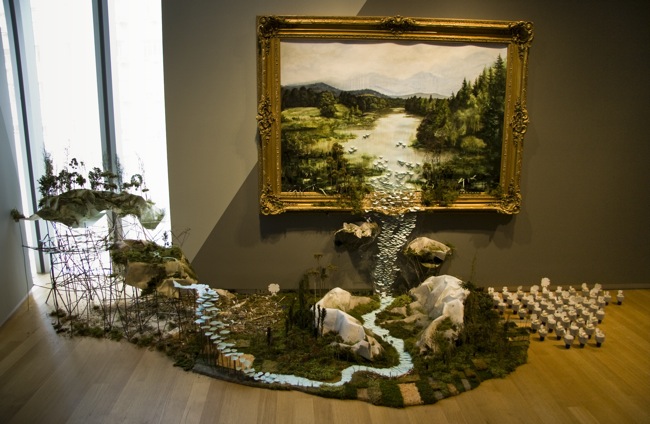
To help celebrate this accomplishment, we’ve planned some fun posts across our social media channels emphasizing the theme of growth. On our Tumblr, our weekly “Themed Thursday” series is focusing on growth with artworks like Gregory Euclide‘s Otherworldly: optical delusions and small realities, 2011.

Gregory Euclide, Otherworldly: optical delusions and small realities, 2011.

Gregory Euclide, Otherworldly: optical delusions and small realities, 2011.

On our Facebook, check out another growth-themed artwork by Rogan Brown, and keep your eyes peeled on our twitter for a special tweet congratulating our 200th venue!

Slow Art Day 2013 is just over a month away; how many venues do you think will register to host by April 27th? Let us know in the comments! There’s still plenty of time to sign up to host; click on the Be A Host tab at the top of the page to register.

Once again, thank you to everyone who has played a roll, small or large, in helping make Slow Art Day such a success!

Alie Cline
Social Media Manager


Slow Art Day Interviews Sarah Bluvas of The Nelson-Atkins Museum of Art

Slow Art Day, recently spoke with Slow Art Day host Sarah Bluvas who works in the education department at The Nelson-Atkins Museum of Art in Kansas City, Missouri. The Nelson-Atkins has been a participating Slow Art Day venue for three years now, though this is Sarah’s first time as a host.

Slow Art Day: What are your thoughts about Slow Art Day?

Sarah Bluvas (SB): I think Slow Art Day is a phenomenal idea. I love the concept of just stopping and looking. One thing I’m curious about is the conversation aspect after the viewing time. I think it’s one thing to encourage people to come and look at a piece of artwork, but it’s a whole other challenge to get them to sit down and talk about it.

Slow Art Day: That’s a good question. We find that once people look at art slowly that they are bursting with enthusiasm to talk. We always tell hosts that they just need to be prepared to get out of the way because attendees – especially first-time museum goers and other novices – are very excited to talk.

SB: I’m glad to hear it. Not only do we want people to come to our programs, we also want them to be more active participants and encourage conversation. So for the discussion after the Slow looking event, I am really hoping that people will be willing to share their experience. Even if it’s as simple as them saying, “I liked that work” or “I didn’t like that work”, and why—I think it further achieves the purpose of art.

Slow Art Day:  So in other words, it solidifies the experience?

SB: Yeah. I mean, first and foremost, it’s about getting people to stop and look at art. But then for me, the question of “Why is it important, why do we want people to stop and look” is brought up.

Slow Art Day: Absolutely.

SB: I just think Slow Art Day is a great program to get people to stop and look at art and to think how it fits into their lives. I’m really excited to be a part of this movement!

Slow Art Day: Great. Shifting gears – have you chosen your artwork yet for Slow Art Day? If so, what are you thinking?

SB: We try to choose works from a variety of areas in the museum’s collection. I’m still trying to narrow down my choices for this year’s Slow Art Day, but I know there will be a nice mix of pieces. Some highlights will include Ritual Disc with Dragon Motifs (Bi), from our Chinese collection, and Memento # 5 by Kerry James Marshall, from our Modern + Contemporary collection. We also have the beautiful Kansas City Sculpture Park, so, depending on the weather, I would love to include a sculpture in the park and send people outside to look!

Slow Art Day: And, what is one of your favorite works of art?

SB: In the museum’s collection, I love all of our works by Thomas Hart Benton, a Kansas City-native and one of the three great artists of the Regionalism movement. However, my all-time favorite work of art is Edward Hopper’s Nighthawks, on view at the Art Institute of Chicago. One of the reasons I like it so much is because of the idea of prolonged looking, actually! The narrative, or lack of a narrative, in Nighthawks is so complicated and fascinating to me. You can look at it for hours without really knowing what’s going on!

Slow Art Day: Finally, tell us a little bit about yourself? What do you do – and why do you do it?

SB: I am the Coordinator for Public Programs at the Nelson-Atkins. I assist with planning, implementing and facilitating more than 120 public programs per year, mostly for adult and family audiences. I think museums are really important resources for the communities they are located in, but I also think museums can be a little intimidating for people. So I plan programs for and with the community to help the public realize that this is their museum and that they can find themselves here, too. It’s nothing to be scared of!

The Art of Looking with Vermeer’s “Girl”

Slow Art Day has asked its 2013 college interns to write short summaries of their own experiences looking slowly at artworks of their choosing.

Few paintings possess the same level of fame as Johannes Vermeer’s Girl with a Pearl Earring. Who was the enigmatic girl in the painting? What was her relationship to the artist? Why did he paint her wearing such a large and distinctive pearl earring? Art historians have speculated tirelessly on the answers to the questions, and the level of mystery surrounding the Girl has led her to be labelled “the Dutch Mona Lisa.”

Given all this, it’s next to impossible to not be aware of Girl with a Pearl EarringThe last time I did a slow art viewing experiment, with Jay DeFeo’s piece The Rose, I had only a passing familiarity with DeFeo and her work. But Girl is an inescapable piece, so when I viewed the painting at the de Young Museum’s special exhibition Girl with a Pearl Earring: Dutch Paintings from the Mauritshuis, it turned out be a completely different viewing experience.

Girl is obviously the star of the exhibition. She appears on all of the de Young’s promotional material for the exhibition, and her face is currently plastered on the side of every bus in San Francisco. Before I even walked into the exhibition I’d seen her face many times over the past few weeks, and was, frankly, a little sick of her. But as any art lover will tell you, seeing a reproduction of a work pales in comparison to seeing the work in person.

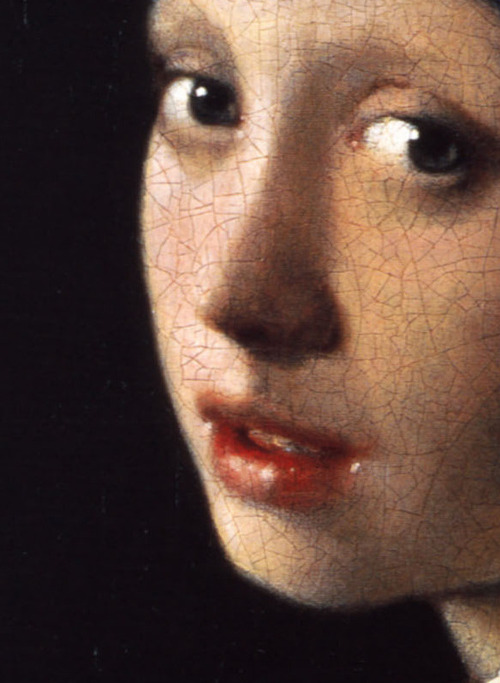
Jan Vermeer, Girl with a Pearl Earring (detail), 1665. Image courtesy of the de Young Museum.

The painting’s placement in the exhibition reinforces its central importance. The exhibition spans five rooms of the gallery, all of which are densely packed with paintings, with the notable exception being the room that houses Girl with a Pearl Earring. The room’s only occupant, the Girl confronts you head-on, visible even from the preceding gallery. The painting’s dimensions are rather underwhelming in person, something that the curators and installers cleverly disguised by shining bright lights on the painting and shrouding the rest of the room in darkness. An otherworldly glow seems to emanate the canvas.

When conducting slow art viewings, I like to view the artwork from as many different angles as possible – far away, up close, from the sides. However, I quickly discovered that this is difficult with a painting as diminutive as Girl with a Pearl Earring. I could barely see it when trying to view it from across the gallery; I just got an impression of large blocks of bright colors, an impression that was validated when I moved closer. One of the things that struck me was how sparingly Vermeer used different shades of pigment. Although the painting seems rich in color, and it certainly is, relatively few different shades of color are used in the painting. It seems almost minimalistic – although this isn’t something we generally associate with the Dutch Golden Age, I was reminded of the sparsity of different color shades used in abstract paintings by Mondrian or Rothko.

However, after spending several minutes in front of the piece, I did start to notice several subtle but startling uses of color. There is a small dot of white paint at the corner of the Girl’s mouth that echoes the white dots in her pupils. Her lips appear at first glance to have been painted bright red, but upon closer examination actually contain traces of black, gray, white, and even blue pigment. Even though her pearl earring is the painting’s brightest focal point, it is actually painted almost entirely in black and gray, with just one small white brushstroke that lends it a luminous, glowing quality amidst the darkness of the surrounding canvas.

I realized at the end of my slow viewing experience that the work, which seemed so diminutive at first glance, seemed to have taken on greater proportions. After looking at each individual detail of the painting at great length, the whole of the painting had become much larger than the sum of its parts. The work is only one and a half feet high, but it feels monumental and, at the same time, intimate, as if she is looking at you alone. If you are in San Francisco, I highly recommend that you make the effort to go see this painting (and the rest of the exhibition). You may think you’ve seen it already, on postcards, book covers, and other reproductions, but when you see it in person you will realize that until that moment you’ve been mistaken.

– Maggie Freeman, Mills College

Jan Vermeer’s Girl with a Pearl Earring (ca. 1665) was viewed at the special exhibition Girl with a Pearl Earring: Dutch Paintings from the Mauritshuis at the de Young Museum in San Francisco, CA]

Public Art and Slow Art Day in Orlando

[In this series, we interview hosts for Slow Art Day and get their thoughts on hosting, the art of looking, and the slow art community. Today we interview Terry Olson, host of Orlando Public Art Slow Art Day.]

Slow Art Day: Tell us about yourself, Terry.

Terry Olson: I’m the Director of Arts & Cultural Affairs for Orange County Florida – which includes Orlando and a dozen other municipalities, Walt Disney World, Universal Orlando Resort, Sea World, etc.  I call myself an “arts instigator.”  I’m out at arts events all the time and oversee funding, public art and our Arts Learning for Life program.  I love bringing people together for new experiences and for building relationships.

Slow Art Day: Tell us a bit more about Orange County Arts & Cultural Affairs. It sounds like a government agency that’s doing a great job.

Terry Olson: Twelve years ago Orange County decided to take a pro-active approach to supporting arts and culture befitting our world class community.  Our office administers the County’s investment in the arts through several different review programs (general operating, cultural tourism, facilities).

Slow Art Day: And you seem to be quite passionate about public art. Public art does remove the intimidation that some people feel when entering a museum – something we are trying to counteract with Slow Art Day.

Terry Olson: Although my background was in the theatre, I have concentrated more on the visual arts and especially public art since we formed this office.  I love to be out in various communities and love to be delighted by some art or other aesthetic feature in a public space.  I have become the president of the Florida Association of Public Art Professionals.  I’ve always been a “populist” kind of guy, and Public Art is probably the easiest entry point for appreciation of art for many people.

Slow Art Day: How did you hear about Slow Art Day?

Terry Olson: One of the FAPAP Board members suggested that we all host a Slow Art Day related to public art in our city.

Slow Art Day: You have been promoting Slow Art Day to other public arts professionals. Why?

Terry Olson: I sent a notice to all the public arts professionals in our state because I think it would be very exciting if public art were being looked at this way all over the state.

Slow Art Day: Tell us about the design of your Slow Art Day event there in Orlando.

Terry Olson: There about 10 sculptures, murals, and media installations within a few blocks of the restaurant where our Slow Art Day will take place.  I can provide a map so that people can spend time that morning walking to any/all of those sculptures and taking time to really look at them.  I also have an exercise about “How to Look At Art” that is a series of 5 questions.  It is best to do that while the person is looking at the art, but it might be interesting to explore those questions after people have looked at the art and met at the restaurant, answering from memory.

Slow Art Day: That sounds like a great design. You have been really thoughtful about what people need – including a map.  Tell us in your “How to Look at Art” exercise – what are the five questions you are asking people to consider?

Terry Olson: First, just stand/sit quietly – and I mean without your mind whirring – and let the art make an emotional impression on you. What feeling do you have (not related to intellectual analysis or cognizant of content, but of the more subjective overall feeling)? Second, describe what it actually is – dimensions, materials, i.e. a 4’X4’ canvas with acrylic paint applied in big globs and bits of organic matter stuck into it. Third, now, finally, you can describe what it “depicts”. Even if it is abstract you can talk about what shapes you see and any associations that it brings to mind. Fourthly, describe how your eye moves about the space. Does the composition bring you around in a circle, or are there lines, triangles, divisions, etc. Lastly, how does this relate to you and what you are thinking about or what you are going through in life? Does it bring up a theme or idea that resonates with you or with which you disagree?

Slow Art Day: Anything else we should have asked about?

Terry Olson: We might see if there could be some pop-up performances around the city that morning to add extra surprise to any participants.

If you’re going to be in the Orlando area, join Terry in his exciting Slow Art Day event.