
For Slow Art Day 2025, the House of European History in Brussels, Belgium, launched a new program called “Slow Looking Saturday,” a guided series designed to accompany the museum’s temporary exhibition Presence of the Past: A European Album, which explores documentary photography and how Europeans engage with memory, history, and the legacy of the past.
The inaugural session, held on April 5 for Slow Art Day, focused on a single photographic project: “Our Family Garden” by Bosnian artist Smirna Kulenović. Participants gathered for a one-hour facilitated slow looking experience led by Pauline Gault, Informal Learning Project Manager at the museum. The session was designed to help visitors deeply explore one image and its many layers of meaning.
“Our Family Garden” documents a remarkable act of healing through nature. In the project, calendula flowers are planted in former trenches used during the Siege of Sarajevo, transforming spaces once associated with violence into places of growth and remembrance. The Slow Art Day session took place just one day before Sarajevo’s city day, when people now gather to care for these gardens.
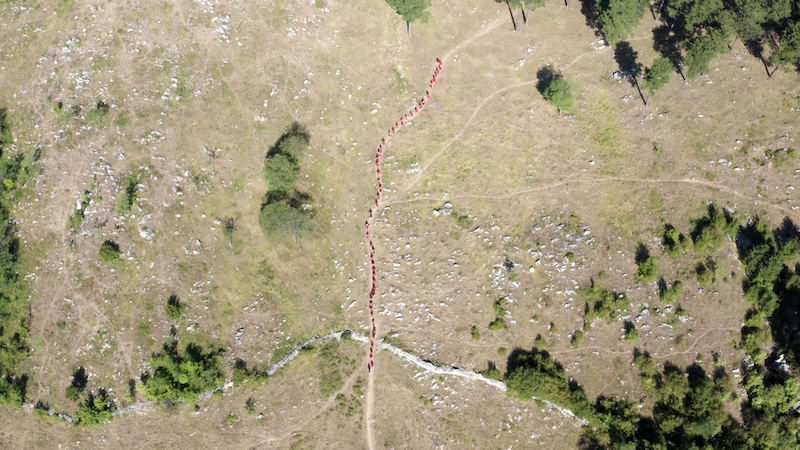

To guide the slow looking experience, Gault incorporated educational frameworks including Project Zero Visible Thinking routines from the Harvard Graduate School of Education and the Thinking Museum® Approach developed by museum educator Claire Bown, author of The Art Engager: Reimagining Guided Experiences in Museums. Participants engaged in several structured activities including Memory Draw, Engage & Imagine, and 3–2–1 Reflection, each designed to deepen observation, interpretation, and conversation.
The session also activated the sense of smell: dried calendula flowers were present in the room, allowing participants to connect physically with the plant at the center of the artwork. During the closing reflection exercise, visitors wrote their thoughts on the back of specially designed postcards featuring the artwork. These served both as reflection tools and souvenirs for participants to take home.
Feedback from participants was very positive. Many remarked that focusing on a single photograph allowed them to notice details and meanings they would have otherwise overlooked.
We at Slow Art Day HQ are delighted to see the House of European History launch an entire learning series from their Slow Art Day program. Special thanks to Pauline Gault and the Learning & Outreach team for developing this thoughtful approach, and we look forward to hearing about their event for Slow Art Day 2026.
— Ashley, Johanna, Jessica Jane, and Phyl
