Six Weeks of Slow Looking in Arizona Border Town

For their third Slow Art Day, Studio 917 Gallery in Douglas, Arizona, extended their event beyond a single day, transforming it into a six-week slow-looking experience. Located in the small town bordering Sonora where visitors often come to shop before discovering local art, the gallery intentionally selected a range of diverse works designed to appeal to audiences of different ages and backgrounds.
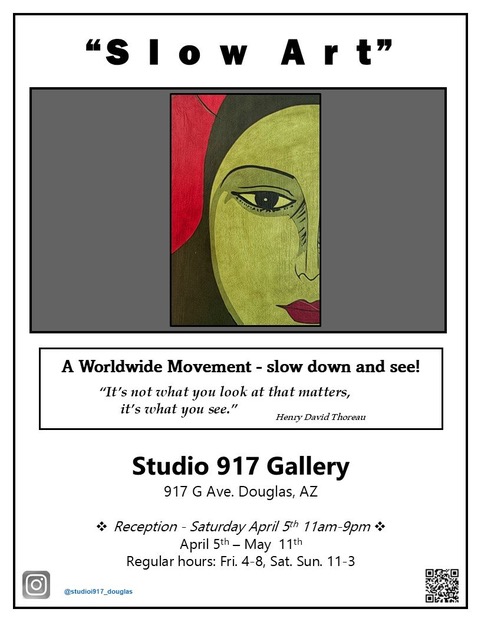

The exhibition opened with a busy first day, welcoming a steady flow of visitors from 11 a.m. to 9 p.m. As the weeks progressed, word of mouth expanded the gallery’s reach. Visitors traveled from nearby communities including Tucson, Agua Prieta, Bisbee, and Willcox, while tourists from farther afield stopped in while visiting the U.S.–Mexico border, including guests from Kansas, Minnesota, Texas, and California.
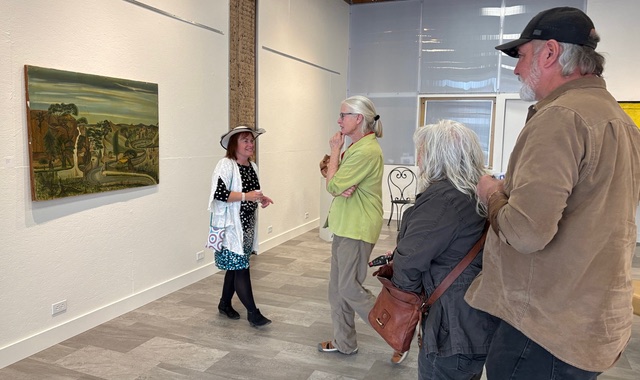
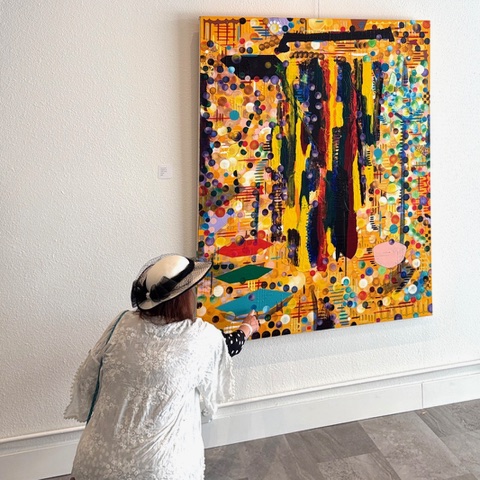
Visitors engaging with artworks during the extended Slow Art Day exhibition. Photos by Allyson Armstrong.

Featured Works:

  • Untitled by Gabino Rivera (c. 1930)
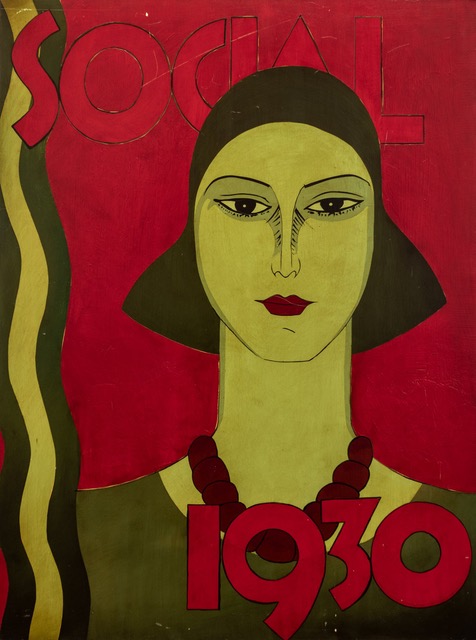
  • Social by Conrado Massaguer (Havana, 1930)
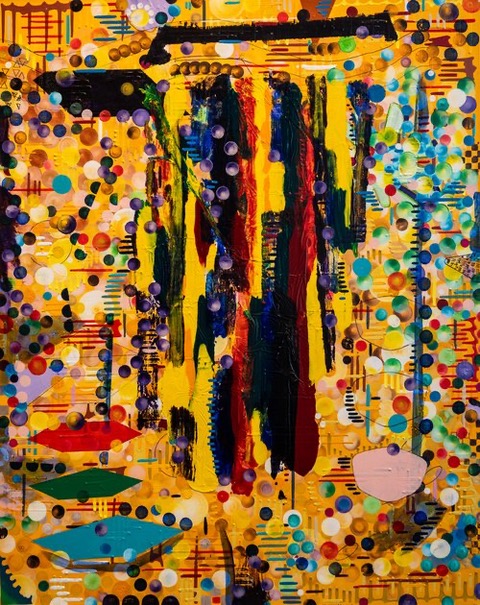
  • Parenthesis by Peter Konsterlie (2017)
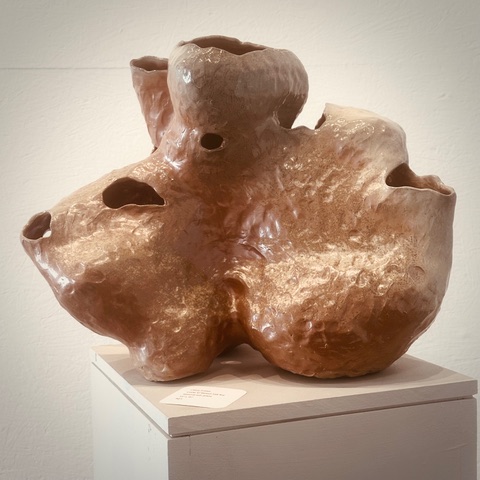
  • Untitled by Chloe Foster (wood-fired, salt-fired ceramic, 2025)

The selected artworks encouraged visitors to linger and look closely. Gabino Rivera’s early 20th-century work reflects the experience of immigration and labor in Douglas, where Rivera arrived as a young man to work in the local smelter. Conrado Massaguer’s Social, originally a magazine cover from Havana in 1930, offered a contrasting cultural perspective. Contemporary works by Peter Konsterlie and Chloe Foster added further range, from conceptual painting to ceramic practice, reinforcing the gallery’s goal of presenting varied entry points for slow looking.

Untitled. Gabino Rivera @1930. Sr. Rivera immigrated to Douglas, AZ as a young man to work in the smelter.
“Social” a magazine cover by Conrado Massager, Havana, 1930.
“Parenthesis”, Peter Konsterlie 2017.
Untitled,  Chloe Foster, Wood, Salt Fire, 2025.
Visitors engaging with artworks during the extended Slow Art Day exhibition. Photos by Allyson Armstrong.

By extending Slow Art Day across six weeks, Studio 917 Gallery created repeated opportunities for intentional looking and conversation, allowing both local residents and traveling visitors to encounter the artworks at their own pace. The approach reflected the rhythms of a small-town gallery while remaining connected to the global Slow Art Day movement.

We thank the team at Studio 917 Gallery for their continued commitment to slow looking and for sustaining this expanded Slow Art Day format year after year. We look forward to their next Slow Art Day.

– Ashley, Johanna, Jessica Jane, and Phyl

P.S. Follow Studio 917 Gallery on Instagram and visit their website at https://www.studio917.art.
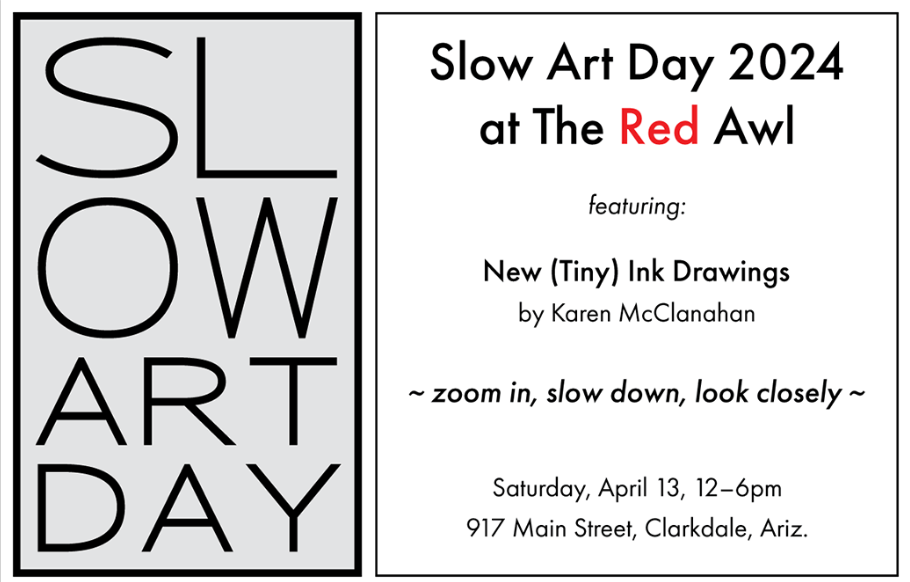
The Red Awl Hosts First Slow Art Day

For their first Slow Art Day, The Red Awl in Clarkdale, Arizona, featured four tiny ink-on-paper drawings by Karen McClanahan. The drawings were chosen because they align with the mission of The Red Awl to create, exhibit, and promote handcrafted, quirky, and often humorous artists’ books and fine art multiples.

The Red Awl is an artist-run project space located in a 100+ year old building in the small town of Clarkdale, Arizona. The building contains studios, a workshop, a copy room with a vintage Xerox machine, and a 242 square foot office lobby that serves as a project and exhibition space.

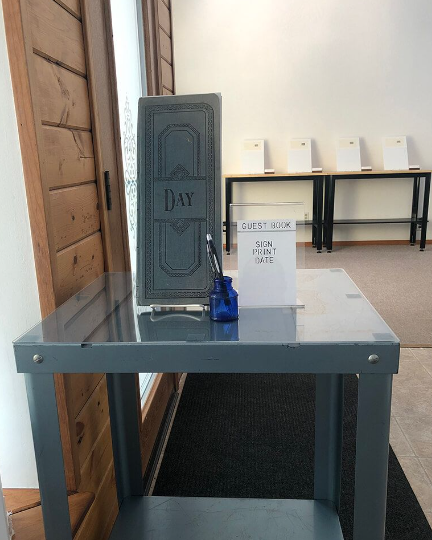
On Slow Art Day 2024, visitors were welcomed and asked to sign an antique ledger guestbook, then they were invited to read a short statement describing Slow Art Day along with an introduction to the drawings on view. Since this was the first time The Red Awl hosted Slow Art Day, they opted for a casual event instead of a formal program. The artist, Karen McClanahan, was on site to engage in discussions and answer questions throughout the day. An extra detail is that all visitors were asked to put away their cell phones and not take any photos or videos during their visit. This allowed them to stay present with the drawings and the artist.

Antique ledger.

 Visitor viewing closely.

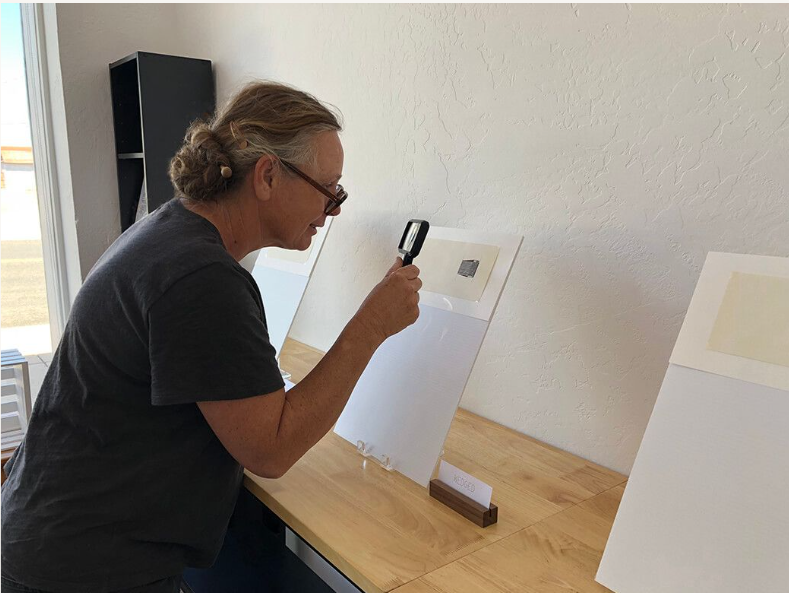
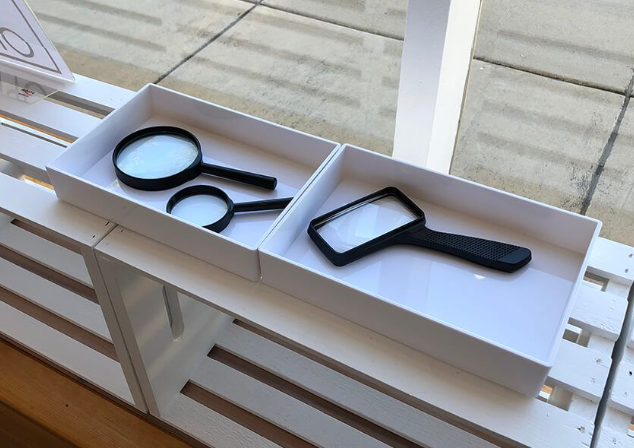
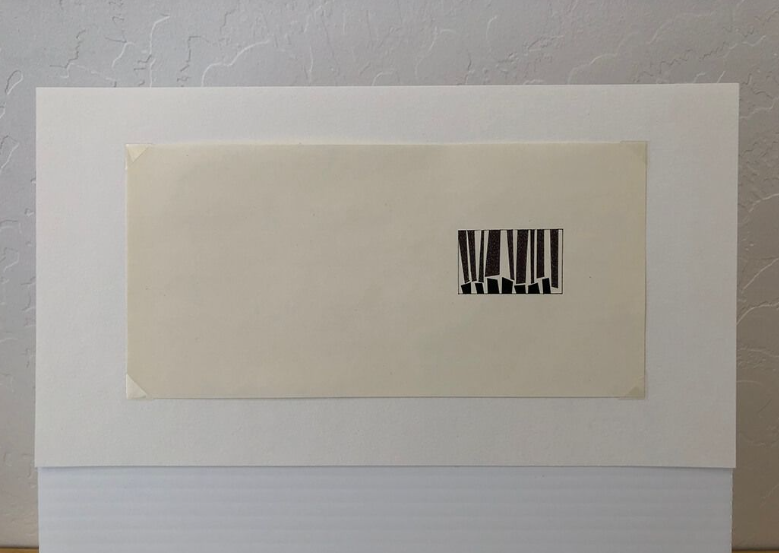
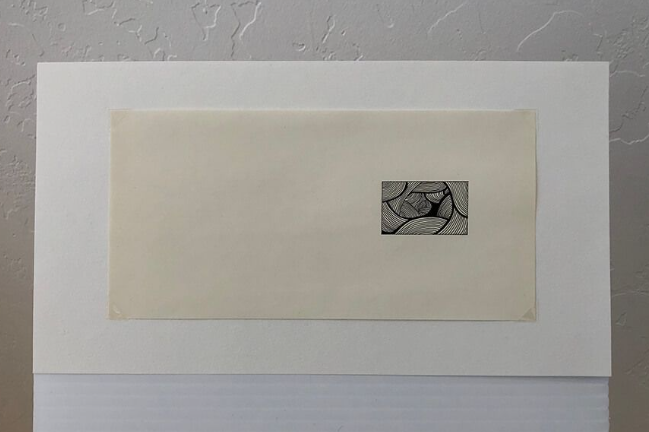
Slow Art Day participants were encouraged to look at the tiny drawings – first with an unaided eye and then with a magnifying glass. This allowed them to see the details up close at a similar magnification as the artist had drawn them. The drawings by McClanahan are small – measuring at 1 in. by 1-5/8 in., or slightly larger than a postage stamp. The size of the works offer a unique way to look slowly, as the intimate scale of the artwork requires a close view, making slowing down imperative.

McClanahan meticulously drew the tiny abstract compositions using a Bic ballpoint pen, a Micron pen, a straight edge ruler, a steady hand, and high-powered reading glasses.

Magnifying glasses for literal close looking.

Ink vs. Ink (Original drawing)

Eddy (Original drawing)

After viewing the works, visitors moved on to view a portfolio with the additional original book “plates” and the finished book titled “Ink vs. Ink.” Seeing the larger context of the four works showed visitors how the artist achieved a conceptual book narrative using pure abstraction.

Informal discussions focused on the various allusions to landscape, the human body, architecture, nature, and fabric. There were many questions regarding the drawing technique itself and how the miniature drawings were created using a humble Bic ballpoint pen.

At Slow Art Day HQ, we love this alignment of the small drawings with the mission of the exhibition space (and the magnifying glasses are cool).

We look forward to whatever The Red Awl comes up with for their second Slow Art Day in 2025.

-Johanna, Ashley, Jessica Jane, and Phyl

P.S. Slow Art Day 2025 is coming up on April 5. If you have not done so, please register your museum, gallery, church, sculpture park here: https://www.slowartday.com/be-a-host/

Slowing Down with Diné art at the Museum of Northern Arizona

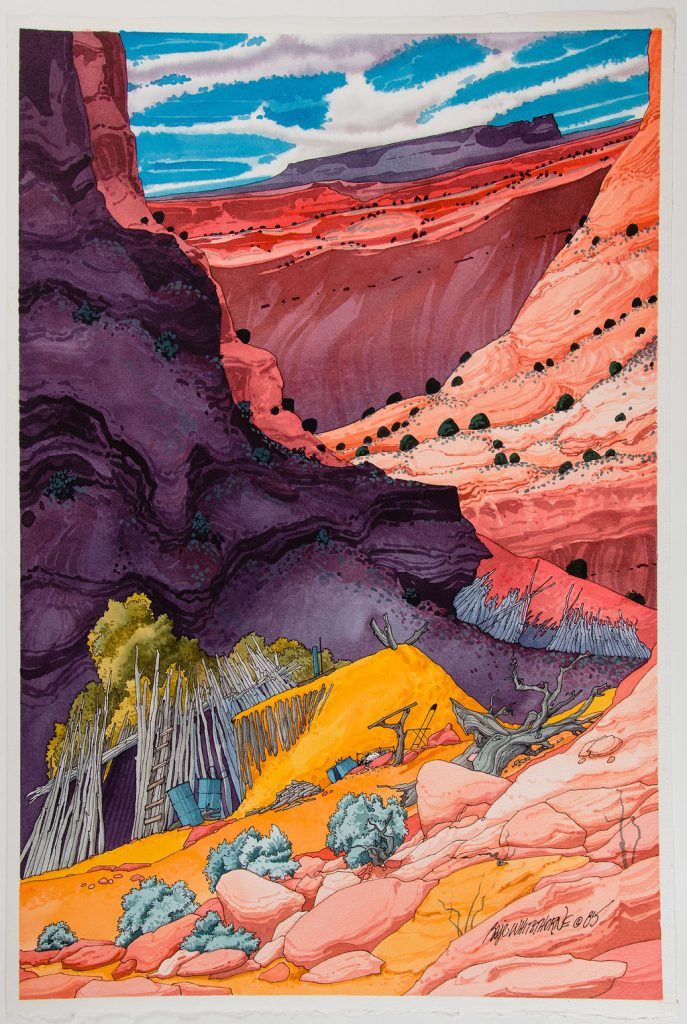
For their fourth Slow Art Day, the Museum of Northern Arizona (MNA) in Arizona, USA, hosted a slow looking event in combination with the opening of a new exhibition, Náátsʼíilid / Rainbow Light, featuring art by Diné artist Baje Whitethorne Sr., who grew up on the Navajo Nation Reservation.

Baje Whitethorne Sr., 1985, Watercolor on paper, MNA#C2587. Image courtsey of the MNA.

Before the event, the museum posted a video to YouTube, where Alan Petersen, Curator of Fine Art, and Samantha Honanie, Bookstore & Publications Manager, introduced slow looking and Slow Art Day.

We highly recommend that all museum educators and curators view this well-done video.

Alan Petersen, Curator of Fine Art, and Samantha Honanie, Bookstore & Publications Manager, at MNA, discussing slow looking and Slow Art Day. 30 March, 2022.

In six minutes, Samantha and Alan show (not tell) the viewer how Slow Art Day works.

They use some simple but ingenious methods for “showing” 10 minutes of slow looking in just a minute or so — and they then capture the joy of discovery and enthusiasm that participants experience (that is so hard to describe in words).

It’s a real joy to watch.

Take a look and think about how you might borrow some of their techniques for your next Slow Art Day event.

For the actual day, participants were given a Slow Art Day cheat sheet of slow looking prompts.

Participants were then invited to view the art by Baje Whitethorne, choosing the order they wanted to see the artworks in, and applying the slow looking promts from the cheat sheet.

At 2pm, all participants gathered in the Living Room at the museum, where Alan Petersen led a discussion of the insights and experiences from the event.

We recommend viewing the following video of artist Baje Whitethorne introducing the title and theme of his exhibition, Náátsʼíilid / Rainbow Light, below.

Baje Whitethorne introducing the exhibition theme – Náátsʼíilid/Rainbow Light.

We love everything about the NMA’s Slow Art Day – the preparatory video, the cheat sheet and the artwork chosen. We hope you get a chance to spend as much time with Baje Whitethorne and their work as we did in preparing this report.

We at Slow Art Day HQ are grateful that via writing these reports we get to look at and experience art from all over the world – art we may never have otherwise been able to see.

We look forward to whatever the Museum of Northern Arizona comes up with for Slow Art Day 2023.

– Johanna, Jessica, Ashley and Phyl

P.S. Stay updated with events at the Museum of Northern Arizona via their Facebook page.