Sweden’s Nationalmuseum Inspires With a Full Day of Programs

Slow Art Day 2023 is but 11 days away!

Meanwhile, more museums continue to register their plans with us including the Swedish Nationalmuseum with its inspiring (and first) full day of slow activities.

Under the direction of Johannes Mayer who coordinates the public events/programming for Nationalmuseum, the museum will start Slow Art Day with a slow yoga class amongst sculptures in the sculpture yard, in the morning at 8:30 am before the museum opens. Participants will be led by yoga teacher Victoria Winderud. The session ends with a fresh smoothie served in the café beneath.

Wow.

Then, once the museum opens young visitors (5-11 years old) will be invited to go on a slow looking tour of a handful of paintings in the collection, led by museum staff, between 10:30 and 11:15 pm. At 2pm, adults will be invited to go on their own slow looking tour.

But that’s not all.

There will also be an art-chill session at the beautiful Strömsalen (a large room with both paintings and sculptures), led by Sara Borgegård, Intendent Pedagogik for the museum (roughly – the “Superintendent of Pedagogy”) who will tell a saga based on one of the sculptures in the room.

Wait. There’s more.

All day long, the Nationalmuseum will offer what they are calling “drop-in art-chill” at the sculpture-hall/yard, where visitors can sit or lay down on a yoga-mat and listen to a pre-recorded art-chill session, slowly observing the beautiful room.

Finally, all visitors can borrow a slow-looking guide to explore and discover our works of art at their own slow pace.

Wow. Wow. Wow.

What a great design.

I hope this inspires other Slow Art Day museums and galleries.

And wherever you are, we hope you have a GOOD and Slow Art Day 2023.

Best,

Phyl and the Slow Art Day team

P.S. Remember to register your Slow Art Day with us so our volunteer team can write-up a report and feature you in our Annual Report, which has become the Bible of the slow looking movement.

P.P.S. If you need any of the host tools – logo for use in your print or digital efforts, and all of the past reports with their many tools, tips, and inspiring approaches – then go to the host tools section of our Slow Art Day website.
Frost Celebrates Its 10th Slow Art Day

It’s going to be another great Slow Art Day this April 15, 2023. More museums continue to register including our first in South Korea.

And I’m proud to share that the Patricia & Phillip Frost Art Museum, a Smithsonian Affiliate and one of the largest academic art museums in South Florida, is celebrating its 10th Slow Art Day this year, which, in addition to being great for the slow looking movement, holds a special resonance for the museum and its staff.

The Frost’s first Slow Art Day was planned by then-docent and longtime museum supporter, Helena Venero. She was dedicated to art education and provided great support to Miriam Machado, who was (and remains) the Director of Education. In fact, Venero helped Machado launch their first docent program.

In 2013, Venero led the planning of their inaugural Slow Art Day. Venero did a great job and everything was set, and then in the early morning of April 27, 2013 (i.e., the morning of that year’s Slow Art Day) Machado received a terrible phone call. Venero had just suffered a massive heart attack and passed away.

As you can imagine, the whole museum was in shock and deeply saddened.

In commemoration of Helena Venero’s commitment to the museum, her family created an endowment to fund Slow Art Day (and other educational programs) in perpetuity. The Venero Endowment has allowed the museum to host interesting Slow Art Day events for ten straight years (and for many more years to come), as well as to amplify their ability to reach underserved students with a variety of programs.

Machado remains connected to the Venero family, and keeps them updated on the projects and programs their endowment supports. “I will be eternally grateful to Helena, to her family, and to their passion for education and the arts,” Machado said.

Let’s all thank Helena Venero – and the Venero family – and the many other volunteers around the world who have helped turn Slow Art Day into a global phenomenon.

Hope you have a GOOD and Slow Art Day 2023.

Best,

Phyl

P.S. If you need any of the host tools – logo for use in your print or digital efforts, and all of the past reports with their many tools, tips, and inspiring approaches – then go to the host tools section of our Slow Art Day website.
Slow Art Day 2023 – About 150 Museums and Counting

It’s going to be another great Slow Art Day – the 14th global event since we officially launched in 2010 – and I’m happy to report that we are nearing about 150 museums, galleries, and venues registered.

If you are participating but have *not* yet registered as a host, then please do.

When you register your plans with us, then we can include you on our site and, importantly, our volunteer team can follow-up after the event to write-up what you did, post it to our site, and add it to our 2023 Annual Report (see all of our past Annual Reports).

The Annual Report is a compendium of slow looking tools, designs, and approaches by talented educators and curators all over the world. Because we’ve seen how much our global community uses these reports, our volunteer team spends hundreds of hours each year compiling, editing, and publishing these write-ups.

But it all begins with you registering as a host.

Hope you have a GOOD and Slow Art Day.

Best,

Phyl

P.S. If you need any of the host tools – logo for use in your print or digital efforts, and all of the past reports with their many tools, tips, and inspiring approaches – then go to the host tools section of our Slow Art Day website.
Slow Art Day 2023 – Looking At and Loving Art

We have another wonderful Slow Art Day coming up April 15, 2023.

Hundreds of museums and galleries are participating (if you have not yet registered your museum, please do).

Here are some highlights:

Nationalmuseum of Sweden
The Nationalmuseum is Sweden’s museum of art and design. The collections comprise painting, sculpture, drawings and prints from 1500-1900 and applied arts, design and portraits from early Middle Ages up until present day. Their plans for Slow Art Day: They are starting the day with slow yoga and then will follow up with different guided tours, and other slow programs.

Belgium is “in the house” again. Four museums/galleries in Antwerp have officially registered including:
Fotomuseum Antwerpen
Red Star Line Museum
Royal Museum of Fine Arts Antwerp
Sint-Pauluskerk

Australia has *7* official locations registered with us (and more not registered):
Incinerator Gallery
Bendigo Art Gallery
Bayside Gallery
Caloundra Regional Gallery
Geelong Gallery
National Portrait Gallery of Australia
QCA Galleries, Griffith University

Canada has *8* official locations, Germany has 5 (we are finally growing in the German world), Scandanavia as a whole has 8, we have our first in New Delhi, India.

It’s going to be a great Slow Art Day.

Register your plans with us so we can include you on the site and also follow-up and add you to our 2023 Annual Report!

Best,

Phyl

Register your 2023 Slow Art Day Event

Please go ahead and register your 2023 Slow Art Day event with us (or click “Be a Host” in the top navigation of SlowArtDay.com).

Registration will tell the world what you are doing – *and* make it easy for us to follow-up and write a detailed report about your event, which we’ll publish on SlowArtDay.com and in our 2023 annual report.

Excited to see what you come up with for Slow Art Day 2023.

Thanks, Phyl

P.S. To get inspiration for your event this year, browse our recent Annual Reports including: 2022, 2021, 2020, and 2019.

2022 Annual Report – Get Inspired!

We are proud to publish our 2022 Annual Report, representing hundreds of hours of work by volunteers to research, compile, and write-up the creative work of educators and curators around the world.

More than 175 museums and galleries participated in 2022 (plus many more that ran Slow Art Day sessions but did not register with us).

And we researched, wrote, and published reports from 54 of these museums and galleries, which is what you will find in this report.

So, read this and get inspired by what a wide range of museums and galleries did last year including The Wallace Collection in London, the Art Gallery of Ontario, The Frederiksberg Museum in Copenhagen, the Khaneko Museum in Kyiv, MIT’s List Visual Arts in Cambrige, MA, the Tarra Warra Museum of Art in Melbourne, and many, many others.

And please join me in thanking the volunteer team who worked tirelessly all year long to produce this report: Ashley, Jessica Jane, Johanna, and our newest member, Robin.

Thanks!

Phyl

P.S. Read earlier annual reports including: 2021, 2020, 2019.

Happy Holidays – 1.1 billion new art lovers?

As I reflect on the last year in art, I must first acknowledge that we at Slow Art Day operate in a different world than our peers at auction houses, art festivals, magazines, and large “money center” museums. In that world, Christie’s just reported that it sold $8.4 billion in art in 2022 up 17% from 2021. Sotheby’s sold $7.7 billion, while Phillips sold $1.3 billion up from $1.2 billion the year before.

So the big three auction houses together moved $17.4 billion in art.

This is not the world of Slow Art Day.

It’s not that we oppose the money-driven art market.

No.

We simply don’t interact with it much.

From time to time they have showed a distant curiosity in us – typically a side glance. And that’s understandable. We don’t create more art buyers.

No.

Instead, we work to create more art lovers (and sure that might create more art buyers, but that would be at most a side effect).

We want to change the reality where, as surveys show, the majority of people do *not* visit an art museum in a given calendar year (with young people being the *least* likely to attend).

So here’s a thought experiment.

What if we took the $17.4 billion spent in the art market this year and applied it instead to buying art museum tickets for first-time visitors. If you assume the average price, when there is a fee, is around $15, then our network of educators and curators at museums all over the world could give those 1.1 billion new visitors a slow looking experience that could help them learn how to look at and love art.

How about that?

As the Washington Post so accurately wrote about us, our movement is radically inclusive. We don’t tell participating museums what to do (except to suggest broad guidelines) and they don’t tell visitors how to interpret what they are looking at (except to suggest guidelines about how to slow down).

We aim to get out of the way and allow the beautiful, emotional, visual, cognitive experience to occur directly between visitor and art.

One of my favorite examples of this comes from the Honolulu Museum of Art.

Watch this short video to see young people slow down and look – and discover the joy of seeing art.

https://www.youtube.com/watch?v=sJCR_tyYs20

At Slow Art Day, our strength comes from our independence.

We do not rely on funding or support from the established art world.

In fact, because we are volunteer-driven and open source, we have almost no budget and thus no need for dollars from anyone.

Instead, we rely on the hard work of our long-term volunteer team *and* thousands of educators and curators around the world.

And, as you can see in the video above, we, and the many millions of people who look at art, are not passive consumers of art, but active co-creator‘s of the art experience.

In other words, we believe in the radical notion first expressed by Duchamp — that the spectator completes what the artist began.

And we believe the art hanging in museum walls around the world is collectively owned by humanity and humanity can come claim that ownership through the simple act of looking.

More than 1500 museums have participated in our annual Slow Art Day and hundreds of thousands have learned to look at and love art.

Maybe we can make our goal for the 2020s to reach 1 billion new visitors with this radically inclusive program.

Just a thought.

Hope you have a wonderful, slow, and happy holiday season filled with art, the love of art, and the love of the best of who we all are as humans.

Best,

– Phyl, Ashley, Jessica Jane, Johanna, Maggie, and Robin

Art and Dresses – Slow Art Day Summer 2022 Retreat

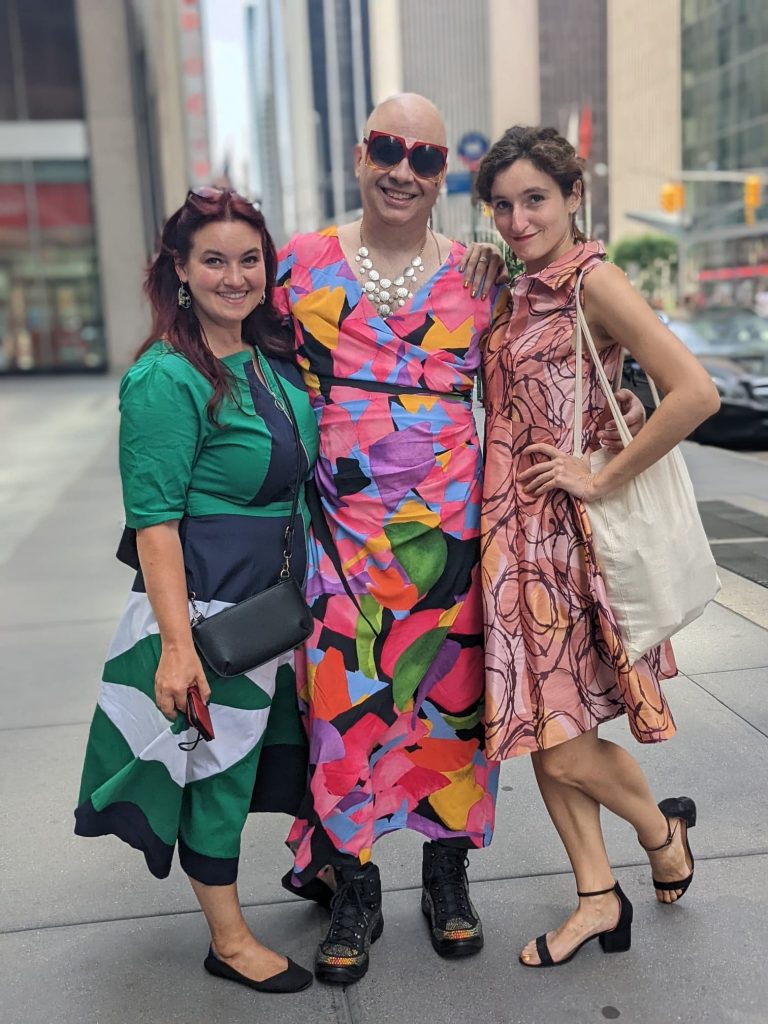
We began our nine-day 2022 Slow Art Day volunteer team retreat by visiting the site of the first test of Slow Art Day: MoMA in New York. 

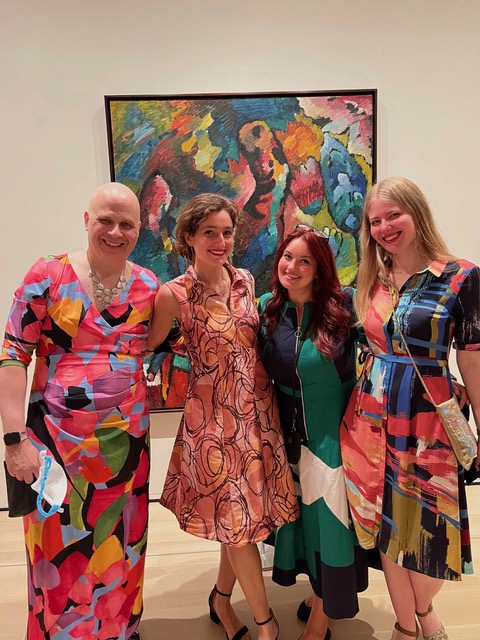
In 2009, Phyl organized four people to visit MoMA and look slowly at five artworks. 13 years and thousands of events later, they returned again with a group of four, but this time it was the dedicated Slow Art Day volunteer team with dresses to match the art. 

Ashley, Phyl and Jessica Jane on their way to MoMA. Photo taken by Johanna.

While looking slowly together in various museums, we decided to use our slow looking algorithm that can be used by small groups anytime all over the world.

Phyl first tried this in 2012 when they took three young brothers to their first art museum with a mother sure they would bounce off the walls and not look — she was shocked when they all slowed down and spent time with the art. 

Here’s how it works:

  • Assign a “selector” in each gallery
    Choose someone who will select an artwork to look at slowly.
  • Then everyone looks around for a few minutes
    While that’s happening, the selector picks their piece.
  • Look slowly at the chosen piece
    Spend 5 – 10 minutes looking together at the artwork.
  • Talk about it
    Ask: what did you see? Then don’t try to moderate. People will have a lot to say. Let them say it. In fact, this is a wonderful moment. You will get closer to each other as you learn how each other sees and thinks.
  • Move to the next gallery, choose the next selector, and repeat

That’s it. Really simple. Nothing else required. 

Further, if you do this as a group – and if you are dressed up like we were – then you’ll likely draw a crowd whenever you slow down to look at a piece of art intensively. That’s certainly what happened to us. No matter what we looked at, it became a temporary “Starry Night” or “Mona Lisa” with big crowds assembling to figure out why everyone is looking (note: this is a great way to get visitors to pay more attention to less well-known art).

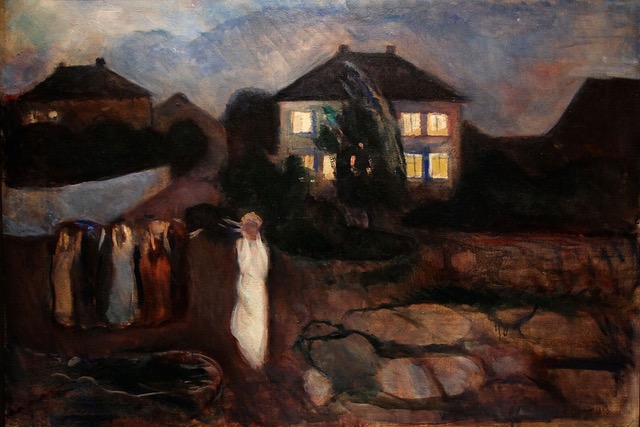
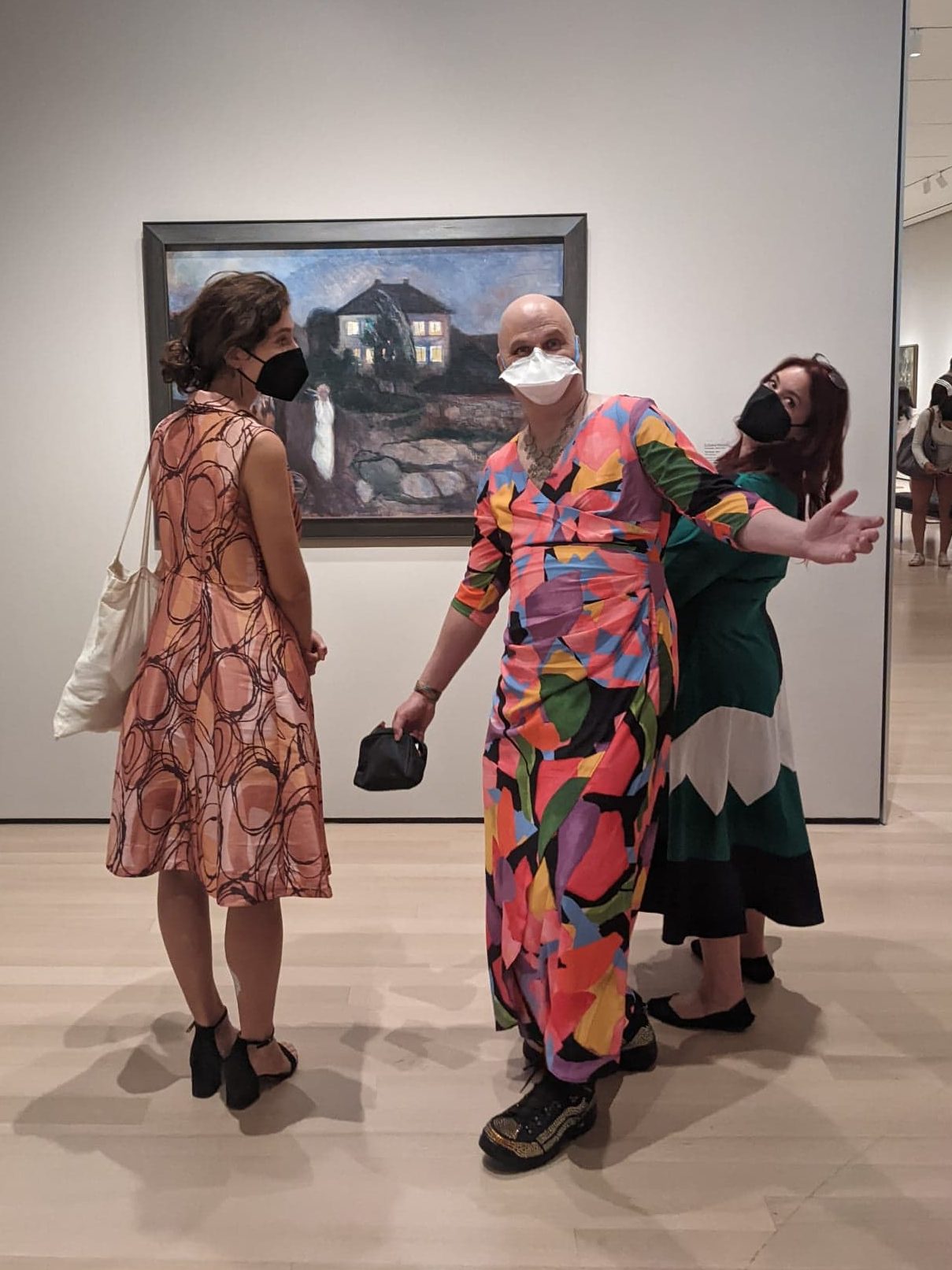
At MoMA, Johanna was the selector for the first gallery we visited. She skipped “Starry Night” and chose Edvard Munch’s “The Storm” (1893). Everyone knows Munch’s “The Scream.” Fewer know “The Storm” and we were glad to bring more attention to this terrific painting.

Edvard Munch, The Storm, 1893
Slow looking at Munch’s “The Storm” at MoMA. Photo by Johanna.

In our discussion after the slow look, we of course learned more about this artwork and more about each other. Johanna and Jessica Jane are very good close lookers. Meanwhile, Phyl is most sensitive to color, while Ashley’s eye for design picks up composition and texture. 

We finished this first session feeling more connected to each other, and to the art. 

We then moved to the next gallery, where Jessica Jane was the selector. And so it went as we slowly looked our way through MoMA, the Met, the Whitney, The Barnes Foundation (in Philadelphia), the Philadelphia Museum of Art, and Philadelphia’s Magic Gardens.  

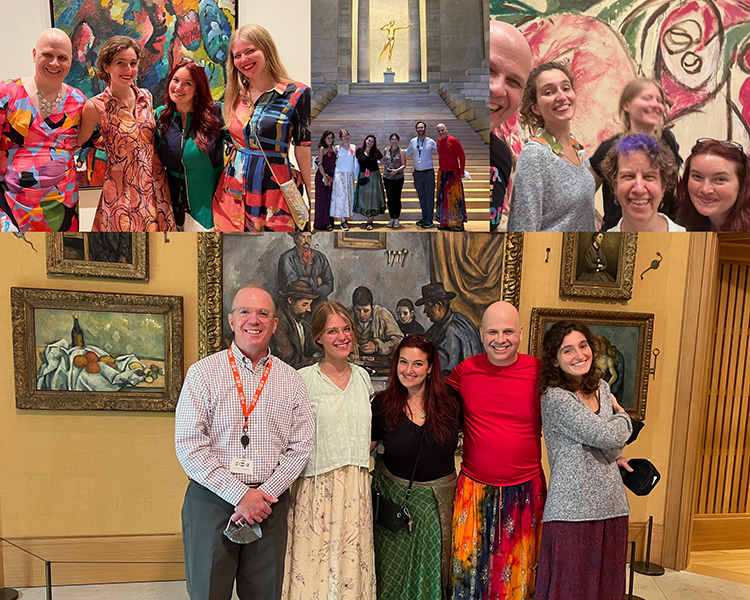
From top left – Phyl, Jessica Jane, Ashley and Johanna at MoMA; all of us with Linnea West and Greg Stuart at The Philadelphia Museum of Art; all of us with Lisa Dombrow at the Whitney Museum; and all of us with Bill Perthes at The Barnes Foundation.

Special thanks to the educators who hosted us along the way, including:

  • Bill Perthes, Director of Adult Education at The Barnes Foundation
  • Linnea West, Manager of Adult Public Programs, Philadelphia Museum of Art
  • Greg Stuart, Coordinator of Adult Public Programs, Philadelphia Museum of Art
  • Lisa Dombrow, play activist, educator, and volunteer at MoMA and AMNH (and original ‘slow looker’)

We can’t wait for our Summer 2023 Slow Art Day retreat somewhere in the world (if you want us to come visit you and your institution, then let us know!).

– Phyl, Ashley, Jessica Jane, and Johanna

Retreat with the Global Slow Art Day Team

We just finished our first ever Slow Art Day team retreat with founder Phyl Terry (U.S.) and global team members Ashley Moran (U.S.), Jessica Jane Nocella (Italy), and Johanna Bokedal (Norway). We came together in New York and Philadelphia for nine days of slow art, friendship, and fun.

We will be posting several reports highlighting our time together at:

  • MoMA (New York)
  • The Met (New York)
  • The Whitney (New York)
  • The Barnes Foundation (Philadelphia)
  • The Philadelphia Museum of Art
  • Philadelphia’s Magic Gardens

Like happens all over the world with Slow Art Day, looking slowly deepened our ability to see from multiple perspectives, to love art even more, and to create closer bonds of friendship and community with each other.

In the reports that follow, we’ll share what we saw, what we learned, and the simple slow looking algorithm we used at each venue. 

Highlights include our coordinated dresses at MoMA, our long conversation and slow looking with the Director of Education at the Barnes Foundation (and a very interesting idea he floated), and our time with the team at the Philadelphia Museum of Art. 

Phyl, Jessica Jane, Ashley, and Johanna at MoMA

We are sad to end our retreat.

The good news, though, is we are looking forward to visiting other participating Slow Art Day institutions in future years around the world. 

And, we are even beginning to put together a global Slow Art conference in 2025 in partnership with a great art museum (more on that in the next several months).

With much love,

Phyl, Ashley, Jessica Jane, and Johanna

P.S. Our longtime global coordinator Maggie Freeman, who is studying for a PhD in Islamic Art & Architecture at MIT, could not join us for this one, but we look forward to future summer retreats with her.

Slowing Down for Summer

Enuma Okoro, weekly columnist for the Financial Times, wrote a lovely article this week, The joy of living off the clock (gift link – first 20 readers to click will have access), about slowing down for summer and some of the art that reflects that.

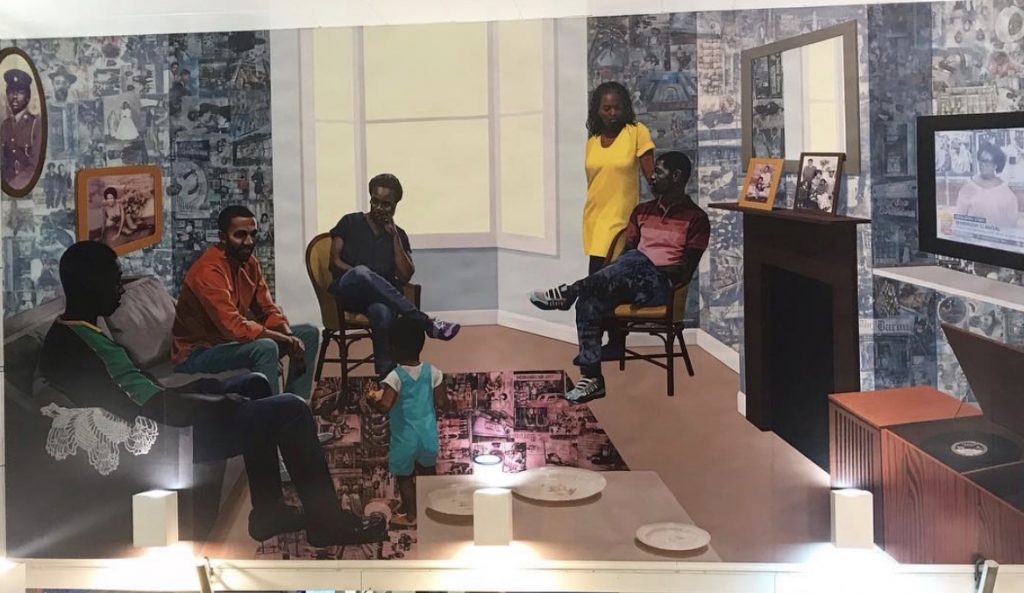
In the column, Okoro spends time with three paintings: Khari Turner’s, “Get Home Before Dark“; John Singer Sargent’s “Two Girls Fishing“, and Njdeka Akunyili Crosby’s “Remain, Thriving.”

In looking slowly at these paintings, Okoro combines her life experience, her work as a curator, her knowledge of art history, and her good eye.

Njdeka Akunyili Crosby’s Remain, Thriving (at Brixton tube station in England)

Enjoy her article.

Meanwhile, the Slow Art Day volunteer team is beginning the process of writing up the reports from this year’s event. We will begin publishing soon and through the autumn. Be patient with us as we slowly work our way through all of your great work.

Hope you are having a good and slow May.

Phyl

P.S. The Slow Art Day HQ team will be slowing down this summer *together*! For the first time, we’ll meet in person (we work via Zoom across continents) and slowly look at art in New York and Philadelphia. We’ll share more about our plans soon in case you want to join us.