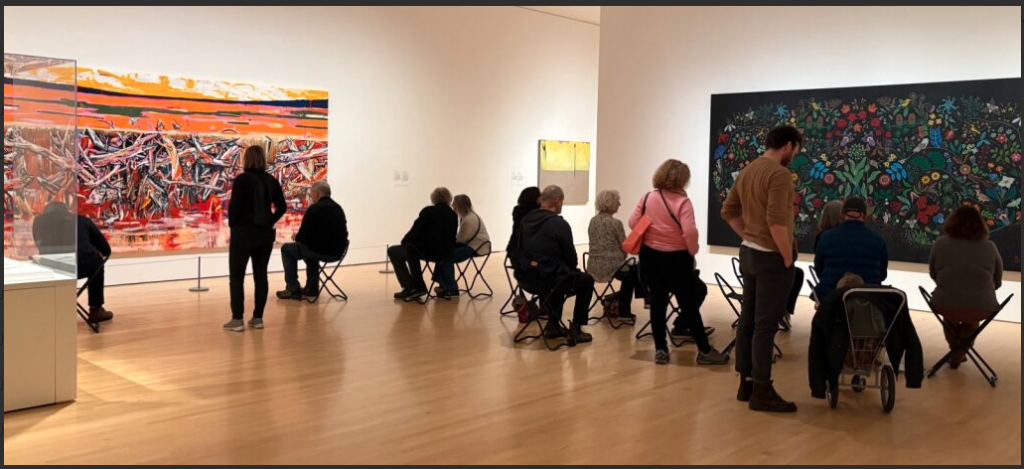
Participants during guided slow looking at the National Gallery of Canada. Photo courtesy of the National Gallery of Canada.
Educator Andrea Gumpert reported that in-person participants were led in both English and French through 2 hour-long sessions by Interpreter-Guides Morel McMaster and Juliana Abramo. Each session began with a brief warm-up and an introduction to the purpose of slowing down with art. Participants then spent five minutes seated with an artwork of their choosing, followed by a group discussion. They repeated the exercise with a different artwork in another gallery, this time extending the observation period.
One of the core philosophies of Slow Art Day is that if you spend a few minutes with a piece of art, then even if you “don’t like it”, you still build a relationship with it and that often means you go deeper than “like or don’t like.”
This experience is repeated thousands of times around the world and was certainly present in Ottawa for Slow Art Day.
In fact, during the first exercise, one participant shared with Juliana that they “didn’t like the painting they chose at first but ended up really appreciating it towards the end,” highlighting how slow looking can shift perception.
Practically speaking, all visitors received a bilingual handout encouraging them to “Slow Down. Reflect. Discover. Engage.”
Based on positive visitor feedback from last year’s Slow Art Day, the Gallery has also introduced monthly Guided Slow Looking Sundays, held on the last Sunday of each month. This warms out heart given that one of our core objectives is to inspire year-round programming.
We extend our appreciation to Andrea Gumpert, Morel McMaster, Juliana Abramo, and the entire National Gallery team for their ongoing commitment to slow-looking experiences. We look forward to their continued participation next year.
– Ashley, Johanna, Jessica Jane, and Phyl
P.S. Explore the National Gallery of Canada’s programs on Facebook and Instagram.
The National Gallery of Canada in Ottawa, one of the largest museums in North America, hosted its first Slow Art Day in 2023, with a simple design: participants were invited to look slowly at art in two rooms of the gallery before discussing their experiences together.
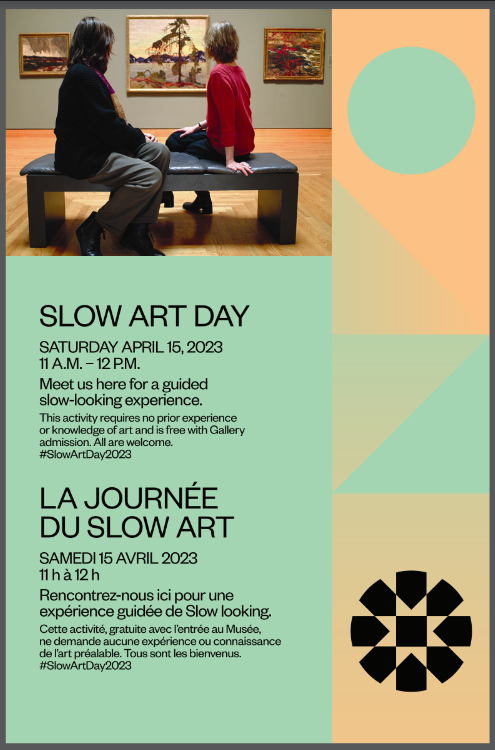
Slow Art Day poster. National Gallery of Canada
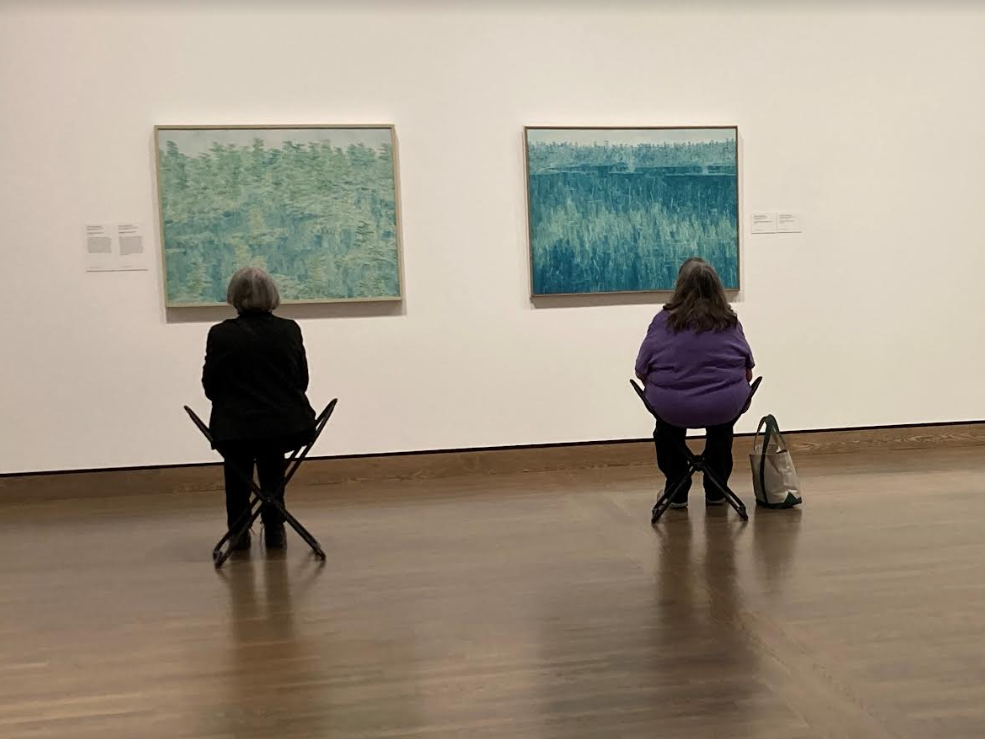
Slow Art Day participants at the National Gallery of Canada, 2023. Featured artworks: Kazuo Nakamura, Landscape, Spring, 1959. Oil on masonite, 93.6 x 121.5 cm; Kazuo Nakamura, August, Morning Reflections, 1961. Oil on canvas, 93.7 x 121.5 cm. Both paintings are located at the National Gallery of Canada, Ottawa. Respectively purchased in 1960 and 1961. Photos: NGC
On April 15, educator Andrea Gumpert and interpreter Valérie Mercier greeted English and French speaking participants in the Great Hall. After a quick grounding exercise and a collective slow looking warm up, participants were taken to two different galleries for their slow looking. They were given a few prompts to keep in mind during each session, including choosing to read or ignore the artwork labels.
Participants were first invited to select a piece in a gallery with only figurative works (Indigenous and Canadian Galleries – A110). They spent 10 minutes looking at their chosen artworks before sharing thoughts.
This was repeated for 15 minutes in a different gallery with a variety of figurative and abstract paintings and Inuit sculptures (Indigenous and Canadian Galleries – A112). After the second session, participants compared experiences from each gallery.
In the sharing sessions, participants remarked that their impressions of the works grew more nuanced as they spent time with them. Some found themselves asking questions about painting techniques or of the artist’s life. Two participants in the French speaking group requested to spend time with Riopelle’s Pavane, and enjoyed the exchange so much that they decided to lunch together afterwards despite not knowing each other beforehand.
In addition to the public group experience, the Gallery also suggested that participants participate on their own or watch the guided slow look of Rembrandt’s Heroine via a video produced by the museum. Several people on social media commented positively about Slow Art Day, and others wrote to the Gallery asking if the exercise would be repeated. A few staff also suggested the approach be offered on an ongoing basis.
The slow looking event was first tested in staff sessions at the Gallery in March prior to the public event in April. Andrea and Valérie ran the program with staff to 1) offer a team building exercise, and 2) test their approach and work out any kinks ahead of the public program. The staff loved it and later answered a survey, including this note from Dina Groulx, Corporate Relations Officer:
I genuinely enjoyed every minute of the tour […]. What a treat it was for me to have experienced that. As a remote employee, it felt very impactful. I really wasn’t sure what to expect when I signed up, but I was so glad to have invested time out of my day for myself. I also thought of how lucky I was as an employee to have had access to the quietness of the space (most of the time) and I realized that as the pilot took place on Monday, it created a calm retreat experience. It was so nice to go through that experience with colleagues outside of my regular work and made connections with them and with the art in a way that I had never experienced before.
Dina Groulx, Corporate Relations Officer
Taking inspiration from the National Gallery of Canada, we strongly recommend that other museums and galleries imitate what they have done and run slow looking sessions with their staff.
Note that the National Gallery of Canada also ran an effective marketing campaign. Their Slow Art Day event was featured in an article by Chelsea Osmond in the National Gallery of Canada Magazine and advertised on local radio stations. The Gallery also promoted the event via social media posts and in their monthly newsletter.
We are so glad the National Gallery of Canada has joined the Slow Art Day movement, and we look forward to the creative design they come up with for 2024.
-Johanna, Ashley, Jessica Jane, and Phyl
P.S. Take a look at these concluding remarks from educator Andrea Gumpert:
“Participation in the Slow Art Day requires little preparation, links the Gallery to a broader global movement and aligns directly with the Strategic Plan. The approach also benefits visitors by reported reduction in stress levels, improved concentration levels and a better ability to foster empathy. As the participants in the Gallery’s Slow Art Day expressed, slow and careful looking helps to unravel complexity, build connections and see things from multiple perspectives. Finally, since slow looking is inclusive: everyone can take part and no prior knowledge is required. For those who want to practice slow looking with art, no art historical knowledge is required giving confidence in one’s own abilities to visit a museum and to understand works of art for oneself. The Gallery is ideally placed to continue the annual Slow Art Day event and might consider further opportunities to host slow looking programs for the public as well as the staff.”
Andrea Gumpert, educator at the National Gallery of Canada