For their 8th Slow Art Day, the Art Gallery of Ontario (AGO), one of the largest art museums in North America, invited participants to join one of two slow looking offerings with the AGO collection: either by designing their own slow looking tour, or by joining a guided tour.
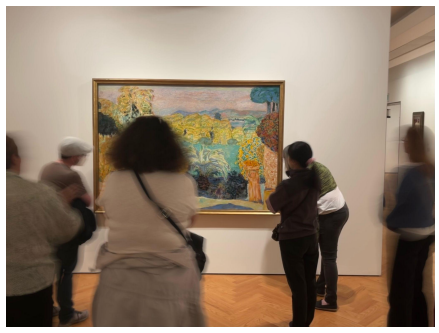
Participants engaging with “Paysage du Midi et deux enfants” by Pierre Bonard (note the slow motion captured in each of the photos from AGO)
For the guided tour, one of the AGO’s art educators asked participants to look at three artworks:
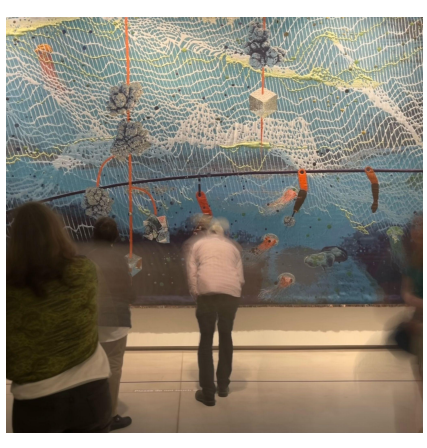
Participants engaging with “Unearthed – Midnight” by Otobong Nkang
AGO curator Mellisa Smith reported that the post-looking conversation gained momentum through the tour as people became more comfortable sharing. This was a function of the trust participants built with each other as they experienced the act of looking at the art through each other’s eyes.
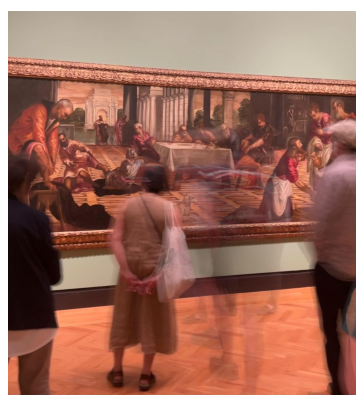
For the final session of the guided tour, the AGO hosts asked participants to wander slowly across the entire length of Tintoretto’s painting, “Christ Washing His Disciples’ Feet.” Specifically, they asked observers to pay attention to a trick with perspective that occurs with this painting. When viewed from the side as one slowly walks its length, Tintoretto’s painting seems to emphasize the gaze of the disciples towards Jesus, thus focusing the viewer on his status as the main subject. This is truly a painting which needs to be seen slowly.
Participants slow looking at (and moving around) “Christ Washing His Disciples’ Feet” by Tintoretto
When asked if they would do anything differently next year, the AGO told us two things:
In the future, they hope to try a more densely curated space, and investigate how participants are able to center themselves in a more chaotic space.
They would like to also avoid choosing artwork with in-depth wall texts, as visitors couldn’t help but to read the labels (understandable!)
We encourage art educators and curators to listen to an episode of the CBC Commotion podcast series hosted by Elamin Abdelmahmoud and featuring AGO curator Melissa Smith – Slow Art Day and the value of lingering. Smith mentions a point that we always like to reinforce about slow looking: it is about building your own meaning with a piece, and you don’t have to have any prior knowledge of art or the piece to do that. Yes! That indeed is the power of slow looking.
We really appreciate the Art Gallery of Ontario’s long-term commitment to Slow Art Day, and can’t wait to see what they come up with for Slow Art Day 2024.
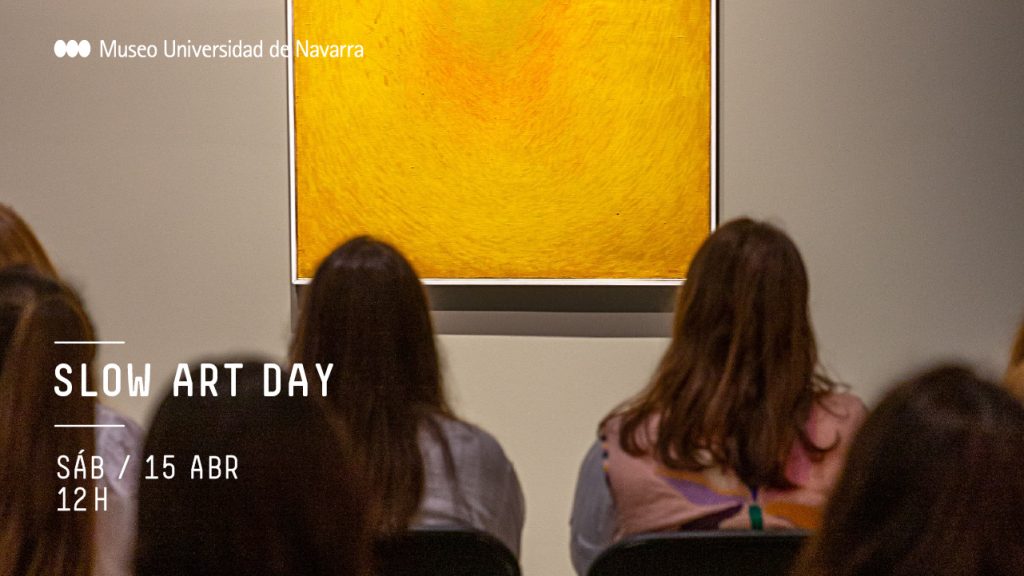
For their first Slow Art Day, the Museo Universidad de Navarra, in the heart of Pamplona, Spain, invited participants to look slowly at three contemporary works for art:
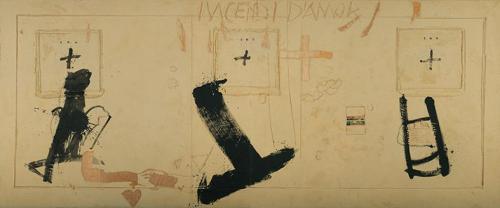
“Incendi” (1991), by Antoni Tàpies
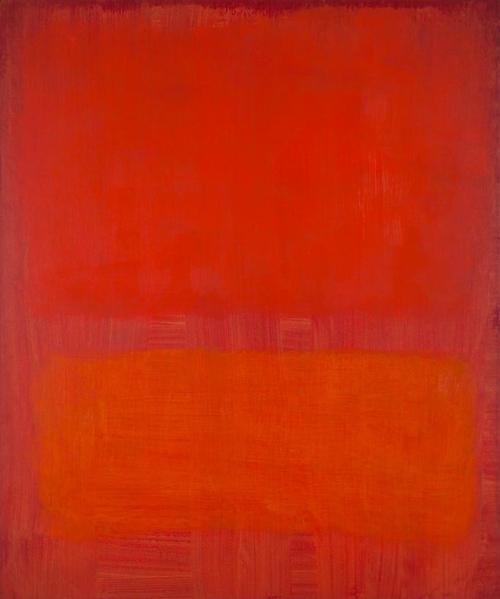
“Untitled” (1969), by Mark Rothko
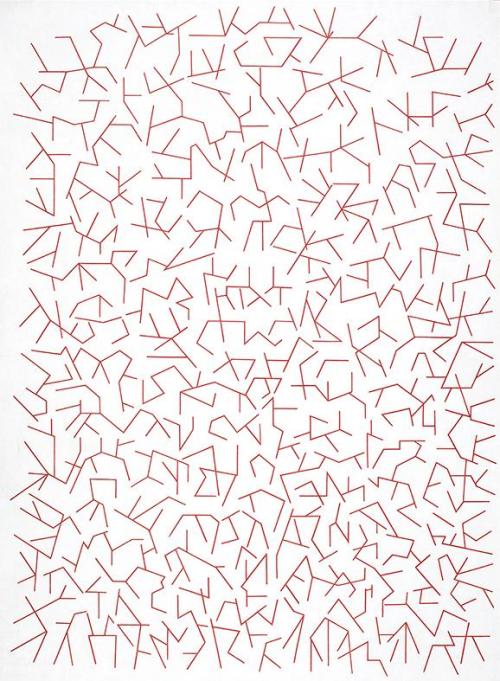
“El número y las aguas I” (1978), by Pablo Palazuelo
Antoni Tàpies. 1991. Incendi. 251 x 603
“Untitled” (1969), by Mark Rothko.“El número y las aguas I” (1978), by Pablo Palazuelo.Slow Art Day at the Museo Universidad de Navarra
The museum offered free tickets, which sold out in a couple of days – slow looking is in demand around the world!
The team at the museum reported that participants were excited to look slowly, share their impressions, and see through each other’s eyes.
Importantly, the museum itself enjoyed hosting their first Slow Art Day and plans to participate again next year. We look forward to seeing what they come up with for 2024.
The National Gallery of Canada in Ottawa, one of the largest museums in North America, hosted its first Slow Art Day in 2023, with a simple design: participants were invited to look slowly at art in two rooms of the gallery before discussing their experiences together.
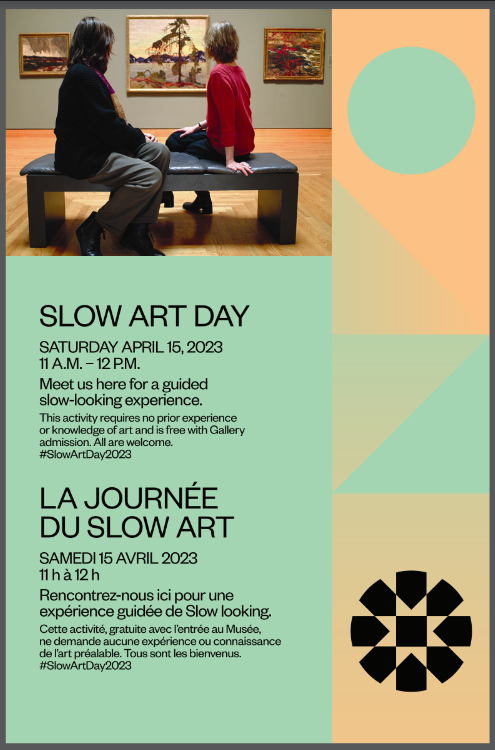
Slow Art Day poster. National Gallery of Canada
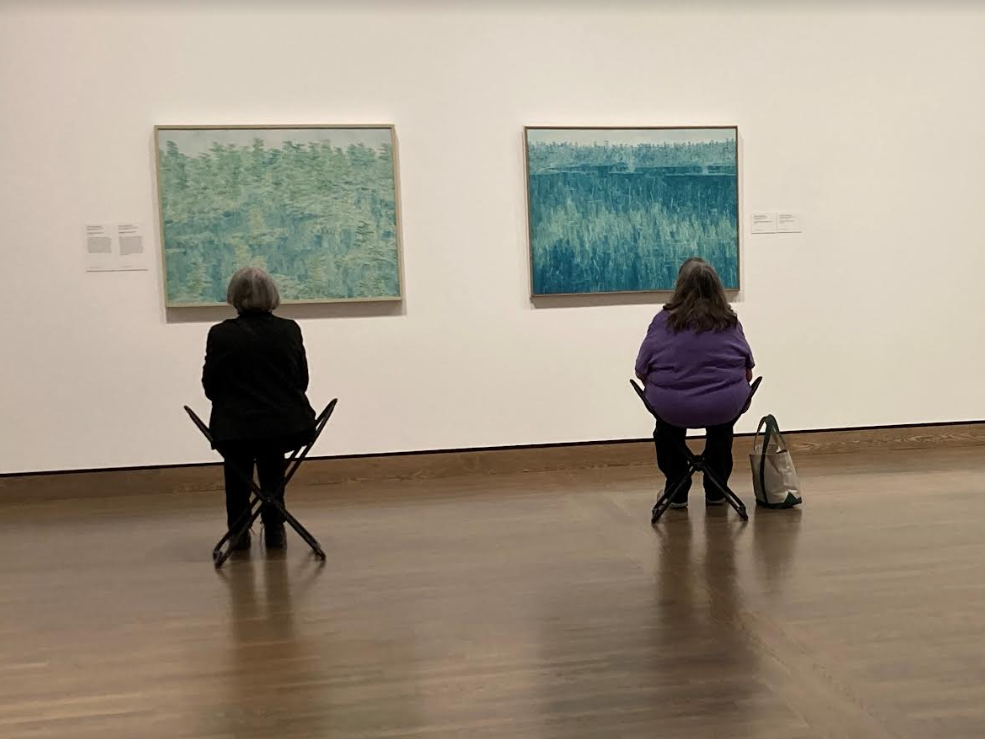
Slow Art Day participants at the National Gallery of Canada, 2023. Featured artworks: Kazuo Nakamura, Landscape, Spring, 1959. Oil on masonite, 93.6 x 121.5 cm; Kazuo Nakamura, August, Morning Reflections, 1961. Oil on canvas, 93.7 x 121.5 cm. Both paintings are located at the National Gallery of Canada, Ottawa. Respectively purchased in 1960 and 1961. Photos: NGC
On April 15, educator Andrea Gumpert and interpreter Valérie Mercier greeted English and French speaking participants in the Great Hall. After a quick grounding exercise and a collective slow looking warm up, participants were taken to two different galleries for their slow looking. They were given a few prompts to keep in mind during each session, including choosing to read or ignore the artwork labels.
Participants were first invited to select a piece in a gallery with only figurative works (Indigenous and Canadian Galleries – A110). They spent 10 minutes looking at their chosen artworks before sharing thoughts.
This was repeated for 15 minutes in a different gallery with a variety of figurative and abstract paintings and Inuit sculptures (Indigenous and Canadian Galleries – A112). After the second session, participants compared experiences from each gallery.
In the sharing sessions, participants remarked that their impressions of the works grew more nuanced as they spent time with them. Some found themselves asking questions about painting techniques or of the artist’s life. Two participants in the French speaking group requested to spend time with Riopelle’s Pavane, and enjoyed the exchange so much that they decided to lunch together afterwards despite not knowing each other beforehand.
In addition to the public group experience, the Gallery also suggested that participants participate on their own or watch the guided slow look of Rembrandt’s Heroine via a video produced by the museum. Several people on social media commented positively about Slow Art Day, and others wrote to the Gallery asking if the exercise would be repeated. A few staff also suggested the approach be offered on an ongoing basis.
The slow looking event was first tested in staff sessions at the Gallery in March prior to the public event in April. Andrea and Valérie ran the program with staff to 1) offer a team building exercise, and 2) test their approach and work out any kinks ahead of the public program. The staff loved it and later answered a survey, including this note from Dina Groulx, Corporate Relations Officer:
I genuinely enjoyed every minute of the tour […]. What a treat it was for me to have experienced that. As a remote employee, it felt very impactful. I really wasn’t sure what to expect when I signed up, but I was so glad to have invested time out of my day for myself. I also thought of how lucky I was as an employee to have had access to the quietness of the space (most of the time) and I realized that as the pilot took place on Monday, it created a calm retreat experience. It was so nice to go through that experience with colleagues outside of my regular work and made connections with them and with the art in a way that I had never experienced before.
Dina Groulx, Corporate Relations Officer
Taking inspiration from the National Gallery of Canada, we strongly recommend that other museums and galleries imitate what they have done and run slow looking sessions with their staff.
Note that the National Gallery of Canada also ran an effective marketing campaign. Their Slow Art Day event was featured in an article by Chelsea Osmond in the National Gallery of Canada Magazine and advertised on local radio stations. The Gallery also promoted the event via social media posts and in their monthly newsletter.
We are so glad the National Gallery of Canada has joined the Slow Art Day movement, and we look forward to the creative design they come up with for 2024.
-Johanna, Ashley, Jessica Jane, and Phyl
P.S. Take a look at these concluding remarks from educator Andrea Gumpert:
“Participation in the Slow Art Day requires little preparation, links the Gallery to a broader global movement and aligns directly with the Strategic Plan. The approach also benefits visitors by reported reduction in stress levels, improved concentration levels and a better ability to foster empathy. As the participants in the Gallery’s Slow Art Day expressed, slow and careful looking helps to unravel complexity, build connections and see things from multiple perspectives. Finally, since slow looking is inclusive: everyone can take part and no prior knowledge is required. For those who want to practice slow looking with art, no art historical knowledge is required giving confidence in one’s own abilities to visit a museum and to understand works of art for oneself. The Gallery is ideally placed to continue the annual Slow Art Day event and might consider further opportunities to host slow looking programs for the public as well as the staff.”
Andrea Gumpert, educator at the National Gallery of Canada
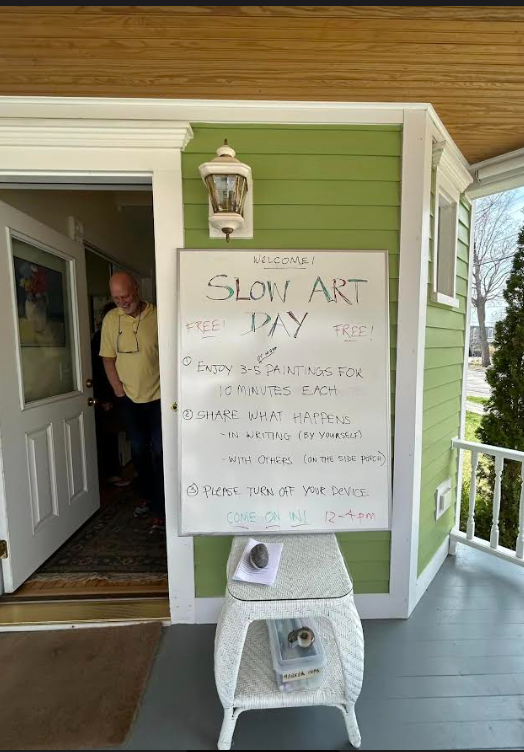
For their first Slow Art Day, Ellie Harold Studio and Gallery in Frankfort, Michigan, a small town of 1,500, hosted a slow looking event from 12 – 4 pm in her home-based venue. One of the things we love about Slow Art Day is that it happens in national museums, regional museums, movie theaters, and even local home-based galleries.
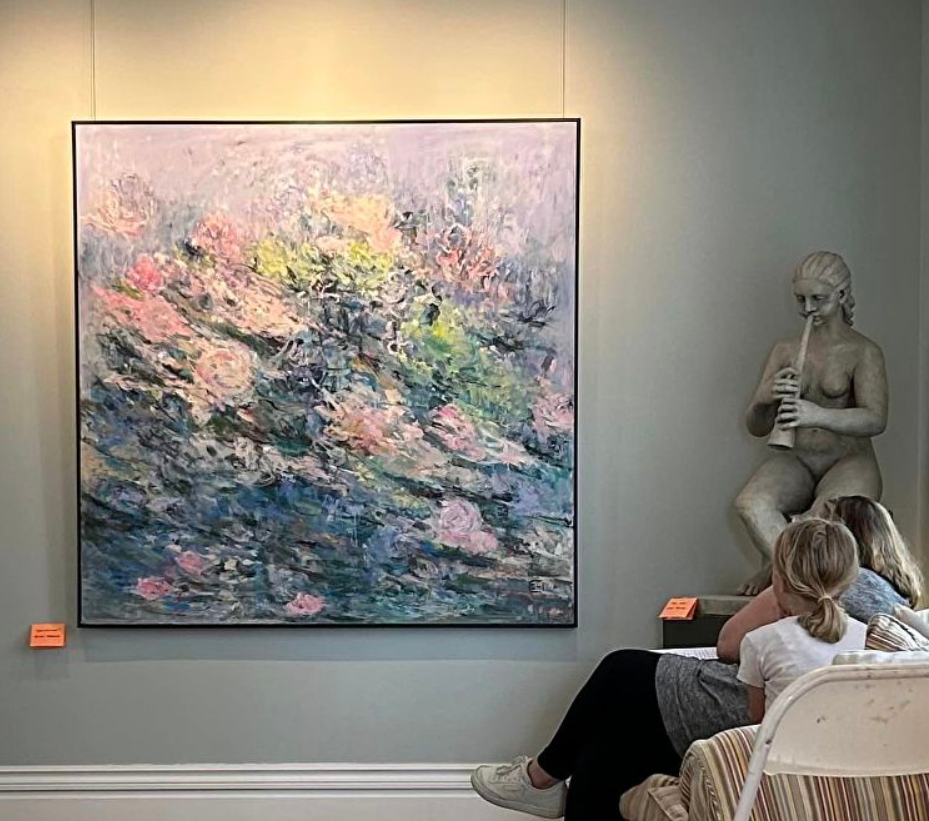
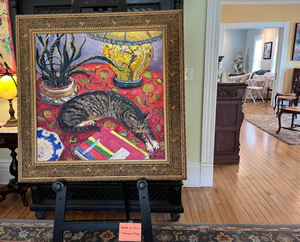
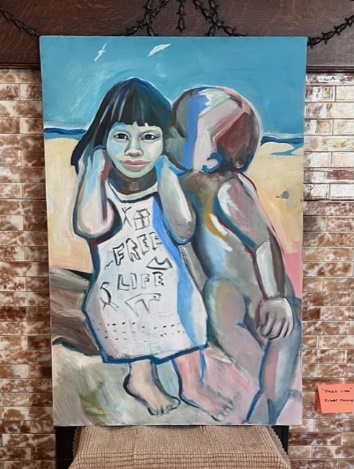
On April 15, Ellie Harold displayed a variety of paintings from her private collection, one large painting of her own, and a sculpture.
Photo courtesy of Carol Lautenbach.
Photo courtesy of Carol Lautenbach.
Photo courtesy of Carol Lautenbach.
Photo courtesy of Carol Lautenbach.
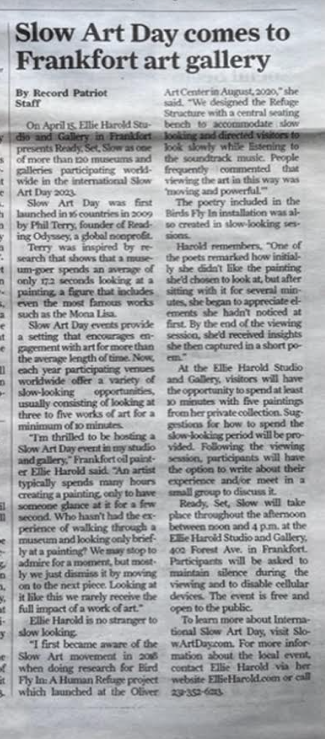
The whole town embraced this first Slow Art Day in Frankfort. Not only did a large group of people come out to view the Slow Art Day, but the local paper, Benzie County Record Patriot, also ran a substantial article.
For the event itself, the gallery handed each participant a sheet with suggestions for slow looking and a blank space and pen for writing down notes:
SUGGESTIONS FOR SLOW LOOKING
Gaze at a spot and let it reveal itself to you.
How do the colors make you feel?
Look at details.
Follow a path through the painting with your eyes.
Find different textures in the painting.
What comes forward and what recedes?
Does the painting take you up, down, or all around?
Look for rhythm or pattern.
Where in the painting do your eyes want to rest?
Does the painting have a message for you?
What else do you notice?
Most participants took 45 minutes to 1 hour to look at the pieces. Since the event took place in Ellie’s home, there was more artwork on display than what was selected specifically for the event, and some visitors chose to look slowly at those as well. During the event, Ellie walked around and discussed the experience with participants. She also later published a blog post: “Slow Art Day: Taking Time to Gaze.”
“Everyone reported having a positive experience and said that the exercise would change how they view art in museums going forward.”
Ellie Harold, Gallery and Studio owner
As we noted, we are always happy to see Slow Art Day being embraced by towns and institutions of all sizes and scale around the world. We welcome Ellie Harold Studio and Gallery to the Slow Art Day community, and look forward to their event next year, which will expand to include several artists.
For their first Slow Art Day, Sigmund Freud University and the Staatliche Museen zu Berlin in Berlin, which comprises seventeen museums in five clusters, jointly sponsored a Slow Art event hosted by Master’s students in Art Therapy Naira Bloss and Ulla Utasch.
The museum complex invited visitors to pre-register for one of two 150-minute long workshops held on April 15th:
WORKSHOP 1: The New Museum / Neues Museum. 9.30 a.m. -12.00 p.m.
WORKSHOP 2: The Old Museum / Altes Museum. 2:30 p.m. – 5:00 p.m.
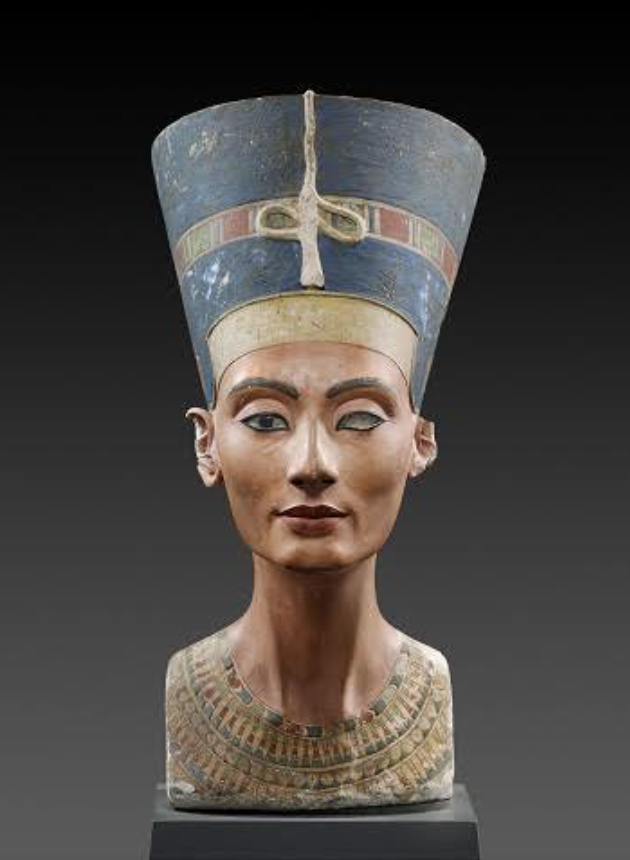
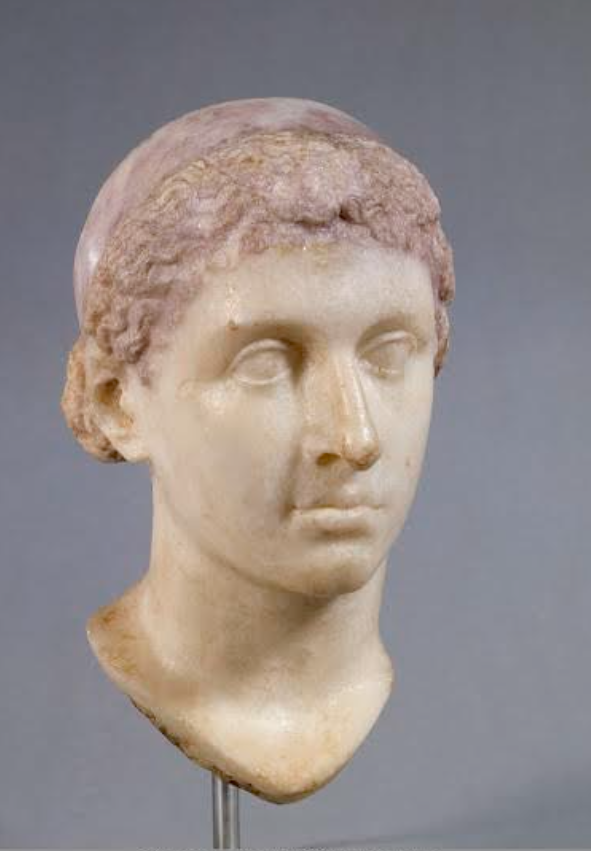
Each session opened with a guided relaxation exercise, followed by slow looking at the busts of Queen Nefertiti (workshop 1) and Queen Cleopatra (workshop 2). Afterwards, the hosts facilitated in-depth discussions.
Bust of Queen Nefertiti c. 1353 and 1336 BC. | National Museums in Berlin | Egyptian Museum with Papyrus Collection | Sandra Steiß
Portrait of Cleopatra around 50-38 B.C. | National Museums in Berlin | Collection of Classical Antiquities | Johannes Laurentius
The sessions concluded with a slow drawing exercise, where the hosts asked each participant to create a design inspired by their experience in the museum, and reflecting on the impact of Slow Looking at art on their mental health.
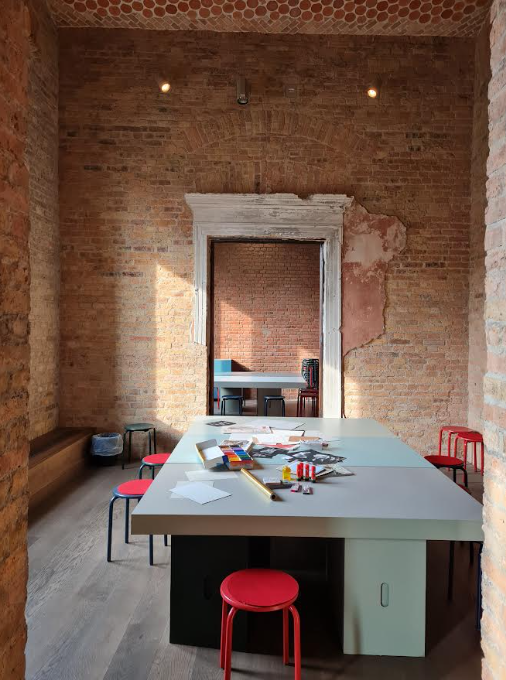
Workshop at the New Museum.
At Slow Art Day HQ, we are so happy to welcome the Staatliche Museen zu Berlin, and its seventeen museums, to the slow looking movement. We also want to thank Prof. Dr. Georg Franzen, Professorship for Psychotherapy Science and Applied Art Psychology at the Sigmund Freud University for supervising his students Naira and Ulla.
We look forward to what the Staatliche Museen zu Berlin comes up with for Slow Art Day 2024.
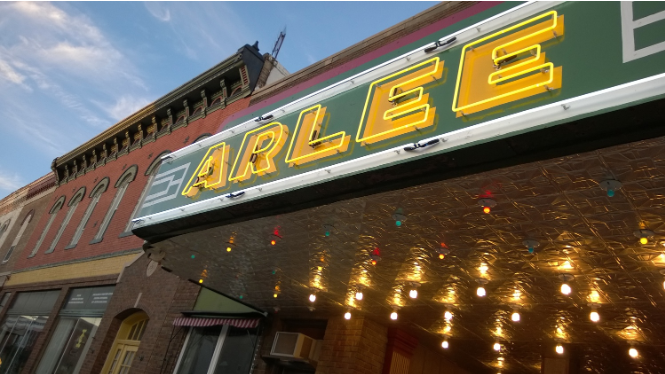
Arlee Theater in Mason City, Illinois, a locally-owned and operated art deco movie theater, which relies on volunteers to stay open, hosted its first Slow Art Day (and the first one we know of in a movie theater – wow!) with great success.
Exterior of the Arlee Theater in Mason City. The photo is from the Arlee website.
Ahead of the event, local residents were invited to submit an artwork to be considered for a slow looking session to be held on the big screen.
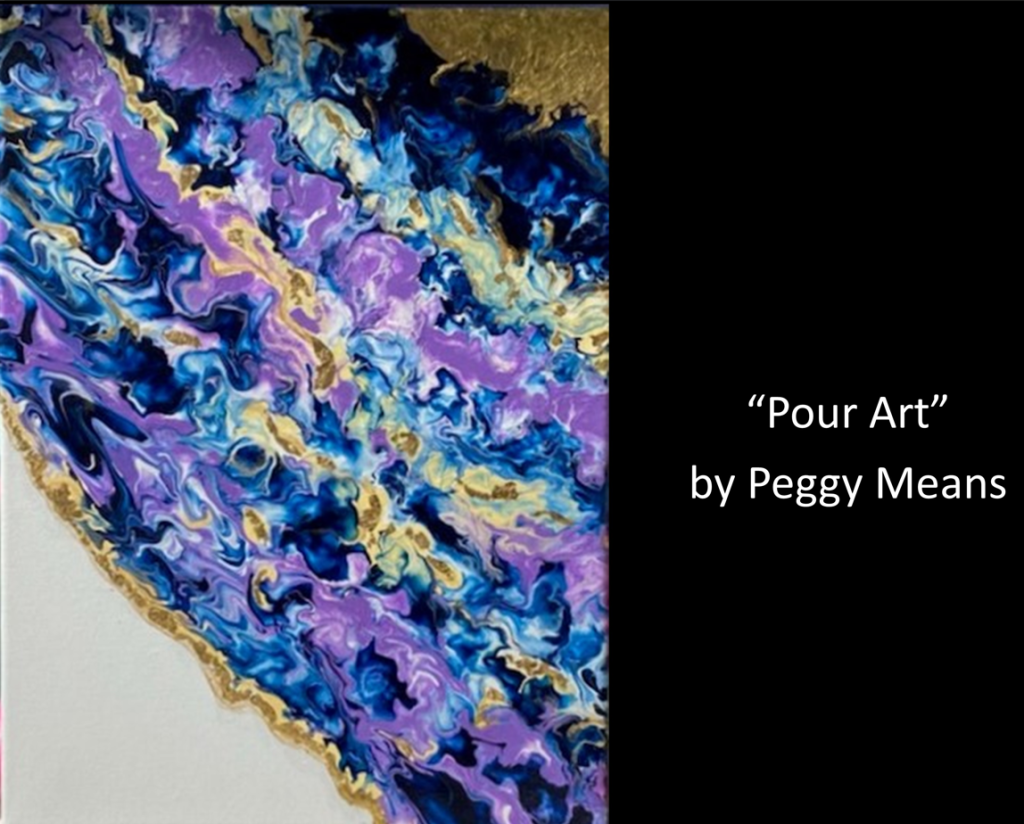
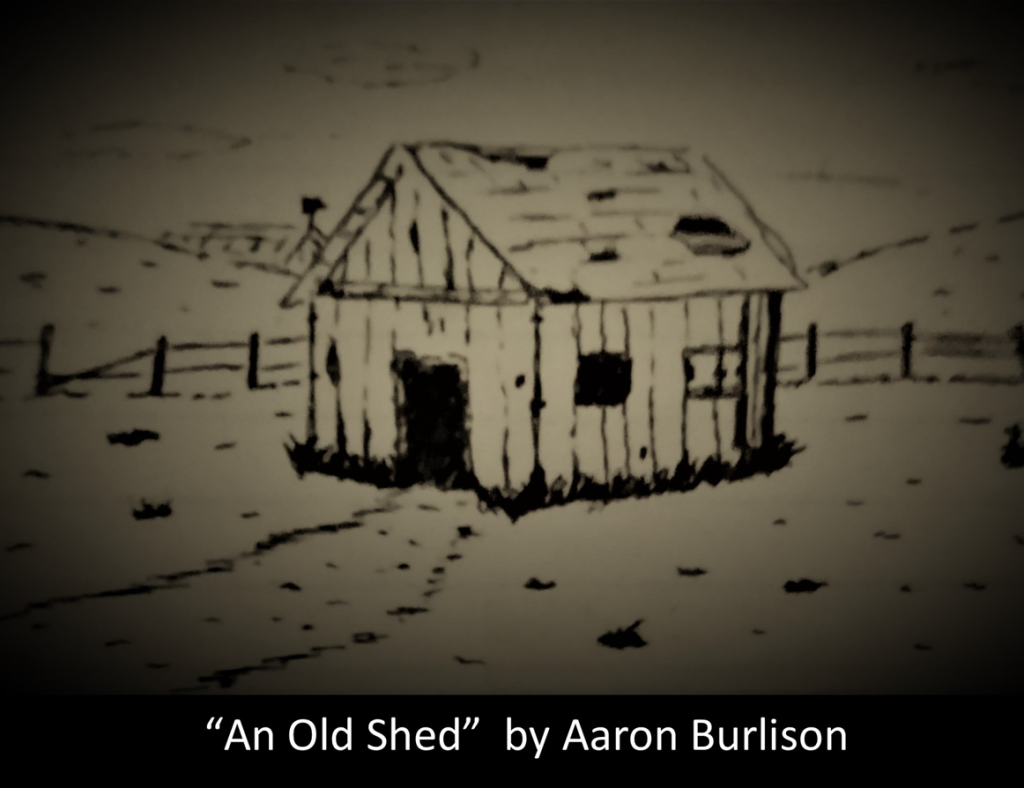
Arlee’s volunteer crew selected five artworks (out of the overall twenty that were submitted) to be shown for five minutes each before Saturday night’s movie screening. These replaced the normal pre-show advertisements, and were accompanied by brief contextual information about Slow Art Day to help orient people arriving at different times. You can view the five works below.
Following the event, a timed video of the artworks was uploaded to the Arlee website and Facebook page so people could participate at home as well.
Marcia Maxson Schwartz, who is an Arlee board member and volunteer, reported that they received a lot of positive feedback, including from visitors who rarely go to museums or galleries. In fact, by bringing art into the movie theater, Arlee is showing all of us how to bring art into the lives of *many* more people.
Further, Schwartz and her volunteer team hope to use this year’s success to create a citywide Slow Art Day in Mason next year.
“While we only had a couple of days to get things together, our team considers it a success and is looking forward to next year – we’ve even started the ball rolling with a store owner and the town’s librarian to coordinate events across this little town next year.”
Marcia Maxaon Schwartz
At Slow Art Day HQ, we love the pioneering efforts of the Arlee Theater and hope they start a movement of movie theaters around the world showing art slowly.
We also love the mix of kinds of institutions that are now participating in Slow Art Day – major national museums, regional and university museums, galleries, outdoor sculpture parks, avant garde art spaces, and local movie theaters in small towns. Hurray!
Art needs to be slowly seen *everywhere* and we thank the volunteers at Arlee for innovating a new way to reach more people.
We eagerly anticipate what Arlee and the town of Mason, which may host a citywide Slow Art Day in 2024, come up with for next year.