Wow. Constanza Ontiveros Valdés — an art writer and cultural project leader – has done it again, but bigger and better.
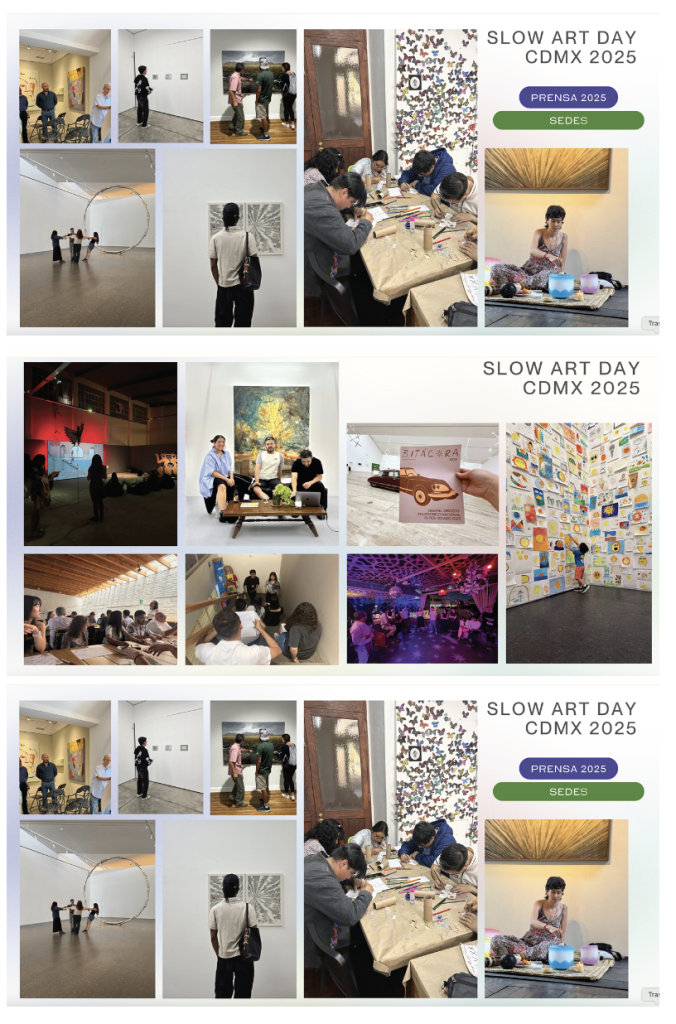
For the second citywide Slow Art Day in Mexico City on April 11, 2026, Ontiveros Valdés has organized more than 50 museums, galleries, artist studios, and independent cultural spaces. She and her volunteer team have also created a website just for their citywide. Photos below are part of their impressive site.
Participating institutions include museums such as Museo del Palacio de Bellas Artes, Museo Vivo del Muralismo and Museo Archivo de la Fotografía, as well as galleries, artist studios, and cultural spaces across the city. Each venue will organize its own program — ranging from guided slow-looking sessions and conversations to workshops and informal gatherings.
As noted, the Mexico City initiative continues to be led by Ontiveros Valdés. This year, she is supported by three enthusiastic and talented volunteers: Alejandra Sánchez Catalán, Shalom Hernández Espinosa, and Rebeca Rosales Reyes, whose collaboration has been key to the project’s expansion.
The initiative is further strengthened by the support of GAMA (Galerías de Arte Mexicanas Asociadas), a network of leading contemporary art galleries in Mexico, and by the cultural platform Artists’ Container, founded by curator and producer Gabriela Andrade Gorab, which fosters collaboration and visibility across artistic communities.
This is a remarkable initiative and is definitely one path for the future of Slow Art Day. We now have two committed citywide organizers – one in Illinois and now one in Mexico City. We hope that more emerge inspired by the success of the efforts of Ontiveros Valdés and her team.
With love and sequins,
Phyl, Ashley, Jessica Jane, Johanna, and Maggie (the Slow Art Day core volunteer team)
P.S. Below are the participating venues:
· ALDO ISLAS ESTUDIO · ALEJANDRA TOPETE GALLERY · ALMANAQUE · AMPLIA GALERIA · ARRÓNIZ ARTE CONTEMPORÁNEO · ARTE ABIERTO · CAM GALERÍA · CASA ENNEA · ENCARTE · ETHRA GALERÍA · ESTUDIO LA DALIA · ESTUDIO MARTE · FIERA ARTE NO DOMESTICADO · FUNDACION TTAMAYO · GALERÍA ANDREA POZZO, IBERO · GALERÍA CAMPECHE · GALERIA CLAROSCURO · GALERÍA HILARIO GALGUERA · GALERIA KAREN HUBER · GALERIA RGR · KÖNIG GALERIE · KURIMANZUTTO · LAGO ALGO · LE LABORATOIRE · LUAN MUSEO EMOCIONAL · LS GALERÍA · MARIANE IBRAHIM GALLERY · MISFIT ART ALLIANCE · MUSEO ARCHIVO DE LA FOTOGRAFÍA · MUSEO CASA DE CARRANZA · MUSEO DEL PALACIO DE BELLAS ARTES · MUSEO SOUMAYA · MUSEO TAMAYO ARTE CONTEMPORÁNEO · MUSEO VIVO DEL MURALISMO · OMR · PATRICIA CONDE GALERÍA · PEANA · PLAYA ESCANDÓN · PROYECTO PARALELO · PROYECTO N.A.S.A.L · SAENGER GALERÍA · STUDIO MITOTE · TALLER CRISTINA TORRES · TERRENO BALDÍO · THIRD BORN · ART TRIGGERIA (HAAB PROJECT CONDESA) · TINTA NARANJA GALERÍA · YUNQUE FÁBRICA DE ARTE · ZONA DE RIESGO
In 2025, Mexico City hosted its first city-wide Slow Art Day – and what may be the largest city-wide in the world – with 35 participating venues, coordinated by art writer and cultural organizer Constanza Ontiveros Valdés.
Ontiveros Valdés organized an unexpectedly wide range of participants, from established museums and galleries to alternative and emerging cultural spaces across the city.
The venues offered a rich mix of programming, including yoga, meditation, aromatherapy, workshops, panel discussions, and multidisciplinary artistic happenings. She noted that the accessibility and inclusiveness of Slow Art Day encouraged participation across diverse spaces, all eager to explore slow looking in ways that felt authentic to their communities.
We received reports from seven of the 35. Below are those highlights.
Galería Oscar Román featured an artist-led conversation titled “Sombras del Pintor” (Shadows of the Painter) with artist Saúl Kaminer, followed by a guided visit to his exhibition “La Tierra en el Cielo” (The Earth in the Sky). Kaminer shared insights into his creative process and the narratives behind his work, inviting participants to engage slowly through conversation and close observation. The session encouraged reflection on the relationship between art and nature, with visitors spending extended time discussing individual works.
Arte Abierto Reported by: Guadalupe Salcedo, Communications
Arte Abierto‘s Public Programs Team designed a Slow Art Day experience around the exhibition long last happy by Swiss artist Ugo Rondinone. Participants engaged in contemplative observation of the large format sculptures the sun and the moon (2022), followed by individual and group body activations inspired by dance and performance. The program invited participants to explore the idea of opposing forces through both stillness and body movement. Adults and children took part, and the event received significant public and media engagement.
Host: Constanza Ontiveros Valdés, Art Writer and Cultural Projects Coordinator Venue contact: Julia Villaseñor, Communications and Media Director
At kurimanzutto, participants were introduced to Slow Art Day through breathing and relaxation exercises before engaging in close looking with works by Haegue Yang from the exhibition Arcane Abstractions. The group explored intricate paper collages from the Mesmerizing Mesh series and interacted physically with the sculptural installation Mesmerizing Votive Pagoda Lantern. The session concluded with a hands-on activity in which participants created visual responses to their observations and shared reflections.
Natalia Martinez Aanaya, Communications Manager shared that Alejandra Topete Gallery participated with Between Threads and Stories, featuring works by Jason Kriegler and Claribel Calderius. The program included individual meditation sessions throughout the day and an empowering roundtable discussion led by Maria Ortiz, Cultural Mediator. Visitors were encouraged to form personal connections with the artworks through guided dialogue and slow observation.
Naranjo 141 gathered participants to look slowly at five selected works from their current exhibition. The session began with a brief introduction to Slow Art Day and the gallery’s residency program. Visitors then spent six to seven minutes in silent observation with each of five selected works:
Lily Alice Baker, Mothers’ Meeting (2024)
Colleen Herman, Blood Bloom in a Blue Field (2024)
Lee Maxey, Face the Front (2024)
Kataria Riesing, Holster (2024)
Pauline Shaw, Blackout (2025)
After slow looking, participants came together for a facilitated group discussion, sharing observations and personal responses over light refreshments. The session concluded with informal conversation and continued engagement with the exhibition.
Lee Maxey, Face the Front (2024)Lily Alice Baker, Mothers’ Meeting (2024)
Tinta Naranja focused on close observation of graphic design and visual culture. Participants explored original materials related to the Mexico 1968 Olympic design system, discussing the origins and historical context of the typography and imagery. The session concluded with a participatory activity in which attendees designed their own names using Olympic-inspired typographic forms.
Zona de Riesgo Art hosted a free evening program that combined slow looking, guided meditation, sound art, and collective reflection. The event opened with a brief introduction, then featured two guided meditative experiences led by artist Mónica Martz M.
The first, Realm of the Devas, combined guided meditation with sound art by Bruno Bresani and the projection of two visual works by Mónica Martz M.
After a short pause, Mónica Martz M. led a second meditation that explored The Human Realm, accompanied by sound art from Mercedes Balard and Montserrat Coltello, alongside projected works by Bruno Bresani.
Following the meditations, participants gathered for an open conversation, sharing sensations, images, and reflections that emerged during the experience. The evening concluded with expressions of gratitude among artists and attendees, highlighting the value of creating spaces for stillness, contemplation, and shared presence.
Together, these seven reports represent just a portion of the 35 venues that participated in Mexico City’s first citywide Slow Art Day. The range of formats—artist talks, guided observation, movement-based practices, meditation, and slow making—demonstrates how Slow Art Day can scale across a major global city while remaining grounded in local artistic practice. Check out a great article summarizing the day (in Spanish).
We thank Constanza Ontiveros Valdés for her leadership and all participating venues, artists, facilitators, and visitors for making this inaugural citywide Slow Art Day possible. We look forward to seeing what they come up with for Slow Art Day 2026.