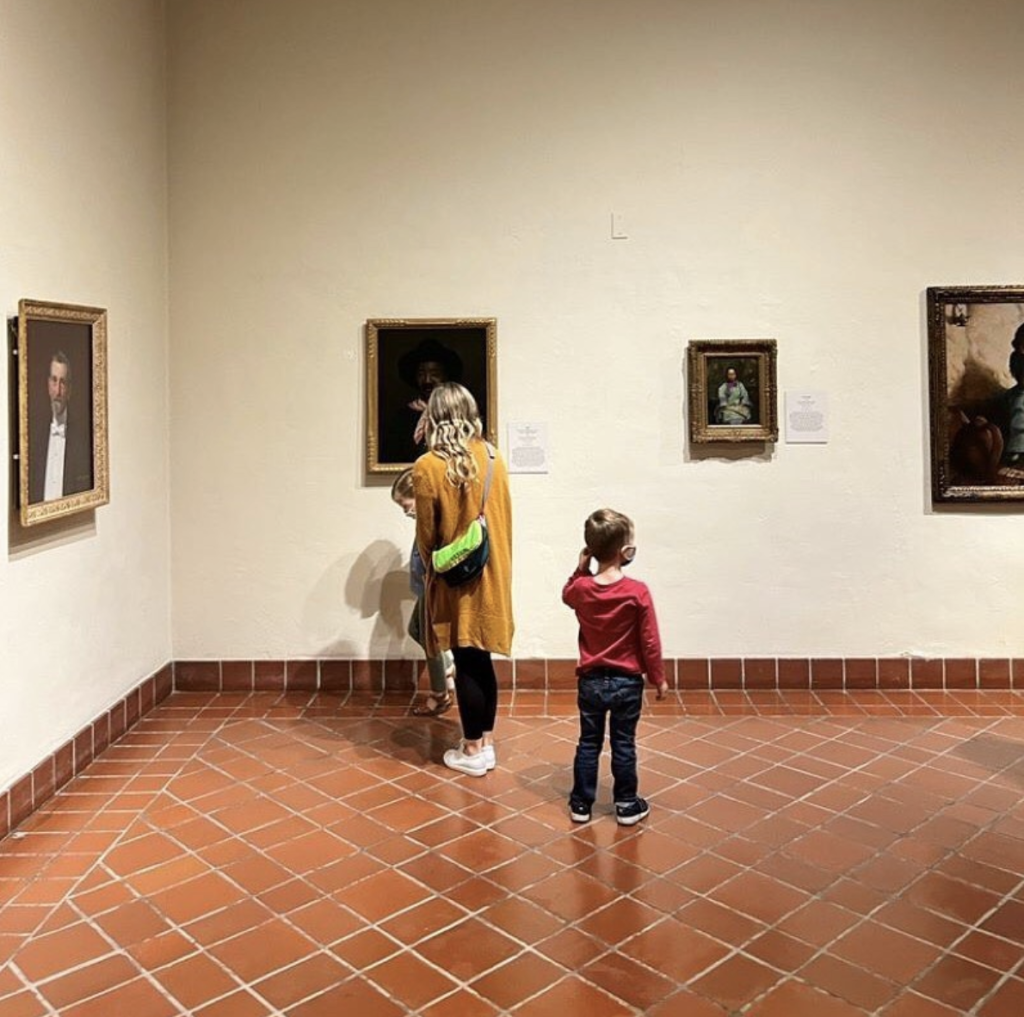
The Bowers Museum in Santa Ana, California ran their second Slow Art Day, where they invited museum visitors to join them in the galleries of California Bounty.
Opened in 2016, this permanent exhibit takes visitors through a “rambling journey” of California’s visual history – a “history shaped by a unique mixture of Mexican and Anglo traditions as well as the state’s position on the Pacific Rim.”
Photo credit: Bowers Museum Instagram page for Slow Art Day
For Slow Art Day, The Bowers Museum replaced their normal public tours with two special Slow Art tours and advertised them as being held in conjunction with Slow Art Day; including links and an explanation about the day. Docents guided visitors in closer looking at select paintings from the historic California collection.
VP of External Affairs Kelly Bishop hosted Slow Art Day. We’ll note that Bishop previously worked at SF MoMA, which has been a longtime participant in Slow Art Day.
We can’t wait to see what Bishop and this important California museum come up with for Slow Art Day 2023.
Led by Director of Education, Philipp Malzl along with student educators Joseph Rowley, Susannah Kearon, Sophie Houghton, Kate Daily, and Alexa Ginn, the social media-based event encouraged viewers to slow down the fast pace of internet/social meldia viewing and contemplate a work of art for 60 seconds or more.
YouTube videos were created highlighting works on display at the museum, and prizes were offered for commenting on each video. Each of the five videos is below:
Some of the comments received include: “I definitely am the type to often rush through art museums and only stop to look at paintings that I have seen before. Once I stopped to look at this for longer I realized just how liminal the composition is, and how much darker it felt when I just spent time with it for a moment. Super cool!”
“I love this series of 60-second videos! It is meditative to watch. My daughters are watching them with me now. One daughter noticed the vertical lines of the figure and the basketball hoop, and how if you turned the painting upside down, those lines would still be in similar places. The other daughter noticed that the basketball hoop was a tin can with the bottom cut out.”
The Brigham Young University Museum of Art hosts slow looking tours on a quarterly basis, in addition to having a printed slow looking guide available year-round at the information desk.
We look forward to seeing what they come up with for Slow Art Day 2023.
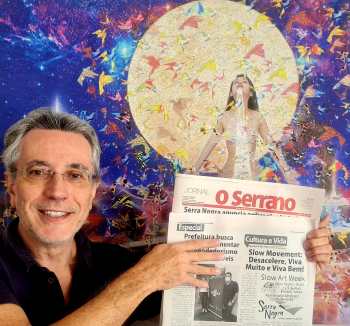
For their third year, the Sociedade Das Artes in Serra Negra, Brazil held a hybrid Slow Art Week, hosted by artist Henrique Vieira Filho. The Sociedade Das Artes features works by contemporary artists, along with artistic services and products.
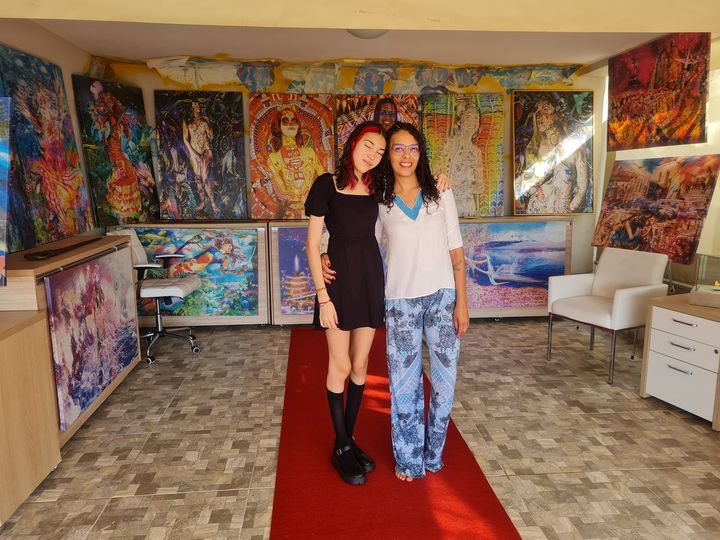
Exploring the theme of “Slow Down, Live Long, and Live Well,” the gallery allowed for four visitors at a time and each visitor chose which works of art they wanted to appreciate slowly (note: the gallery asked that visitors RSVP ahead of their visit to secure a time to attend).
Visitors in the gallery space.
Henrique Vieira Filho wrote, as part of the day, “Living at a fast pace certainly has a certain charm (“live fast, die young”), however, I think the alternative is much more interesting: slow down, live a lot, and live well! The Slow Art Movement advocates the experience of time with greater QUALITY for everything and everyone.”
We couldn’t agree more.
Online advertisementHenrique Vieira Filho holding a copy of O Serrano with an article about Slow Art.
The event was advertised online (see above) and there was also an article written in the local press (also see above).
Visit Google Drive or Facebook to view a video that was created to allow people to explore the exhibit virtually.
We love their focus for 2022 and look forward to seeing what they come up with for next year.
Best,
– Robin, Ashley, Phyl, Johanna, and Jessica Jane
P.S. The Sociedade Das Artes can be found on Instagram and Facebook.
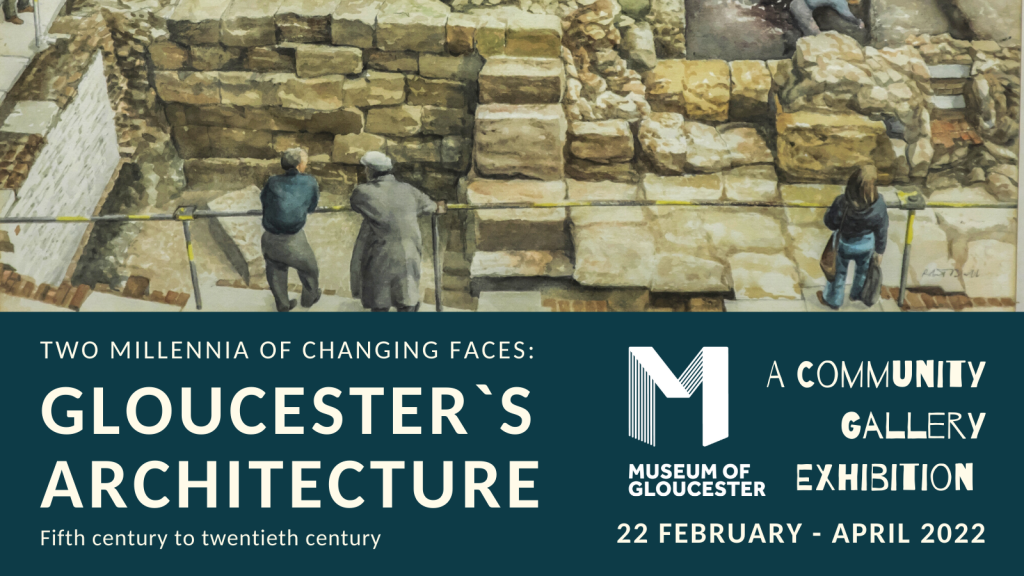
Flyer of the exhibition “Two Millenia of Changing Faces: Gloucester’s Architecture.”
For the event, visitors were encouraged to slow down and look closely at each piece for 5-10 minutes so that they could ponder how architecture has inspired and shaped stories of Gloucester’s people, culture and industry.
At Slow Art Day HQ we look forward to their next year’s event!
For their third Slow Art Day, Sweden’s Gothenburg Museum of Art hosted a meditation session in their exhibition Barbro Östlihn. New York Imprint, featuring renowned post-war Swedish artist, Barbro Östlihn, who was friends with several US-based artists such as Robert Rauschenberg, Frank Stella, Claes Oldenburg, and Roy Lichtenstein.
Linda Noreen, program coordinator, organized the event, while the meditation was lead by Lars Hain, who has 25 years of leading meditation workshops.
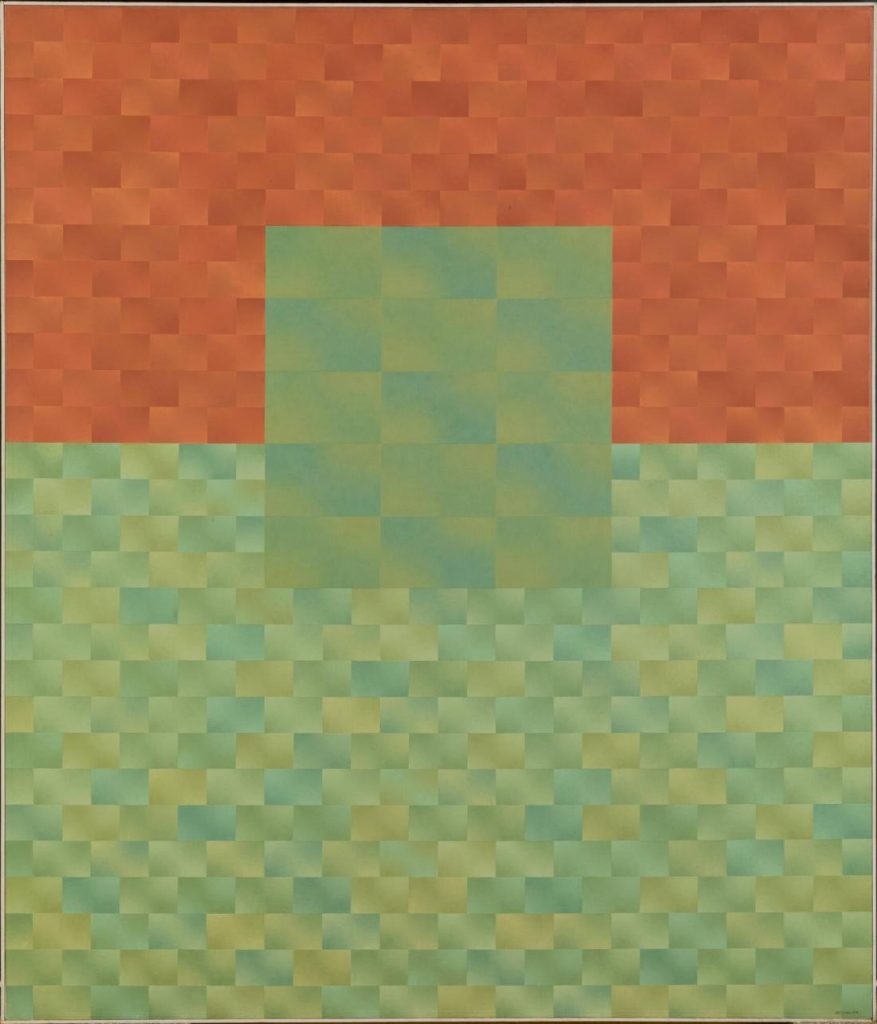
IMG_1444: Barbro Östlihn (1930-1995) Suffolk Street Wall, 1972 Oil on canvas Moderna Museet, Stockholm. Donation 1994 from Anders Lönnqvist, Stockholm.
Once they arrived at the museum, participants were taken to the Barbro Östlihn exhibit, invited to sit down on chairs and cushions, and then led through a meditative slow looking experience.
We’ll note that mixing meditation and slow looking is not new to Gothenburg Museum of Art.
In fact, as part of Slow Art Day 2021, they created a meditative video guide on how to slow down with art (in Swedish), while the museum was forced to close due to the pandemic. If you are a speaker of a Scandinavian language, we recommend viewing the video below for inspiration.
We at Slow Art Day HQ love the mixing of meditation and slow looking and especially appreciate that Gothenburg Museum of Art provided soft chairs and cushions (sounds really comfortable – every museum needs to do this!).
We look forward to seeing what Gothenburg Museum of Art comes up with for their 4th Slow Art Day in 2023.
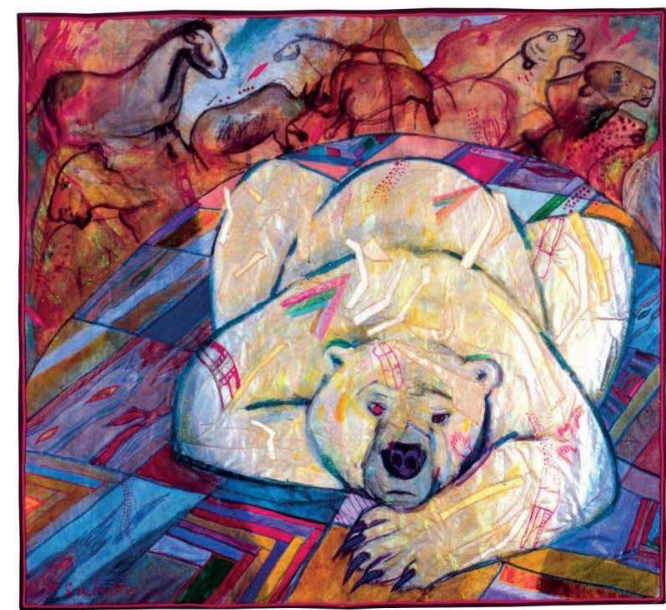
For their third Slow Art Day, the Missoula Art Museum (MAM) in Montana organized an in-person event encouraging participants to focus on Nancy Erickson’s (1935-2022) Hall of Memory #10: Guard Bear.
Nancy Erickson. 1999. Hall of Memory #10: Guard Bear.
Interestingly, to help guests slowly engage with this one work of art, they set up a small “maker station” in the gallery space with a 5-minute timer, worksheet, prompts, and materials for guests to create their own artworks.
Below is an explanatory video they put together for guests.
We recommend that educators and curators throughout the slow looking movement take a look at this video and think about how to integrate art making into their 2023 Slow Art Day.
MAM Slow Art Day 2022 explanatory video
We at Slow Art Day HQ, are excited to see art making brought into slow looking and would like to thank Educator & Outreach Specialist Cameron Decker and his team for organizing this event.
We look forward to what they come up with for Slow Art Day 2023.
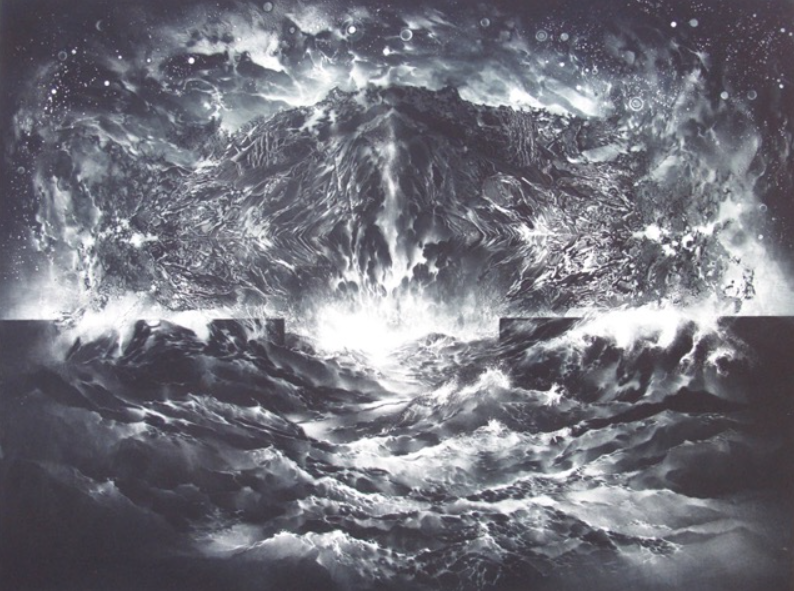
For their first Slow Art Day, Galleri Pictor in Munka-Ljungby, Sweden, hosted an in-person slow looking event with visiting art students from Munka folkhögskola.
André Bongibolt, Les 1000 soleils entrevus (64 x 83 cm), mezzotint on paper. Read more.
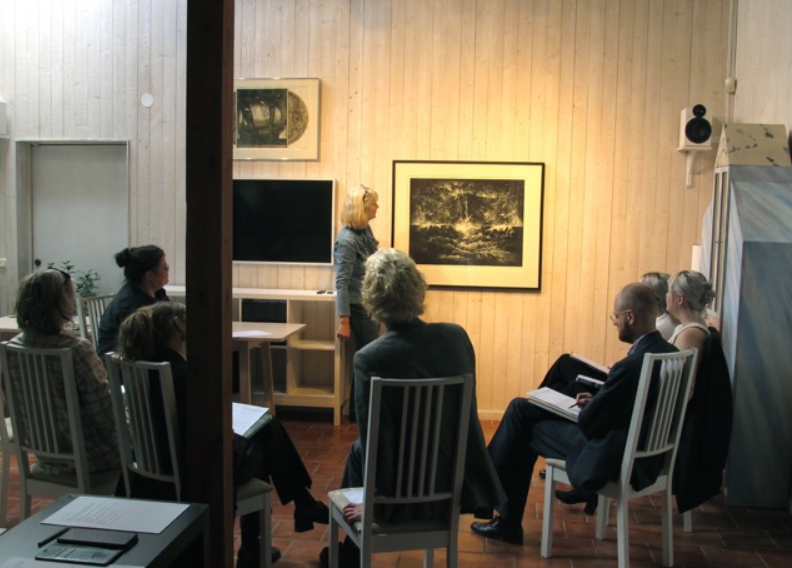
Participants looking at the artwork by André Bongibolt. Photo courtsey of Galleri Pictor.
On Slow Art Day, the group gathered in a gallery and sat in a half circle in front of a picture by André Bongibolt. They started with relaxing their bodies and minds for a moment before looking slowly at the artwork. Participants were also given a document with slow looking instructions in Swedish, viewable below.
Following this, all participants wrote their thoughts and observations and shared them back with the group. To round off the event, participants reflected on their slow looking experience over a cup of tea and cookies (or ‘biscuits’ as they sometimes say in Europe).
Reflecting on the event, Charlotte Fällman Gleissner shared the following with us:
Even as a gallerist, I seldom give myself time to really see the artwork in a deeper sense – therefore this was a new experience for me too. Further, I now understand how flexible slow-looking is and how it can be used with different kinds of groups in a range of settings. This is wonderful. Thank You!
Charlotte Fällman Gleissner
We at Slow Art Day HQ are excited that Galleri Pictor has joined the slow art movement – and, in fact, we now believe that all slow looking events should end with tea and cookies. That is certainly a best practice!
– Johanna, Phyl, Ashley, Jessica and Robin
PS: Stay in touch with other events at Galleri Pictor via their Instagram
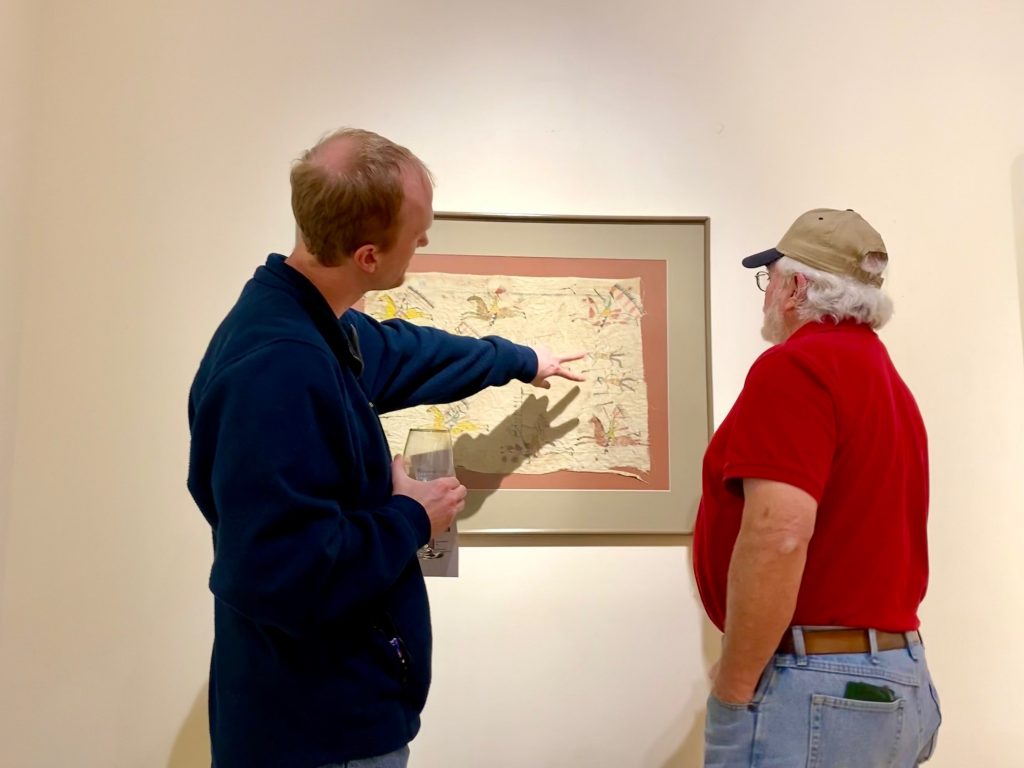
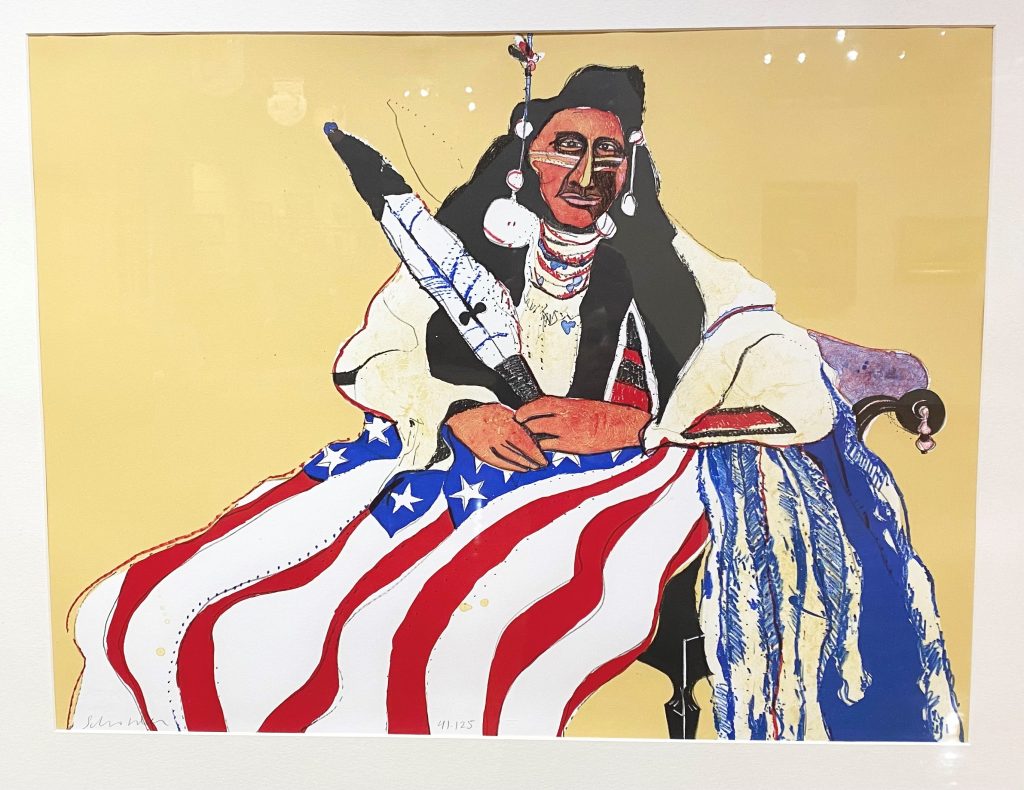
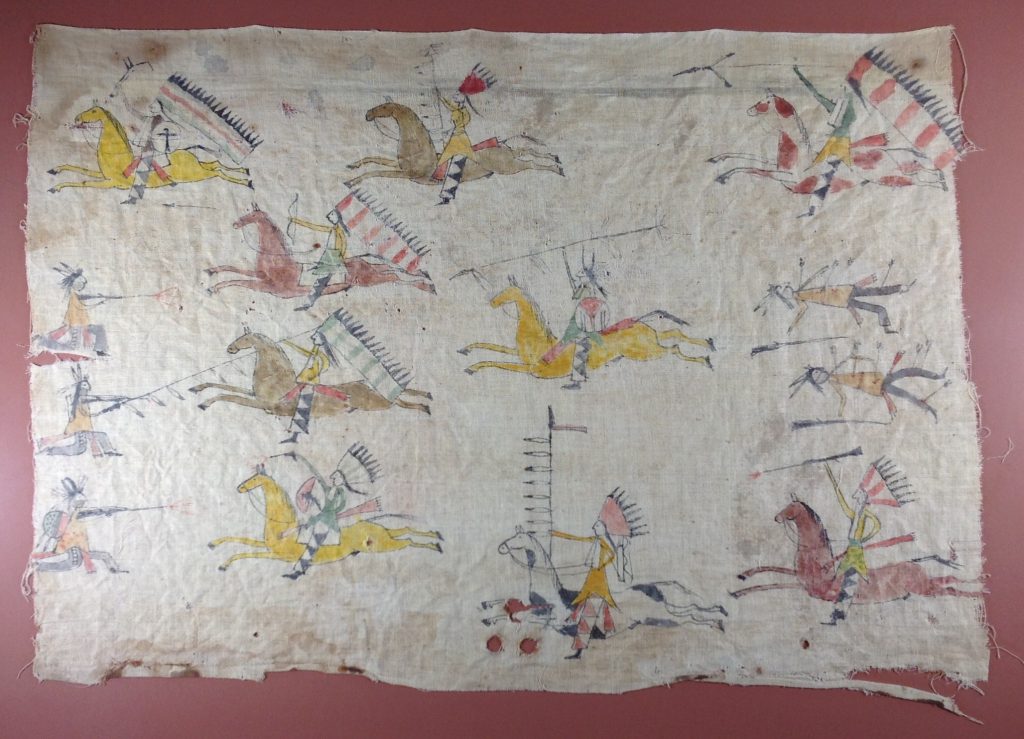
Slow Art Day participants Ethan and Rick looking at War Party Pictograph by Unknown Sioux Artist.
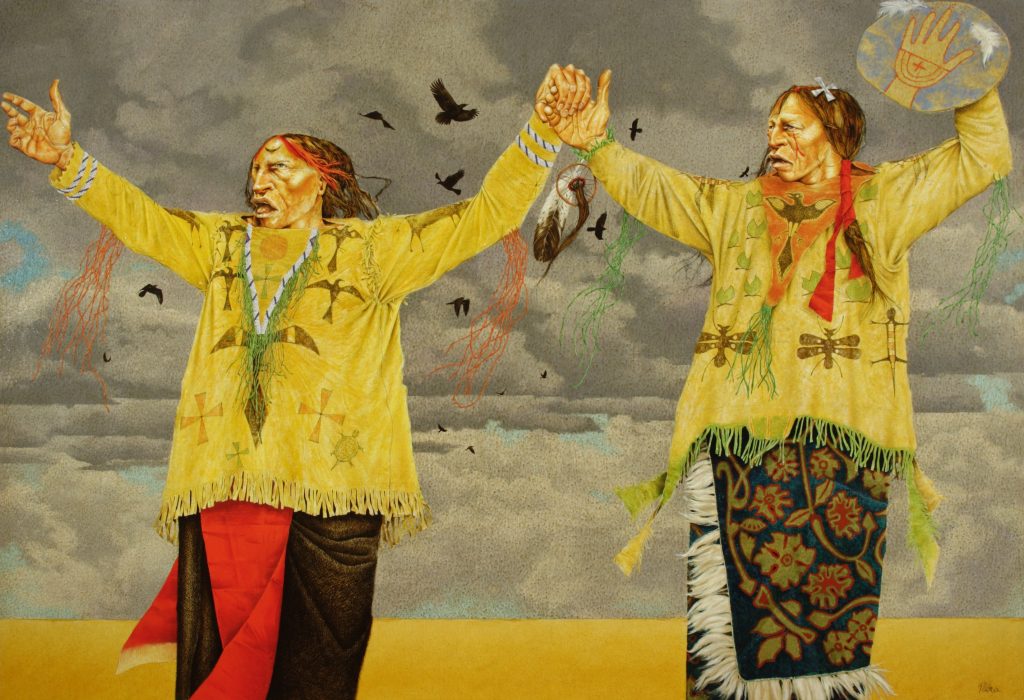
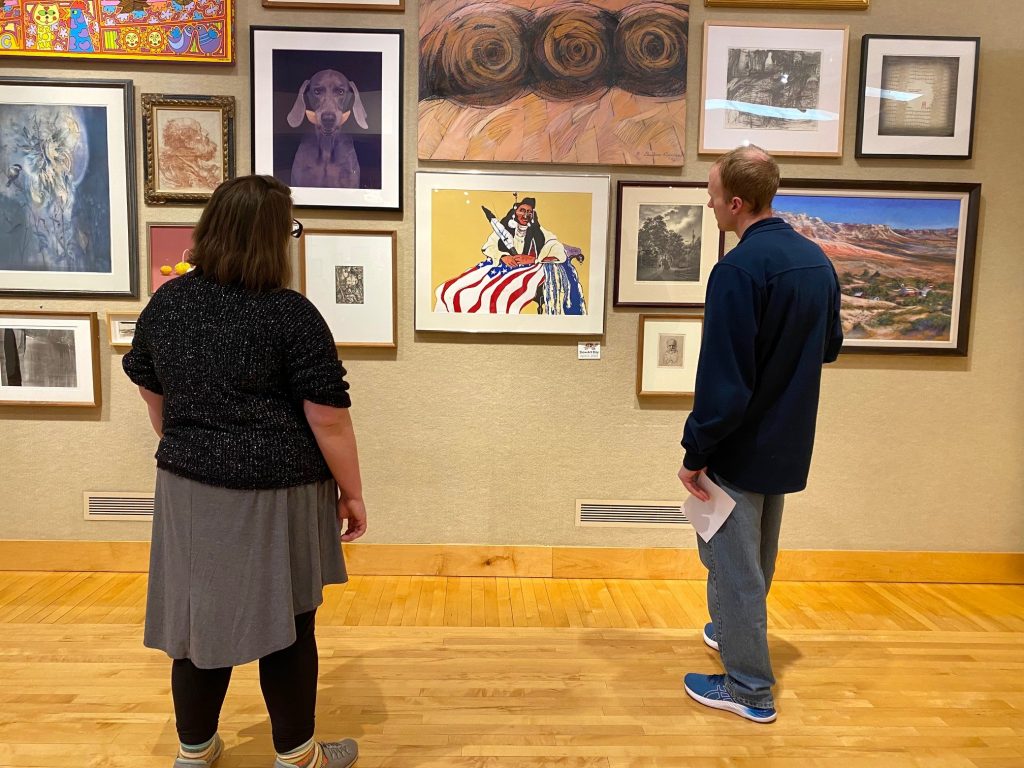
Hosts Jill Carlson, AKMA Marketing & Communications Manager, and Amber Wilcox, AKMA Event Manager, invited participants to look at three works of art for 10 minutes. Afterwards, they facilitated an open group discussion for 15 minutes. They then pointed out contextual information about the pieces and how they were acquired.
Paul Pletka (American, b. 1946), I Hear Everything, I Am the Crow, 1990, Acrylic on canvasFritz Scholder (American/Native American – La Jolla Band of Luiseño Indians, 1937 – 2005), Bicentennial Indian, 1975, LithographUnknown Sioux Artist, War Party Pictograph, 1870 – 1900, Pigment on muslin
The staff enjoyed being able to engage and customize the experience based on what participants saw and said, reporting that this kind of individual immersion was “exactly what we all needed.”
Staff member Amber and visitor Ethan looking at artwork Bicentennial Indian by Fritz Scholder. This work is located on the newly installed “Salon Wall” at the entrance of the building.
We can’t wait to see what the Albrecht Kemper Museum of Art decides to do for Slow Art Day 2023!
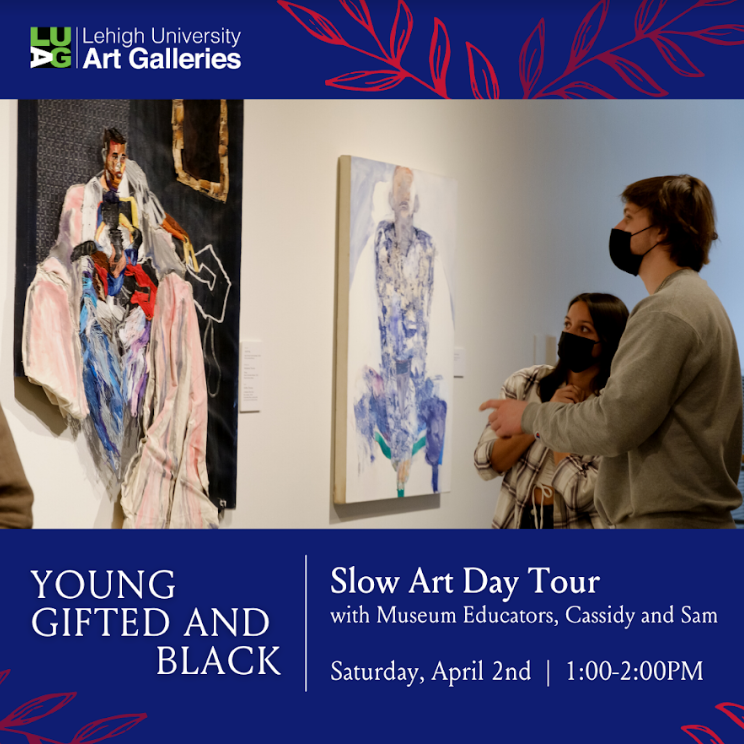
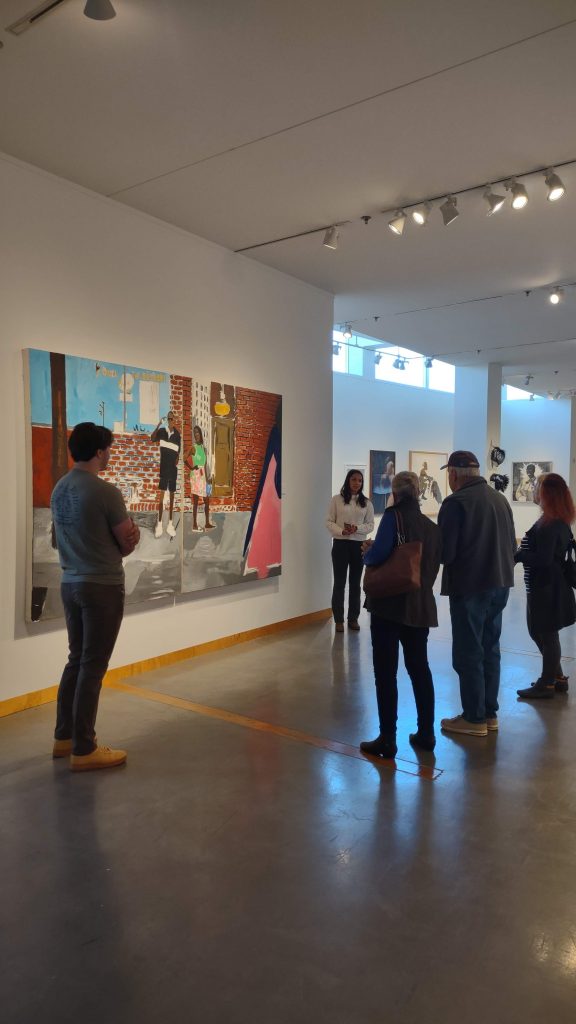
For their third Slow Art Day, the Lehigh University Art Galleries (LUAG) in Bethlehem, Pennsylvania, organized a variety of interesting, student-led slow looking activities.
Sam Ginn and Cassidy Rubio guiding visitors on the Slow Art Day tour, 2022
On April 2nd, visitors to the galleries were invited on a Slow Art Day Tour between 1-2PM to look at and discuss some visiting artworks from the exhibition Young, Gifted and Black together with Sam Ginn and Cassidy Rubio, both museum educators and students at Lehigh University.
Visitors were also separately given the change to join a Connect & Create Workshop with Lehigh student Afiwa Afandalo and the group Artists for Change.
For that workshop, participants read a short written piece connected to the theme, then discussed how a selection of artists engage with ideas of community in their work. In the final part of the session, they created an art piece (written or visual) that represented the influence of community on identity or vice versa. Participants considered their roles as community members, and reflected together on how “the collective and the self are equally important.”
In a LUAG student spotlight post, Afiwa Afandalo, the student and artist, reflected on how she created the workshop, which was inspired by sketching and contemplating one of the art works in the exhibit Young, Gifted, and Black.
We recommend you read her revelatory quote below –
The idea of having a workshop on the theme of identity and community came to me while viewing Blue Dancer by Tunji Adeniyi Jones. Every time I go to the gallery, I stop by that piece, the colors, the shape of the figure, the movement, they all feel so organic to me! I was so in love with that piece (I still am), I did a sketch of it in my sketchbook and used it as my artist study for my self-portrait painting. Sketching this piece allowed me to engage and decipher it; it felt like a puzzle—I love puzzles and I think it makes sense that I saw it as that: a puzzle—every piece carefully and intentionally crafted to create this beautiful piece. Something that stood out to me in this process was how the movements within the figure and outside of it are in sync with the form of the figure. I was trying to figure out which of the motion was impacting the other and couldn’t quite put my finger on it. When I finished the figure and was working on the surroundings, that’s when I had my “lightbulb moment”; it is not one or the other, it is both together, working at the same time, and having an impact on each other. That made me think of myself and my environment, how both work together and are equally important to the person I am and becoming. That’s when I knew what the workshop should be about.
LUAG is an example of a university art museum that has incorporated slow looking and non-judgmental looking practices deeply into their tours, programs, and student engagement.
Seeing this brings us real joy and makes us look forward to seeing what LUAG comes up with for their 2023 Slow Art Day program.
For their second Slow Art Day, the Atelier delle Fate in Calvagese della Riviera, Italy, hosted a week of hybrid in-person and virtual slow looking events.
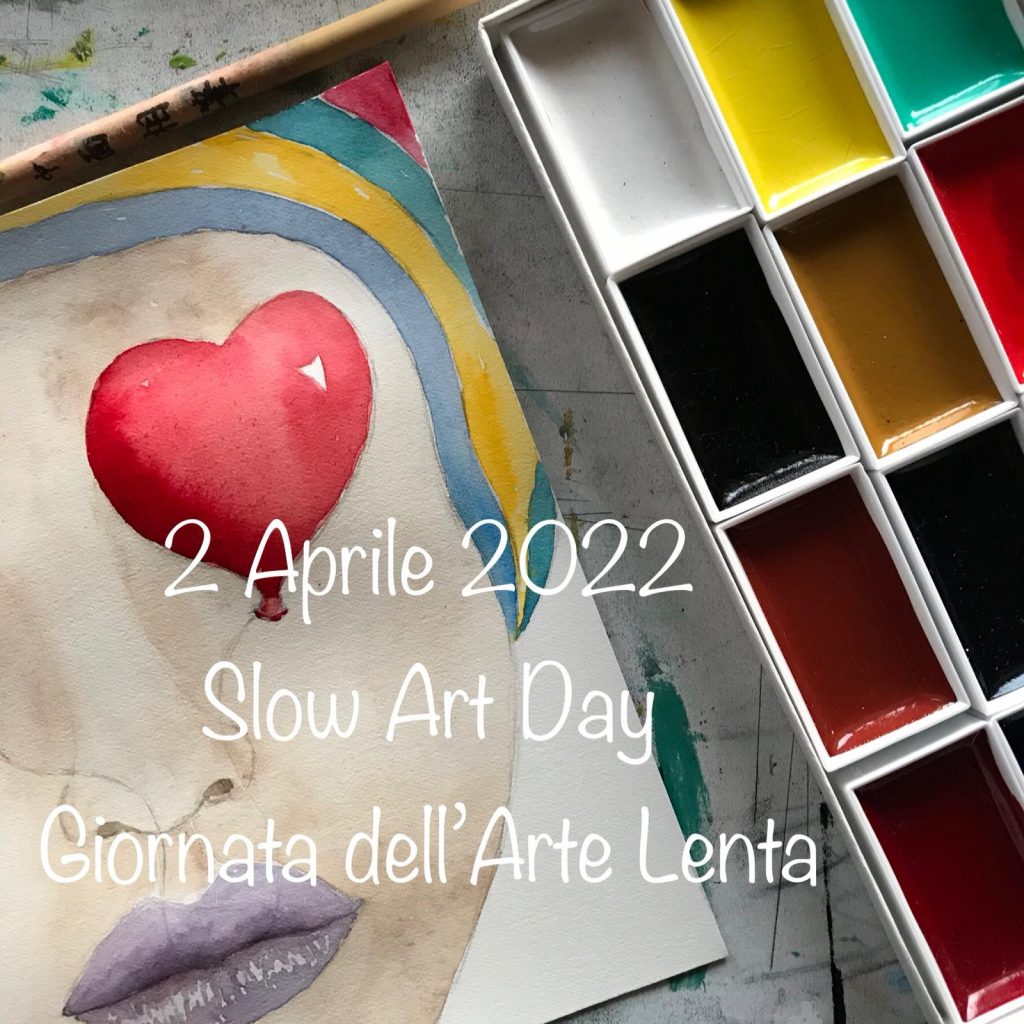
Atelier della Fate Slow Art Day poster 2022Artwork by Lorenzo Bianchini • Samuel Maccarinelli • Lorena Bianchini. Photo: Lorena Bianchini.
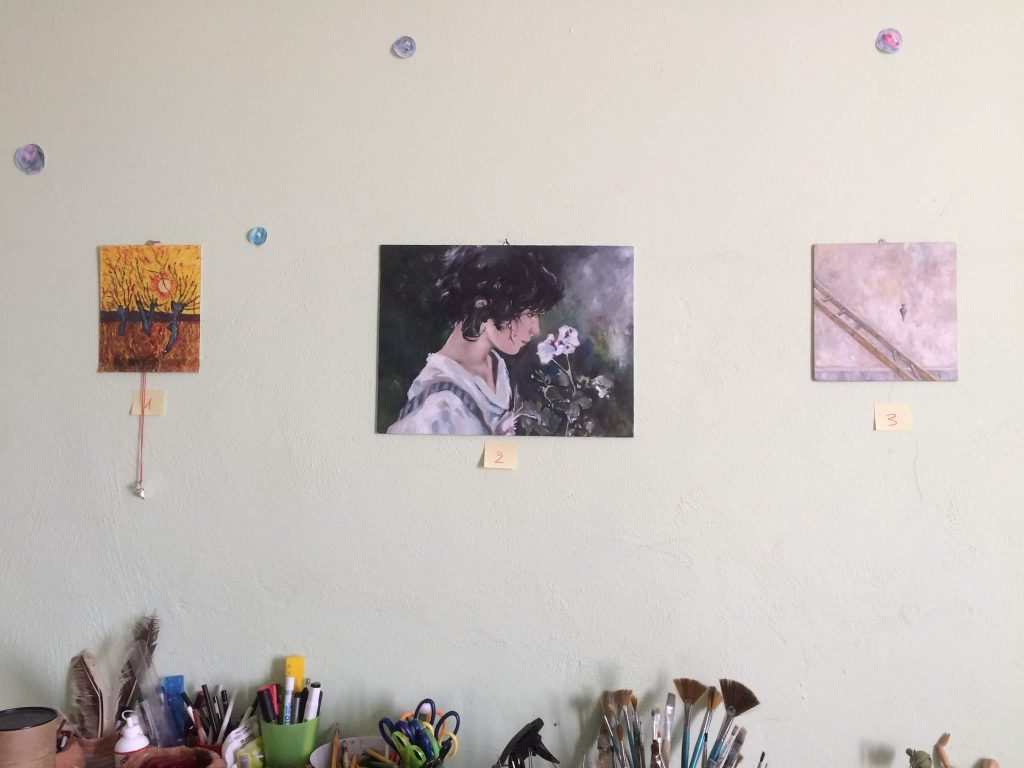
During the week, visitors to the gallery were able to slowly look at a series of 15 artworks by different artists. They were encouraged to write a written response to each of the artworks, including reflection about the emotions or memories evoked by each painting.
The event was also made virtual, and images of each work were shared in staggered intervals to the event page on Facebook, where people also shared their thoughts in the comments.
At Slow Art Day HQ, we especially like that participants who could not visit the gallery in person could still join online. The idea of staggering images to be released across a week allows people to make slow looking part of each day — a practice we love to see.
We look forward to what the Atelier delle Fate comes up with in 2023.