BYU Museum of Art: Four Ways to Slow Down in “Crossing the Divide”

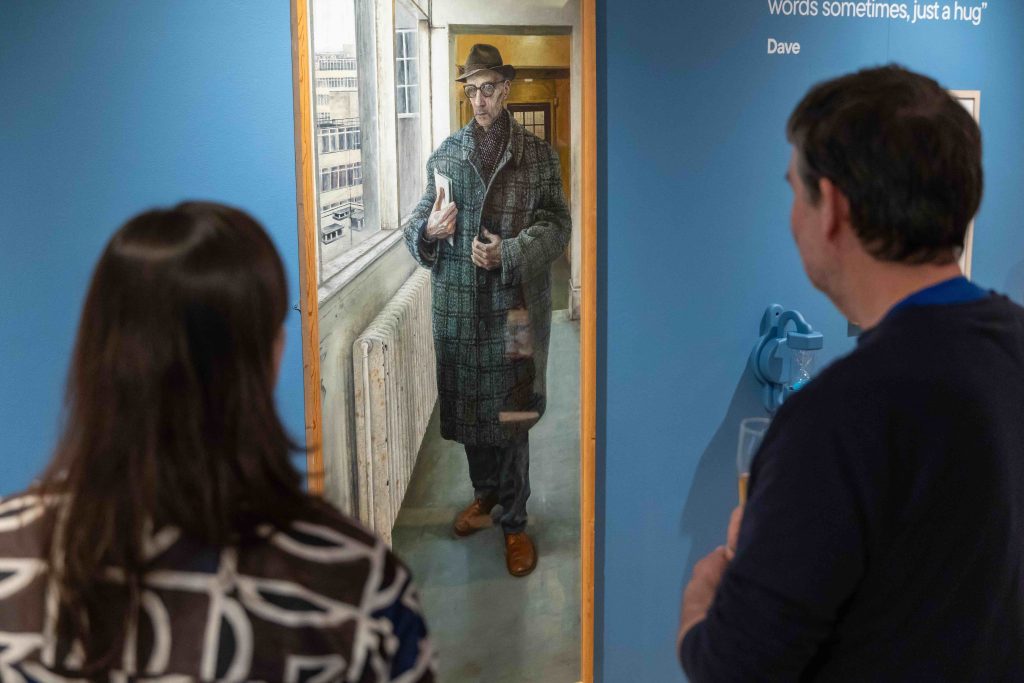
For their fourth Slow Art Day, the Brigham Young University Museum of Art in Provo, Utah celebrated from Monday, March 31 through Saturday, April 5 and invited visitors to practice slow looking using four different strategies and a small group of works in the Crossing the Divide exhibition on display on the main level of the museum.

Featured works:

  • “A Corner Window in a Pawn Shop” by Rose Hartwell (1893)
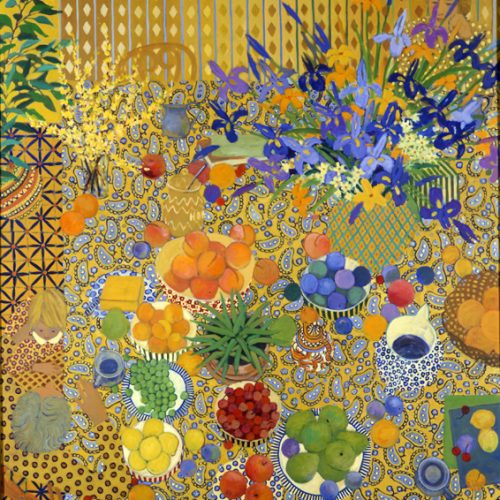
  • “Trifloria” by Jeanne Leighton-Lundberg Clarke (c. 1981)
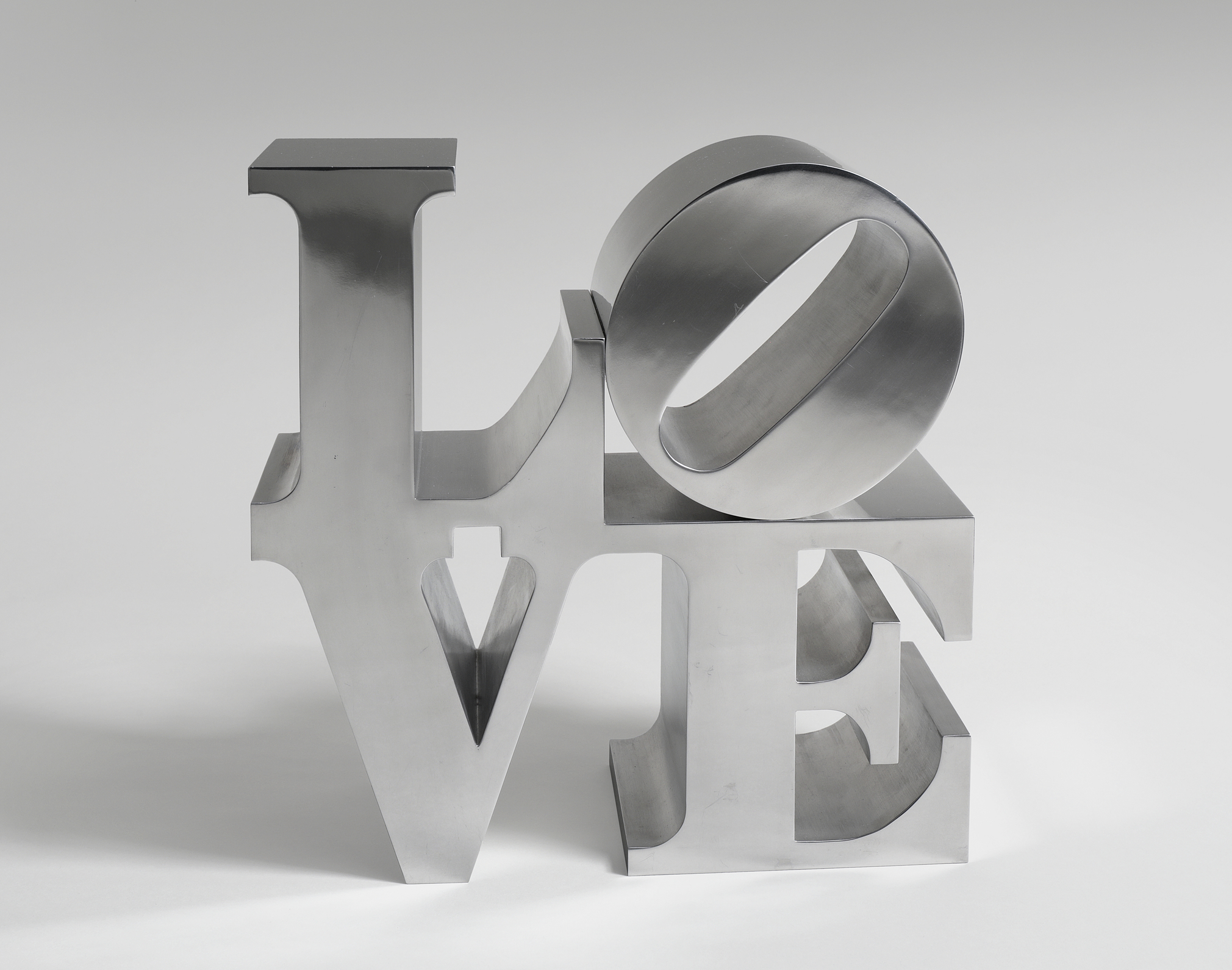
  • “LOVE” by Robert Indiana (1973)
  • “View of Monterey Bay” by Raymond Dabb Yelland (1879)
  • “Great White Throne” by Phillip Henry Barkdull (1930)

Look Big

Image
Rose Hartwell, A Corner Window in a Pawn Shop (1893), oil on canvas. Brigham Young University Museum of Art.

Visitors were encouraged to “cast a wide net” and examine every detail in Hartwell’s painting. The prompt challenged them to name ten different items for sale in the shop window — a structured way to slow down and notice complexity.

Narrow Your Focus

Image
Image

Jeanne Leighton-Lundberg Clarke, Trifloria (c. 1981), oil on canvas. Brigham Young University Museum of Art.

Here the instruction was the opposite: limit attention to colors, shapes, and patterns. By narrowing their focus, visitors discovered how repetition, contrast, and structure shape the viewing experience.

Change Your Perspective

Image
Image

Robert Indiana, LOVE (1973), aluminum. Brigham Young University Museum of Art.

Participants were invited to view Indiana’s sculpture from multiple angles, either in person or through online images. Altering physical perspective revealed new alignments of form and shadow.

Compare and Contrast

Image
Raymond Dabb Yelland, View of Monterey Bay, 1879, oil on canvas.
Image

Phillip Henry Barkdull, Great White Throne (1930), oil on canvas. Brigham Young University Museum of Art.

Image
Visitors looking, comparing and contrasting Yelland and Barkdull.

Visitors were prompted to compare subject, color, line, and composition between the two landscapes. This strategy encouraged noticing similarities and differences in mood, structure, and visual language.

After completing the activity, participants returned to the front desk to receive a small prize. All visitors selected a postcard or sticker featuring one of the works. Children also received a kaleidoscope, and adults chose between a museum pin or sticker.

At Slow Art Day HQ, we love that The BYU Museum of Art asked visitors to look with four different. That’s a great design for a thoughtful Slow Art Day.

We look forward to seeing what the BYU Museum of Art comes up with for Slow Art Day 2026.

– Ashley, Johanna, Jessica Jane, and Phyl

Salem’s Public Art Commission Hosts Its First Slow Art Day

For their first Slow Art Day, the Salem Public Art Commission partnered with the Salem Public Library to invite the community to slow down with three abstract paintings from the City of Salem’s Public Art Collection. The event took place on Saturday, April 5, 2025, from 11:00 AM to 12:00 PM and followed the classic Slow Art Day format: quiet viewing followed by discussion.

Featured works:

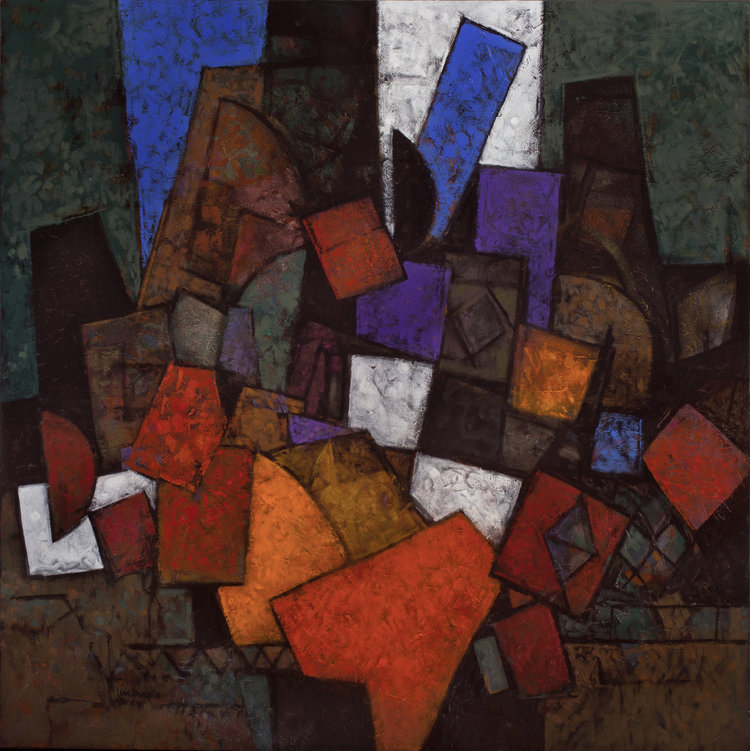
  • Still Life in Flux (2014) by Nancy Lindburg
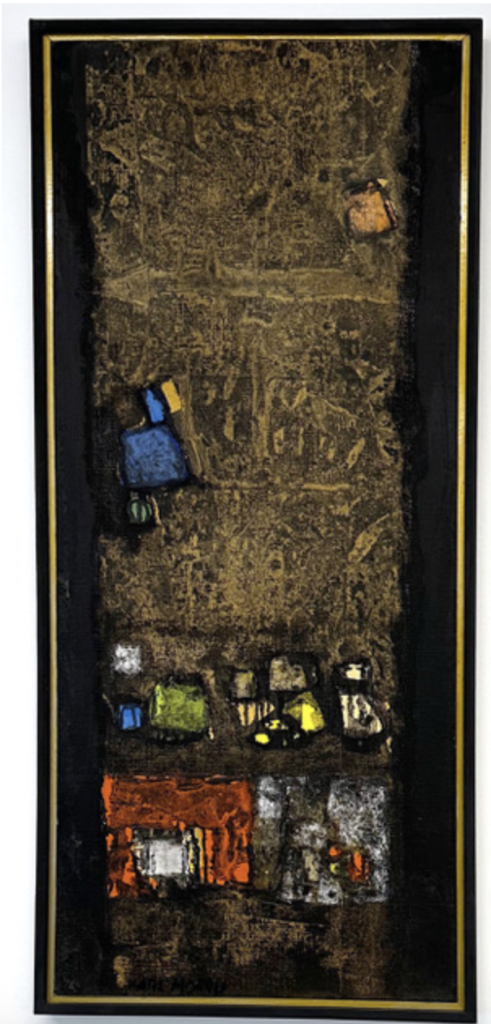
  • Dwelling (1965) by Carl Morris
  • View (1973) by Louis Bunce
Image
Still Life in Flux by Nancy Lindburg, 2014.
Carl Morris Dwelling, 1965
Image
Louis Bunce View, 1973

The Commission selected these three abstract paintings because they are thoughtfully installed within the Salem Public Library and represent artists with strong ties to the Pacific Northwest.

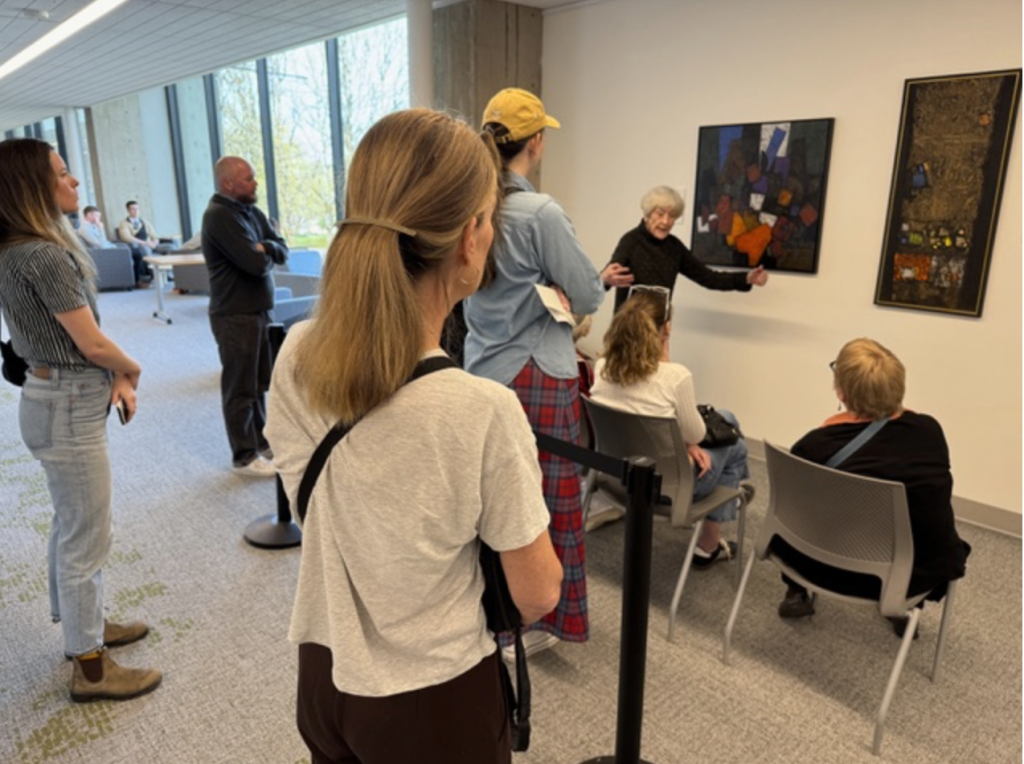
Participants gathered by the window facing Peace Plaza and began with approximately ten minutes of silent viewing per artwork. The group was encouraged simply to look — noticing color relationships, compositional structure, surface texture, and emotional tone before moving into conversation.

Nancy Lindburg’s Still Life in Flux (2014) presents layered geometric forms in vibrant oranges, blues, and deep neutrals, creating a sense of movement within abstraction. Carl Morris’s Dwelling (1965) offers a vertical composition grounded in earthy browns and textured surfaces, punctuated by small bursts of color. Louis Bunce’s View (1973) introduces architectural structure and rhythmic pattern, balancing a vivid green plane with repeated arch-like motifs and a distant horizon.

The experience was made especially meaningful by the presence of Nancy Lindburg herself — a Salem resident and long-time local arts advocate — who joined the group. After the quiet viewing period, Lindburg shared insights into her artistic process and engaged directly with participants during what coordinators described as a lively post-viewing discussion.

The conversation that followed the silent viewing allowed participants to compare perceptions and discoveries. As often happens on Slow Art Day, viewers noted details they might otherwise have missed — subtle shifts in color, interplay between positive and negative space, and how each painting’s scale influenced their physical experience in the room.

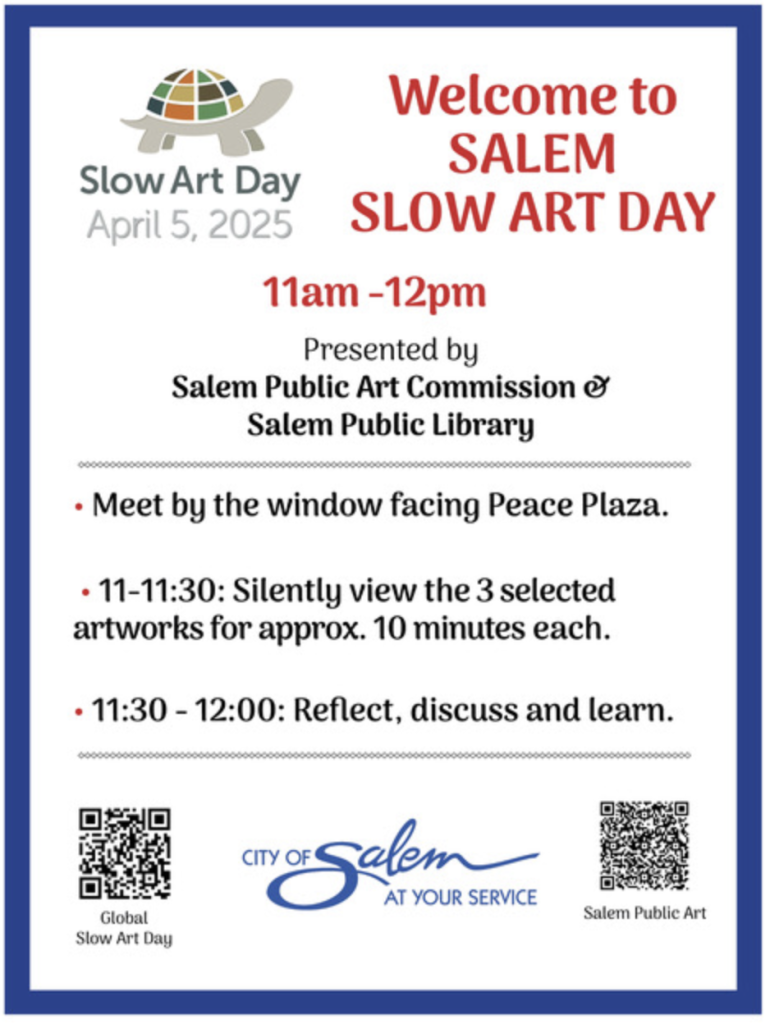
The event was organized by Susan Napack, coordinator for the Salem Public Art Commission, in collaboration with Kathleen Swarm and the library team. The Commission also created a clear and inviting flyer (below) outlining the structure: silent viewing from 11:00–11:30, followed by reflection and discussion from 11:30–12:00 and providing QR codes to the global website and to their event site.

Also, they did a good job of marketing including getting The Statesman Journal, the local newspaper, to cover the event.

At Slow Art Day HQ, we are especially glad to welcome Salem’s Public Art Commission to the global movement. We love when city collections — especially those installed in civic spaces like libraries — become the focus of slow looking. Public art belongs to everyone, and this event demonstrated how simply creating space and time can transform everyday encounters into meaningful experiences. We also appreciate the generosity of artist Nancy Lindburg in participating directly in the conversation.

We look forward to seeing what the Salem Public Art Commission comes up with for Slow Art Day 2026.

– Ashley, Johanna, Jessica Jane, and Phyl

African Art and Haiku in South Africa

For their eighth Slow Art Day, Artichoke Gallery at MelonRouge in Magaliesburg, South Africa invited visitors to slow down with art and poetry at an interactive morning titled “Afriku: Slow Visions & Whispered Words.” The event paired slow looking at a curated selection of African artworks with a hands-on Japanese haiku writing workshop led by gallery owner Hannelie Sanders.

On Saturday, April 5, 2025, participants gathered in the gallery’s contemplative space to begin their slow looking experience. The exhibition offered a rich range of African art — from textured mixed-media works and figurative compositions to abstract pieces that emphasize line, pattern, and gesture. The diversity of the artworks created varied visual rhythms: some pieces invited attention to bold color and dynamic shapes; others unfolded quietly, revealing depth and nuance through closer observation.

As participants slowed down with individual works, they were encouraged to engage with formal elements such as surface texture, mark making, and spatial relationships, and with the emotional presence each piece carried. These visual qualities provided fertile ground for deep attention, allowing slow lookers to connect more intimately with what they saw.

After an initial period of quiet observation, Hannelie Sanders introduced the basics of Japanese haiku. Participants were then invited to translate what they noticed in the art into their own three-line poems, using mood, imagery, and sensory detail as inspiration. The morning’s workshop emphasized presence, patience, and creative response, encouraging people to let what they saw inform what they wrote.

Following the haiku writing, the group shared reflections over a light lunch. Many spoke of how slowing down shifted their perception, helping them notice details and relationships within the artworks that might otherwise go unseen. In a further celebration of creative engagement, the haiku poems crafted during the session were displayed alongside the exhibition for the remainder of its run through May 4, allowing poetry and visual art to exist side by side.

At Slow Art Day HQ, we appreciate how Afriku wove visual art with poetry (and lunch!) into the slow looking experience. We love that participants’ poems became part of the exhibition itself.

We look forward to seeing what Artichoke Gallery at MelonRouge comes up with for Slow Art Day 2026.

– Ashley, Johanna, Jessica Jane, and Phyl

P.S. Follow them on Facebook

Job Seekers and Art Converge in Seattle Art Museum

Volunteers Ashley Christensen, Erinn Kruser and Forrest Corbett organized a group of 25+ job seekers to spend an evening together looking at art slowly at the Seattle Art Museum, Thursday, June 5, 2025. This is part of a growing partnership between Never Search Alone and Slow Art Day.

Below is Christensen’s write-up. And the team at Slow Art Day HQ agree – we couldn’t have described the impact of slow looking at art better.


Slow Art Day at Seattle Art Museum – Recap

1. We all saw something different.
Despite looking at the same painting for 10 minutes, my group came away with wildly different takeaways. From metaphors and feelings to objective facts (sometimes one of us missed whole sections of the art pieces). I was honestly surprised. I thought the longer we looked, the more we’d converge. But the opposite happened, we diverged. The art unfolded differently for each of us.

It was such a clear reminder that our lived experiences shape what we notice, how we interpret, and what moves us.

2. People wanted to connect, with the art and each other.
More than 20 of the 26 attendees stayed after the art viewing, gathering at the MARKET to talk, laugh, and share takeaways. That blew me away. We moved up to Seattle two years ago and I’m still getting to know my new home but this felt deeply communal in a beautifully unexpected way. I assumed folks would drift off after the art-viewing but instead, the shared experience created something worth lingering for. People wanted to stay.

3. The vibe was genuinely kind.
Networking events are awkward but this was different. I could tell some folks felt anxious or uncertain but people showed up with open minds. 

There was something disarming about the format. No pitches. No small talk. Just attention, presence, and an invitation to be curious. It didn’t feel like a networking event. It felt human.

4. Slow looking really changed our state.
One person mentioned at the end that she couldn’t focus at first. Her mind was racing. She wanted to move on after a minute. But then she started to settle and by the end of the first painting, she was present.

Another person noticed that someone in our group was fidgety and tense at the start but was visibly relaxed by the end. I felt that too. Like my body had slowed to meet my gaze. The longer we looked, the more the art gave us back.

5. Our attention had ripple effects.
As our small groups paused in front of pieces of artwork, something unexpected happened: strangers began to gather near us. They looked from the painting to us and back again, curious about what had captured our attention for so long.

Our stillness seemed to signal that these pieces were worth an extra-long look. That quiet attention drew people in. It was a beautiful reminder that focus is contagious and that how we engage with the world can invite others to do the same.

Thanks again for the inspiration and for building such a powerful global movement. It was an honor to be part of it.

Ashley Christensen

P.S. Here’s the Never Search Alone website.

Art, Community, and the Job Search: A New Movement Begins

A new kind of partnership is taking shape — one that connects art and the job search in a powerful way.

Slow Art Day and Never Search Alone are working together to support both museums and job seekers.

Why this partnership matters:

  • For museums: It brings in new and more diverse visitors — something many are working hard to do.
  • For job seekers: It creates a space to pause, reflect, and feel connected during what can be a very isolating time.

On Monday, May 19, 2025, Never Search Alone members Stuart Ridgway and Caitlin Thistle hosted one of these special events at the Smithsonian American Art Museum. Forty job seekers took part.

They started outside the museum (see photos below), then split into groups of four. Each group moved through the galleries together. One person at a time picked a piece of art. Everyone looked at it slowly — for ten minutes — then they talked about what they saw.

Afterward, everyone met back in the courtyard. They kept talking for hours — forming new friendships and reconnecting with something often lost in the job search: the simple, human experience of looking at art and being with others.

Caitlin, pictured in the left foreground of the group photo above, and Stuart both reported that the group left feeling energized and connected — lifted by the simple yet profound act of looking at art together.

Because the participants meet outside the museums, and break up into groups of four, and buy their own tickets, this is a scalable program that also doesn’t involve complicated group tour arrangements with museums. 50 or 100 job seekers just meet up, get divided into groups of 4, and go slow looking.

I hosted recent events as well at the Brooklyn Museum, with 50 participants, and the Metropolitan Museum of Art where more than 120 Never Search Alone members came together.

Below are photos from the Metropolitan Museum of Art outing.

Already, Never Search Alone members around the country are beginning to plan more events including one coming up at the Seattle Art Museum (more on that in a separate post).

Stay tuned. This is only the beginning.

– Phyl, Ashley, Johanna, and Jessica Jane

P.S. More information about Never Search Alone can be found at Phyl.org.

ArtWrite on Slow Art

I’m always looking for thoughtful, interesting, accessible and jargon-free writing about art and the power of slow art.

Thus, when Maggie Levine, who runs the ArtWrite Substack, published a lovely essay on slow art and Slow Art Day, I wanted to bring it to the Slow Art Day community.

Take a moment and enjoy her writing (and photography). I particularly like her description of her trip to Naoshima, an “art island” in the Seto Inland Sea.

ARTWRITE #26: SLOW ART

Yayoi Kusama Pumpkin, 2022

Maggie is a teacher and writer who works at the intersection of writing, art, and the creative process. She studied English and art history at Barnard and received her MFA in Fiction from the University of Arizona.

– Phyl

P.S. We are beginning to write up the reports from Slow Art Day 2025. More soon!

15th Annual Slow Art Day Tomorrow

The 15th Annual Slow Art Day – with 210+ museums, galleries, churches, and hospitals are – begins tomorrow Saturday, April 5, 2025 (see full list of venues around the world and register yours if you have not yet done so)‬.

New York, Berlin, Mexico City, Paris, Hong Kong, Brussels, Athens, Budapest, Washington, DC, Toronto, Rome, Paris, San Francisco, Sydney, Melbourne, Stockholm, Seoul, Antwerp, Los Angeles, London, Barcelona, Stockholm, Johannesburg, Brazil, Singapore, and many, many other places are participating in Slow Art Day.

We are proud that in this topsy-turvy time, Slow Art Day is a model of global cooperation.

So, yes, while trade barriers, tariffs, and acrimony fill the global political debate, thousands of people across every continent will celebrate the power of art to bring us together.

Here are some highlights from this year’s festival of slowing down to look at and love art.

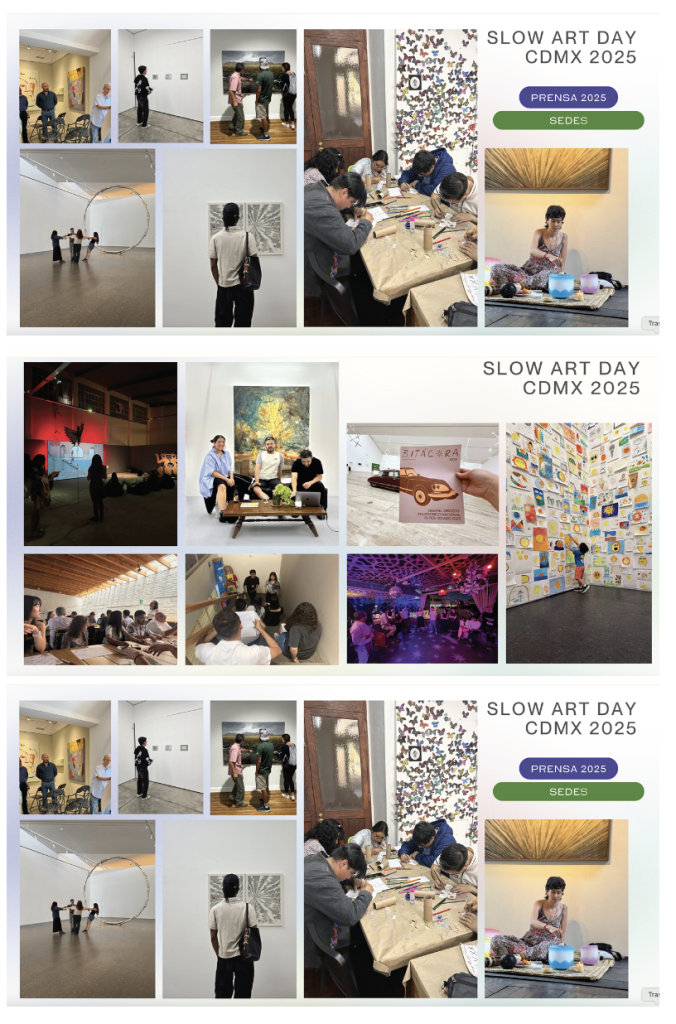
Mexico City is hosting its first citywide Slow Art Day with more than **40** museums and galleries participating. Read these two articles from CDMX – Ad Magazine and Milenio – to learn more. I also encourage you to check out the Instagram for the Mexico City Slow Art Day – there are a lot of great resources, images, and stories there. Constanza Ontiveros Valdés, writer and cultural projects organizer, has done an amazing job.

Bloomington, Illinois, which started the citywide movement, is now hosting 20+ museums and galleries and a big party to boot. Read this article to learn more or see our post.

Here are two posters from these two citywide events.

Mass‬ MoCA‬‭ is celebrating again as is the beautiful and wonderful‬‭ Athenaeum‬‭ in Boston while the Morgan Library is hosting in New York, and The Barnes Foundation‬‭ ,‭ Glenn Foerd‬‭, and the‬‭ Magic‬‭ Gardens‬‭ are all hosting in Philadelphia.

In Washington D.C., the‬‭ National Museum of Women in‬‭ the Arts‬‭ is hosting yet again while the National Museum of Asian Art is joining us for the first time.

Antwerp’s church-based Slow Art movement continues to grow while St. Vincent’s Hospital‬‭ in Melbourne has become a leader in hospital-based Slow Art.

‭The‬‭ Ur Mara Museo‬‭ in Spain’s Basque country holds its‬‭ 10th Slow Art Day with another full day of‬ slow looking, cooking, eating, and dancing.‬ While Ur Mara Museo has been celebrating Slow Art Day for a decade in the Basque country, The‬ Altes Museum‬‭ (English: Old Museum), a UNESCO World‬‭ Heritage Site in the heart of Berlin’s‬‭ museum island, holds their second Slow Art Day tomorrow.

The‬‭ Goulandris Museum of Contemporary Art‬‭ in Athens‬‭ also holds their second Slow Art Day while‬‭ The AGO‬ in Toronto‬‭ , one of the largest museums in North America,‬‭ hosts their‬‭ 10th‬‭ Slow Art Day.‬

Australia has 11 participating museums, galleries and hospitals. The first Slow Art Day is being hosted at the De Young Museum in San Francisco (hosted by Slow Art Day pioneer, Carol Rossi).

There is so much happening all over the world, it’s impossible to summarize effectively.

But you can check out our 2024 Annual Report to get a sense of the range of activities from last year (and get inspired for this year).

Have a great 15th Annual Slow Art Day.

This is certainly a year we all really need to slow down, look at and love art, and love each other.

– Phyl, Ashley, Jessica Jane, Johanna, and Maggie


Daylong Celebration at Yellowstone Art Museum

For the 15th anniversary year of Slow Art Day, the Yellowstone Art Museum (YAM), Montana’s largest contemporary art museum, will host its first event this Saturday, April 5, 2025 at the same time as hundreds of museums and galleries around the world.

And they are going all out with a full day of activities designed to encourage visitors to experience art slowly and mindfully.

The festivities begin with yoga at the YAM from 9:30 to 11:30 a.m., featuring a unique session that integrates slow observation of art in the museum’s Murdock Gallery.

At 11:30 a.m., Krista Leigh Pasini, owner of Rain Soul Studio and former YAM Artist-in-Residence, will lead a guided meditation in the museum’s newest exhibition, “Tyler Joseph Krasowski: Everything Becomes Something.” Krista will conduct another meditation session later in the afternoon from 2 to 3 p.m.

Throughout the day, local artists known as the Copyists will paint selected works by Gennie DeWeese from 9 a.m. to 12 p.m. and again from 1 to 4 p.m. Additionally, the Billings Urban Sketchers will be actively sketching around the museum campus.

Museum admission and all Slow Art Day activities are free and open to the public. No registration is required.

We are happy to welcome the Yellowstone Art Museum to Slow Art Day and look forward to hearing to getting a report on their first event.

Best,

– Phyl

P.S. The 15th anniversary Slow Art Day is coming up this Saturday, April 5, 2025 – with hundreds of museums, galleries, churches, sculpture parks and other venues – be sure to register your event if you have not yet done so.

Slow Art Day en Plein Air in Cheshire, England

The 15th anniversary Slow Art Day is coming up this Saturday, April 5 – with hundreds of museums, galleries, churches, sculpture parks and other venues (be sure to register your museum, gallery, church, hospital, sculpture garden or other venue).

One location this year will be en plein air so to speak – in a hectic shopping center – hosted by the West Cheshire Museums in England.

They are bringing art outside to the heart of the city center and thereby making both the art and the art of slow looking more accessible.

Museum staff and community groups (including their dementia-inclusive Meet and Make group) have set questions for the public to encourage a slower look at the images.

They have chosen three art works out of their multiple galleries to bring to the Grosvenor Shopping Centre in Chester. The art they have chosen depict the city in different eras of its development – early 18th century (first image below), the Victorian era (second image below), and 2017.

The West Cheshire Museums are a diverse group of museums, which includes Grovesnor Museum, and other locations like a working watermill and a restored salt production site. Their collections cover a large slice of Cheshire’s history and tell the stories of the area’s people and places, from prehistoric times to the present day.

The West Cheshire Museums have been celebrating Slow Art Day since 2017 and we are happy to welcome them back for our 15th anniversary year – especially with their program to bring art out to the people.

– Phyl

P.S. We are proud this is now the 15th anniversary of Slow Art Day – the movement has grown and we continue to be delighted by the creative and innovative ways that museums, galleries, churches, hospitals and other venues choose to celebrate this day dedicated to looking at and loving art.

House of European History Slow Art Day 2025

Slow Art Day 2025 is coming up April 5 – with hundreds of museums, galleries, churches, sculpture parks and other venues (be sure to register your museum, gallery, church, hospital, sculpture garden or other venue).

One of these locations this year will be The House of European History in Brussels, which is focusing on “Our Family Garden” by Smirna Kulenović, a citizen-led photographic project designed to heal collective trauma from the Bosnian War.

And we are happy to report that their Slow Art Day event will launch Slow Looking Saturday, a monthly guided experience that will focus on a different image from the exhibition, examining topics such as commemorations, historical re-enactments, and personal legacies.

These sessions will continue monthly through the end of the exhibit in November 2026.

We at Slow Art Day love seeing this.

Our goal since day one has been to inspire museums and other venues not only to participate in the annual event, but to create year-round programming that helps visitors slow down.

We’ll note that The House of European History worked with Claire Bown to develop this program. Claire is author of The Art Engager: Reimagining Guided Experiences in Museums.

We are glad to see the House of European History’s year-round commitment to Slow Art Day and look forward to getting updates on their progress.

Have a great Slow Art Day 2025.

Best,

– Phyl

P.S. Slow Art Day 2025 is coming up – be sure to register your museum, gallery, church, hospital, sculpture garden or other venue.