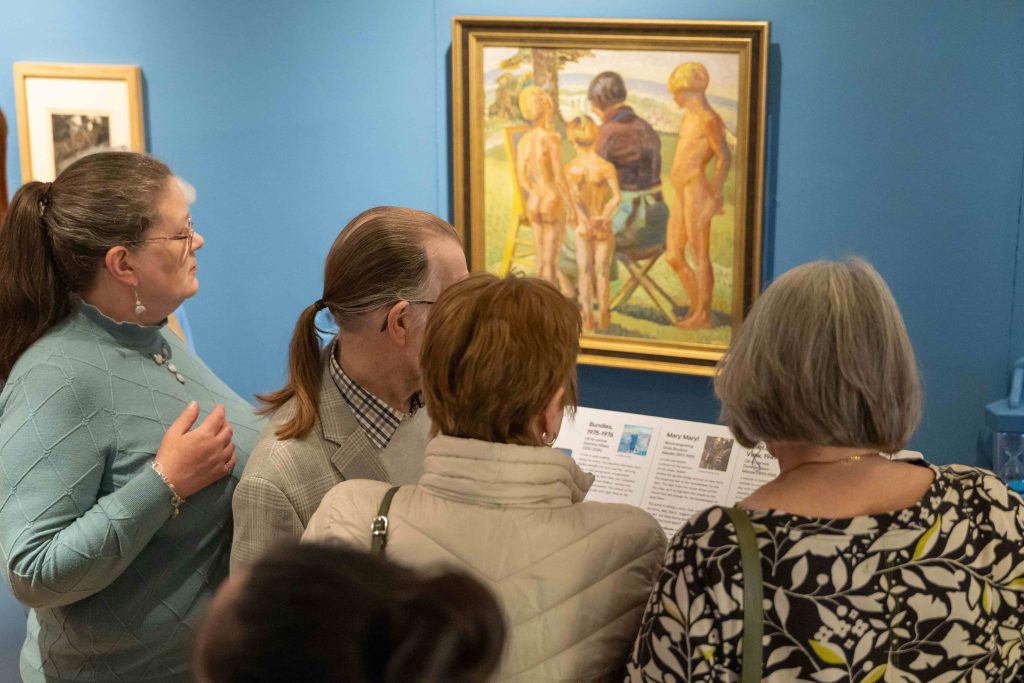
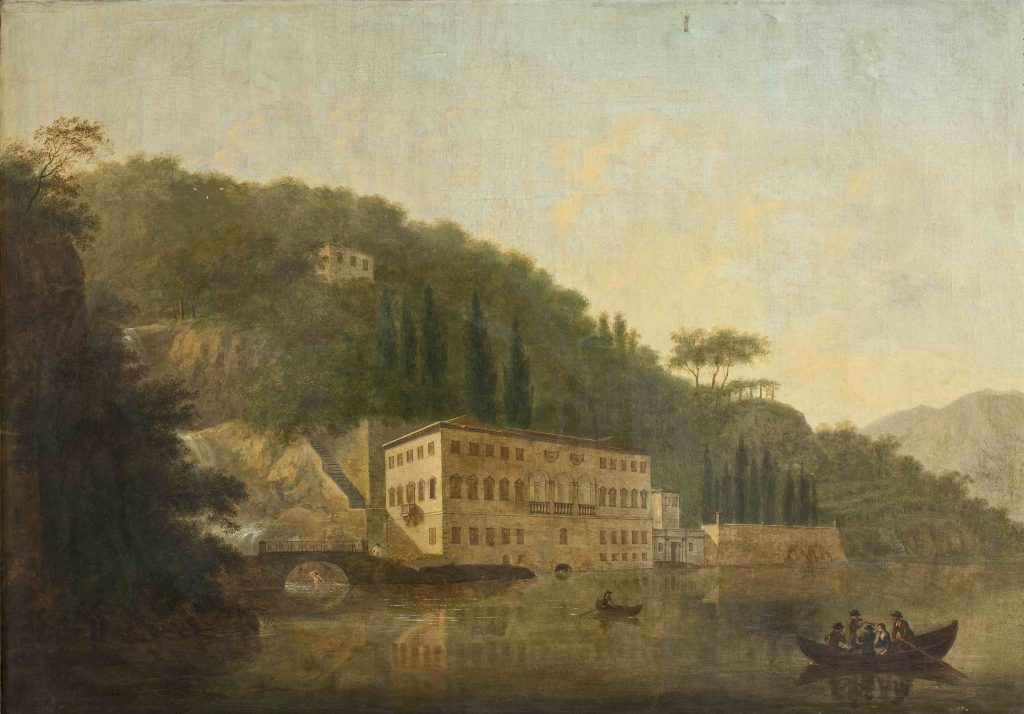
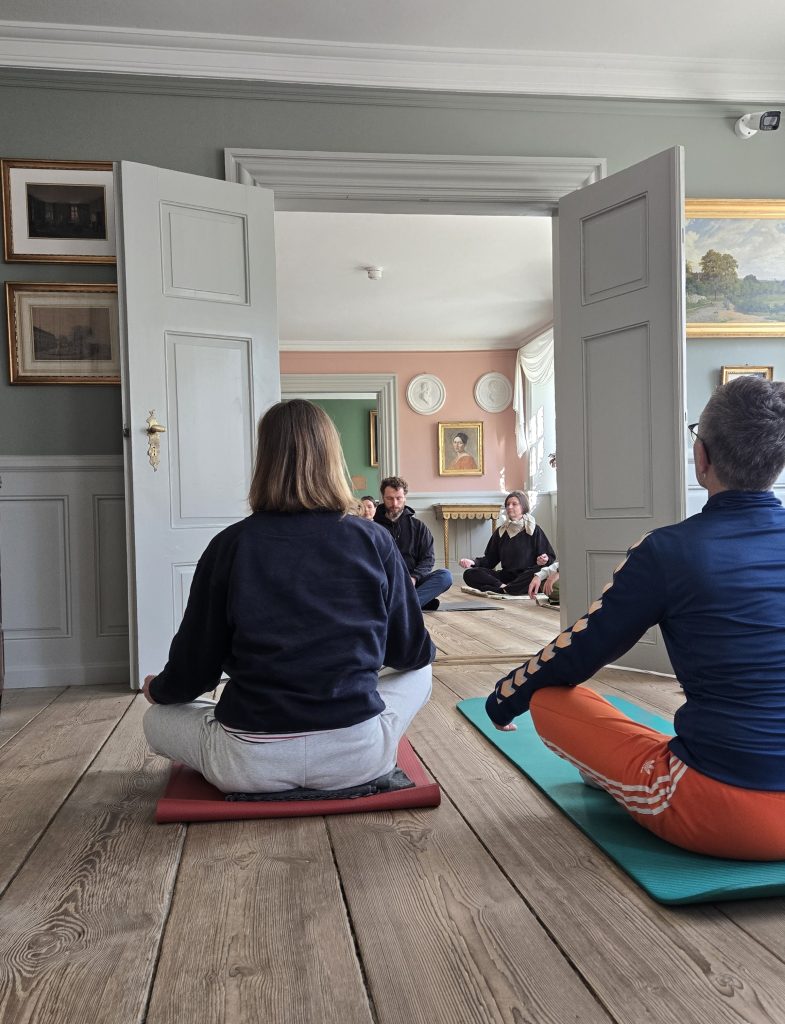
For Slow Art Day 2025, St Vincent’s Hospital in Melbourne, Australia hosted its fourth Slow Art Day, continuing its thoughtful integration of art into healthcare settings. Led by Art Curator, Monique Silk, this year’s event was titled The Slow Art of Landscape: Observing and Transforming the Art of Nina Ryan.
The program centered on the current exhibition of landscape paintings by Melbourne artist Nina Ryan, including:
Nina Ryan, Paddocks (2017), oil on canvas, 62 x 87 cmNina Ryan, The Road Less Travelled (2024), oil on board, 50 x 49 cmNina Ryan, Southern Aspect (2020), oil on linen, 78 x 89 cm
Participants, including staff, patients, and members of the wider community, were invited to select a painting, spend time observing it slowly, and then create their own image by transforming cut-out photocopied squares of the original artwork into new compositions. The resulting collages reflected personal interpretation, creative play, and deep engagement with Ryan’s landscapes.
Participant slow-making. Photo by Monique Silk.Participant slow-making. Photo by Monique Silk.Participant slow-making. Photo by Monique Silk.
Beyond the gallery, the Slow Art Day spirit extended across other campuses. A flyer invited patients to engage in slow looking wherever art was present, in foyers, corridors, courtyards, and even views from hospital windows. The gentle prompts encouraged participants to look, observe, feel, and share. As described in the hospital’s materials, Slow Art requires nothing more than one’s presence and attention — there is no right or wrong way to respond Flyer Slow Art 2025 St Vincents….
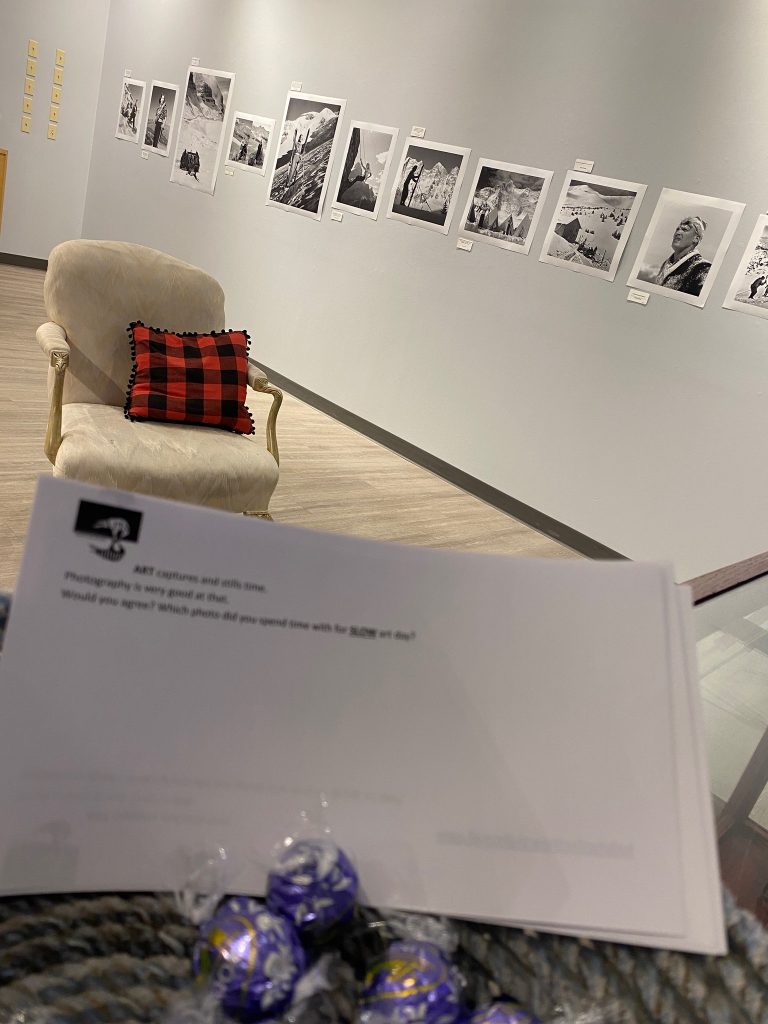
At Caritas Christi Palliative Care Hospice, a Slow Art Station was set up in the creative arts room, offering Slow Art card resources and a quiet space for reflection. We at Slow Art Day HQ are deeply touched by this extension into palliative care settings. Wow. We hope that more hospitals and hospices follow St. Vincent’s lead.
Slow Art Station at CCPC. Photos by Monique Silk.
We are inspired by how St Vincent’s Hospital Melbourne adapts Slow Art Day to the rhythms of hospital, and hospice, life — offering patients, staff, and visitors an opportunity to pause, reflect, and transform experience through art. We look forward to seeing how they continue to grow this program in 2026.
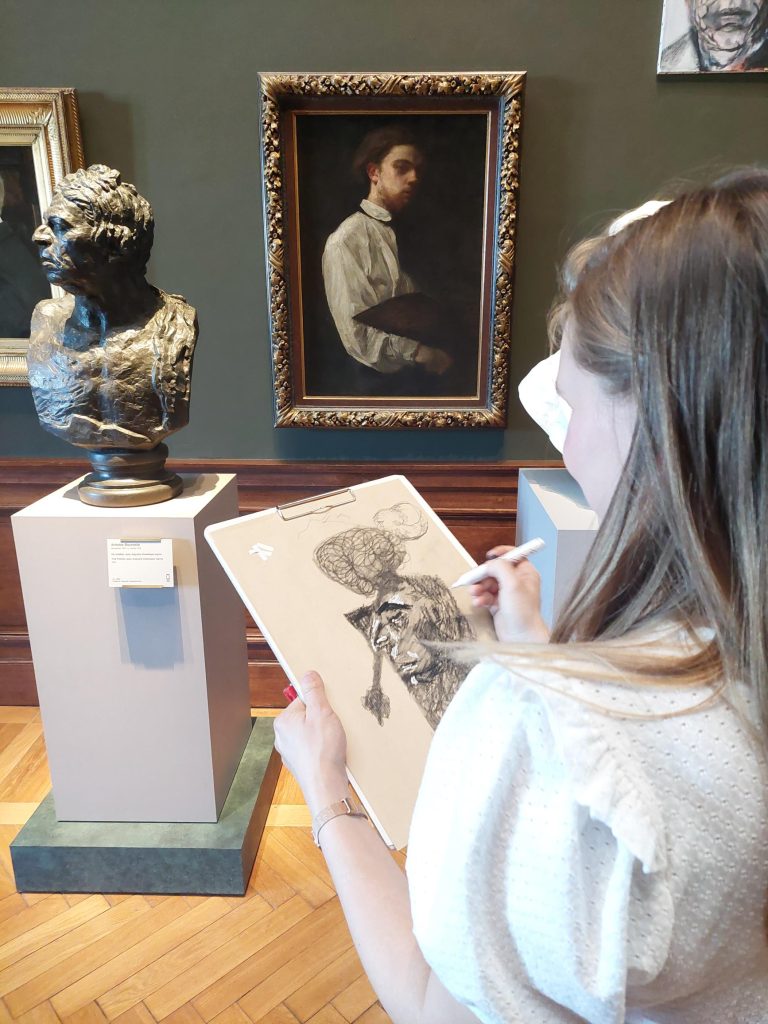
For Slow Art Day 2025, Maria Gontea, a Slow Art Day volunteer, led an independent slow looking session at The Getty Center in Los Angeles, California. A small group of art lovers, including children as young as seven, gathered to pause and engage deeply with four selected works from the collection, set against the museum’s striking hilltop architecture and sweeping views of the city.
Cabinet on Stand by André-Charles Boulle
Irises by Vincent van Gogh
Femme Debout I by Alberto Giacometti
Boating Party by Gustave Caillebotte
View from The Getty. Photo by Maria Gontea.View from The Getty. Photo by Maria Gontea.
Participants spent ten minutes with each work before gathering to share observations and reflections. From the luminous color and movement of Van Gogh’s Irises to the quiet presence of Giacometti’s standing figure, the session emphasized attentive looking and open conversation rather than expertise.
Maria promoted the event through LinkedIn, inviting her professional community to “rediscover the art of seeing.” In her post, she described Slow Art Day as simple by design: look at four works for ten minutes each, then talk about the experience. No rush, no prior knowledge required. While the group was smaller than anticipated, those who attended found the experience meaningful and energizing.
The Getty Center’s setting amplified the spirit of the day. Its gardens, architecture, and panoramic views created a natural transition from the intensity of Los Angeles life into a more reflective mode of engagement. The event demonstrated how anyone can lead a slow looking session simply by showing up and inviting others to do the same.
We thank Maria Gontea for organizing and hosting this Slow Art Day gathering at The Getty Center. We look forward to seeing what she comes up with for Slow Art Day 2026.
For their 10th Slow Art Day, Ur mara Museoa in Alkiza, Spain, hosted a gathering that combined exhibition, performance, and a shared meal in a single, community-centered experience.
The event featured an exhibition by artists Ruth Anne Lopez, Amaia Conde, and Ainhoa Apezteguia, alongside a live performance by Leire Ugalde.
They put together a terrific video summary of the full day, which you can watch below.
Highlights included:
– A poetic reflection on touch and memory (0:59-2:08), using the metaphor of raindrops to explore how we interact with and preserve moments.
– An artistic piece focusing on skies and images (2:18-2:38), highlighting how images can capture what life cannot.
– An interview with artist Amaya Condechirt (2:51-3:36), who discusses her passion for wood carving and how her sculptures (3:03-3:18) explore the human form and complex life themes to bridge communication gaps in society.
– A sculptural work featuring older individuals and children (3:37-3:47), with one child breaking the fourth wall to question what they are being told, adding a touch of adolescent humor (3:48-3:56).
– A brief moment of reflection on new ideas and connections (4:41-4:50).
In addition, here are some still photos of the event.
As always with Ur Mara Museo, slow food was a part of the full day experience.
Thus, following the exhibition opening and performance, the museum organized a community lunch that brought together artists and visitors. The day as a whole reflected Ur mara Museoa’s mission, which we love, to connect contemporary artistic practice with local community life.
Below is their flyer for the event.
The museum shared documentation of the day through its social media channels, capturing both the exhibition and the collective atmosphere of the event.
We thank the team at Ur mara Museoa for their dedicated 10 years of leadership in the Slow Art Day movement. We look forward to seeing what they come up with for Slow Art Day 2026.
In 2025, Mexico City hosted its first city-wide Slow Art Day – and what may be the largest city-wide in the world – with 35 participating venues, coordinated by art writer and cultural organizer Constanza Ontiveros Valdés.
Ontiveros Valdés organized an unexpectedly wide range of participants, from established museums and galleries to alternative and emerging cultural spaces across the city.
The venues offered a rich mix of programming, including yoga, meditation, aromatherapy, workshops, panel discussions, and multidisciplinary artistic happenings. She noted that the accessibility and inclusiveness of Slow Art Day encouraged participation across diverse spaces, all eager to explore slow looking in ways that felt authentic to their communities.
We received reports from seven of the 35. Below are those highlights.
Galería Oscar Román featured an artist-led conversation titled “Sombras del Pintor” (Shadows of the Painter) with artist Saúl Kaminer, followed by a guided visit to his exhibition “La Tierra en el Cielo” (The Earth in the Sky). Kaminer shared insights into his creative process and the narratives behind his work, inviting participants to engage slowly through conversation and close observation. The session encouraged reflection on the relationship between art and nature, with visitors spending extended time discussing individual works.
Arte Abierto Reported by: Guadalupe Salcedo, Communications
Arte Abierto‘s Public Programs Team designed a Slow Art Day experience around the exhibition long last happy by Swiss artist Ugo Rondinone. Participants engaged in contemplative observation of the large format sculptures the sun and the moon (2022), followed by individual and group body activations inspired by dance and performance. The program invited participants to explore the idea of opposing forces through both stillness and body movement. Adults and children took part, and the event received significant public and media engagement.
Host: Constanza Ontiveros Valdés, Art Writer and Cultural Projects Coordinator Venue contact: Julia Villaseñor, Communications and Media Director
At kurimanzutto, participants were introduced to Slow Art Day through breathing and relaxation exercises before engaging in close looking with works by Haegue Yang from the exhibition Arcane Abstractions. The group explored intricate paper collages from the Mesmerizing Mesh series and interacted physically with the sculptural installation Mesmerizing Votive Pagoda Lantern. The session concluded with a hands-on activity in which participants created visual responses to their observations and shared reflections.
Natalia Martinez Aanaya, Communications Manager shared that Alejandra Topete Gallery participated with Between Threads and Stories, featuring works by Jason Kriegler and Claribel Calderius. The program included individual meditation sessions throughout the day and an empowering roundtable discussion led by Maria Ortiz, Cultural Mediator. Visitors were encouraged to form personal connections with the artworks through guided dialogue and slow observation.
Naranjo 141 gathered participants to look slowly at five selected works from their current exhibition. The session began with a brief introduction to Slow Art Day and the gallery’s residency program. Visitors then spent six to seven minutes in silent observation with each of five selected works:
Lily Alice Baker, Mothers’ Meeting (2024)
Colleen Herman, Blood Bloom in a Blue Field (2024)
Lee Maxey, Face the Front (2024)
Kataria Riesing, Holster (2024)
Pauline Shaw, Blackout (2025)
After slow looking, participants came together for a facilitated group discussion, sharing observations and personal responses over light refreshments. The session concluded with informal conversation and continued engagement with the exhibition.
Lee Maxey, Face the Front (2024)Lily Alice Baker, Mothers’ Meeting (2024)
Tinta Naranja focused on close observation of graphic design and visual culture. Participants explored original materials related to the Mexico 1968 Olympic design system, discussing the origins and historical context of the typography and imagery. The session concluded with a participatory activity in which attendees designed their own names using Olympic-inspired typographic forms.
Zona de Riesgo Art hosted a free evening program that combined slow looking, guided meditation, sound art, and collective reflection. The event opened with a brief introduction, then featured two guided meditative experiences led by artist Mónica Martz M.
The first, Realm of the Devas, combined guided meditation with sound art by Bruno Bresani and the projection of two visual works by Mónica Martz M.
After a short pause, Mónica Martz M. led a second meditation that explored The Human Realm, accompanied by sound art from Mercedes Balard and Montserrat Coltello, alongside projected works by Bruno Bresani.
Following the meditations, participants gathered for an open conversation, sharing sensations, images, and reflections that emerged during the experience. The evening concluded with expressions of gratitude among artists and attendees, highlighting the value of creating spaces for stillness, contemplation, and shared presence.
Together, these seven reports represent just a portion of the 35 venues that participated in Mexico City’s first citywide Slow Art Day. The range of formats—artist talks, guided observation, movement-based practices, meditation, and slow making—demonstrates how Slow Art Day can scale across a major global city while remaining grounded in local artistic practice. Check out a great article summarizing the day (in Spanish).
We thank Constanza Ontiveros Valdés for her leadership and all participating venues, artists, facilitators, and visitors for making this inaugural citywide Slow Art Day possible. We look forward to seeing what they come up with for Slow Art Day 2026.
For their 7th Slow Art Day 2025, Sint Pauluskerk (St Paul’s Church) in Antwerp, Belgium offered a rare viewing experience as two masterpieces of the Flemish community were presented side by side for the first time in four hundred years. The Flagellation by Peter Paul Rubens and The Carrying of the Cross by Anthony van Dyck were temporarily displayed at eye level due to partial restoration work in the church.
Normally installed approximately four meters high, the paintings’ lowered placement allowed Slow Art Day participants to examine details that are usually difficult to see. Visitors were invited to spend time closely observing both works and share their observations and questions during guided discussion with the three guides who were present, Regina, Stéphane, and Armand.
Sint Pauluskerk has been a pioneering leader in the church wing of the Slow Art Day movement, and their continued involvement has helped demonstrate how churches and other religious organizations can become powerful spaces for slow looking.
We thank the wonderful Armand Storck and the team at St Paul’s Church for making this exceptional viewing opportunity possible and for supporting Slow Art Day 2025. We look forward to seeing what they come up with for Slow Art Day 2026.
For their first Slow Art Day 2025, the Museum of Art, Architecture and Technology (MAAT) in Lisbon, Portugal participated with a guided slow-looking session held within the exhibition Transe by Rui Moreira, whose work is known for its meditative atmosphere. The event featured these 6 works:
Mindfulness – “I’m a giant lost in the woods”
A Noite (O Telepata)
A máquina de emaranhar paisagens VII
Nossa Senhora do Aborto I
Telepata I
Eclipse I
Capturado com OldRoll Classic M.
The session was led by Mário J. Rodrigues, a psychologist and certified mindfulness teacher, who opened with a brief mindfulness exercise. Participants then looked slowly at each work for ten minutes. The session concluded with a group conversation, allowing participants to share observations and reflect on their emotional and sensory responses.
MAAT also holds monthly art and meditation sessions, and you can check out their programming on their website.
We thank Joana Simões Henriques, Head of Public Programmes at MAAT, for organizing this Slow Art Day experience, and look forward to seeing what they come up with for Slow Art Day 2026.
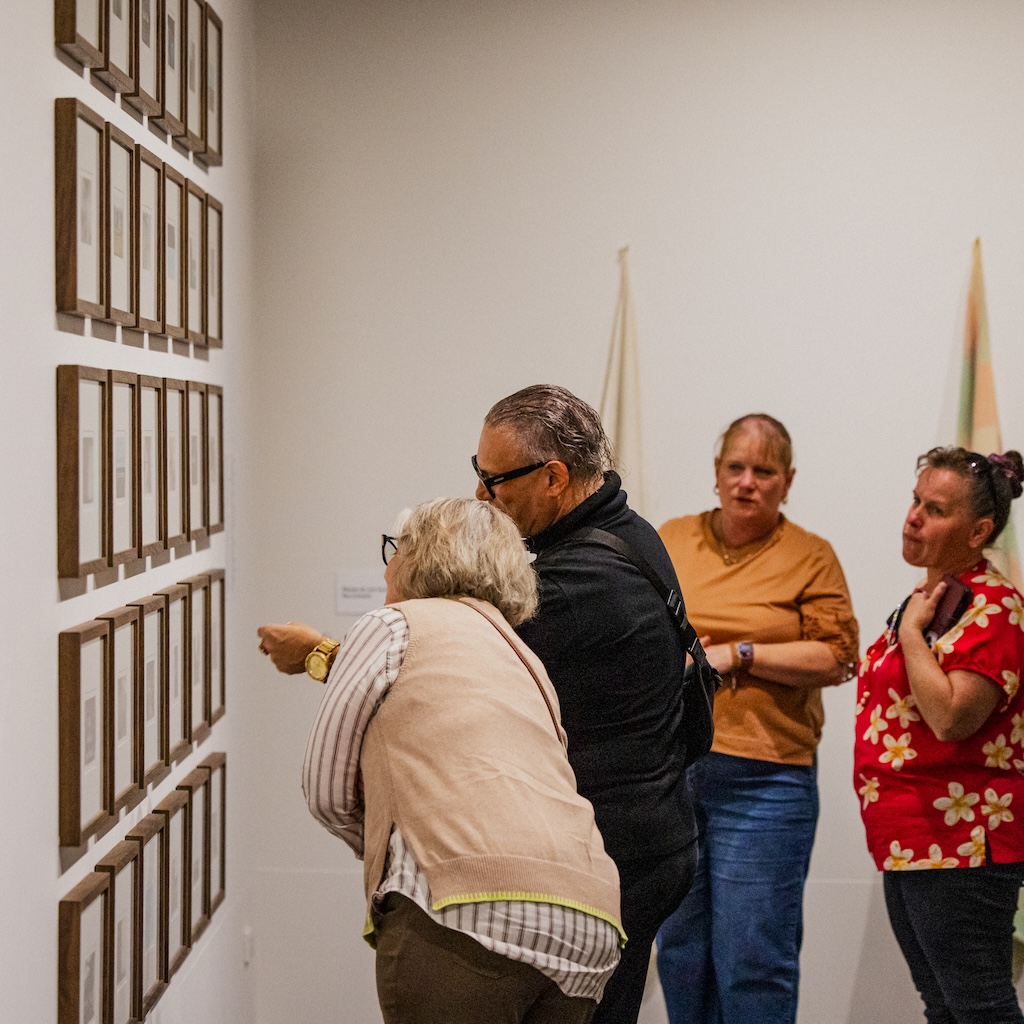
For Slow Art Day 2025, Cameron Art Museum in Wilmington, North Carolina invited visitors to participate in a self-guided slow-looking experience designed to encourage careful observation and personal meaning-making. The museum emphasized that slow looking is not driven by curators or historians, but by individuals forming their own connections with artworks.
Visitors were encouraged to intentionally select three to four artworks and spend extended time with each, using a printed Guide to Slow Art that offered practical suggestions such as finding a comfortable place to sit, bringing a notebook and pencil, and building meaning through sustained observation and conversation with companions
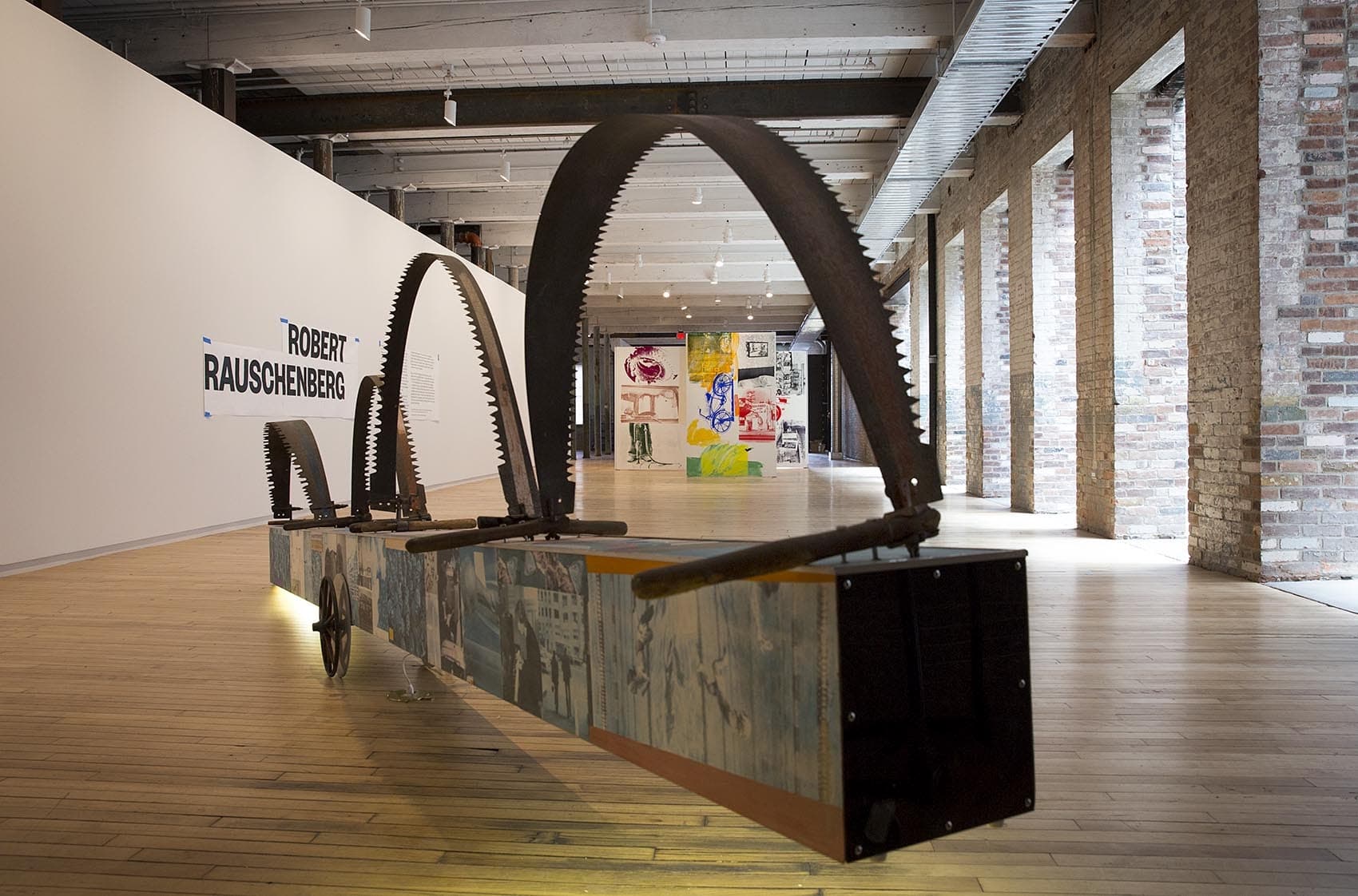
Th guide suggested visitors spend time with artworks from the exhibition The Game Changers, which highlighted the Abstract Expressionist artists Helen Frankenthaler, Richard Diebenkorn, and Robert Rauschenberg. Suggested works included:
Girl Squatting (1960) by Richard Diebenkorn
Tiger’s Eye (1987) by Helen Frankenthaler
Autobiography (1968) by Robert Rauschenberg
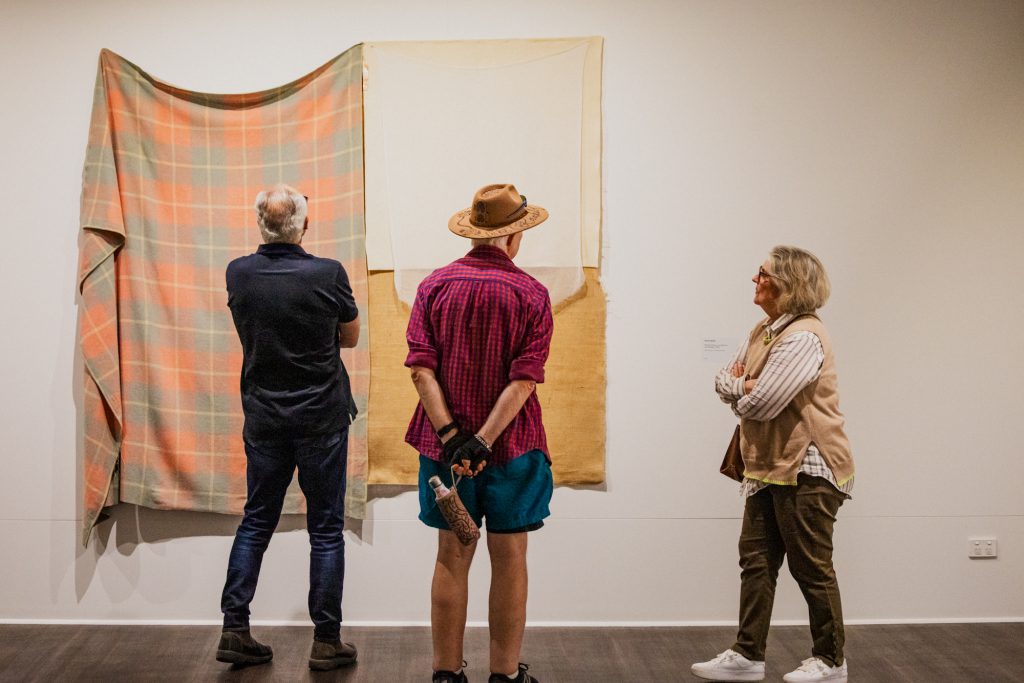
From left to right: Helen Frankenthaler, Tiger’s Eye, 1987. Color etching, aquatint, lithograph, and silkscreen. Collection of Cameron Art Museum, Belden Collection. Richard Diebenkorn, Girl Squatting, 1960. Oil on canvas. On loan from the Akron Art Museum, purchased with funds from the Phyllis Albrecht Memorial Fund. Bottom: Robert Rauschenberg, Autobiography 1968. Offset lithography on paper. On loan from Nasher Museum of Art at Duke University, Gift of Blake Byre, A.B. ‘57. Slow Art Day participant viewing Robert Rauschenberg, Why You Can’t Tell #2, 1979. Lithograph and collage on paper. On loan from the Weatherspoon Art Museum, University of North Carolina, Greensboro, NC, Gift of Mr. and Mrs. Samuel Dorsky. Slow Art Day participants viewing Robert Rauschenberg, Autobiography 1968. Offset lithography on paper. On loan from Nasher Museum of Art at Duke University, Gift of Blake Byre, A.B. ‘57.
By offering a clear framework while leaving interpretation open, Cameron Art Museum created a Slow Art Day experience that supported independent exploration and reflection throughout the day.
Below is their front desk signage for the day, and you may download their Slow Art Day Flyer to see how they framed their instructions for the day. (PDF, 7.5 MB).
We thank Ashley Rowland, Education Assistant, and the Cameron Art Museum team for hosting Slow Art Day 2025 and look forward to seeing what they come up with for Slow Art Day 2026.
For Slow Art Day 2025, Bloomington–Normal, Illinois once again led a citywide Slow Art Day – they were the first to pioneer citywide events several years ago. Led by Pamela Eaton of Eaton Studio Gallery, the citywide Slow Art Day has grown into a statewide collaboration with a number of sponsors and leaders coming together. See the beautiful poster below.
The collaborative citywide scope of the event was documented by the Illinois Route 66 Scenic Byway. These photographs captured the range of venues and the conversations taking place across the city during the Slow Art Day weekend.
Here are a few reports we received from across the 2025 Citywide.
Eaton Studio Gallery At the Eaton Gallery, their Slow Art Day event centered on Star Crossed Pollinators, a refurbished sculpture by artist Herb Eaton originally created in 2000 for Bloomington’s Sesquicentennial celebrations. The work was on view during Slow Art Day as part of its refurbishment process ahead of its planned move to a permanent location at the McLean County Museum of History.
Photos below are of artist Herb Eaton with the original sculpture in 2000 on the left, and the new version in 2025 on the right.
Inside Out Accessible Art (IOAA) IOAA hosted artists demonstrating their techniques alongside other artists who brought individual works to discuss with patrons. The open format encouraged dialogue and allowed visitors to spend time with both artistic process and finished work. Photographs of the event below were taken by Shelley Schultz.
Red Raccoon Games Red Racoon in downtown Bloomington hosted artist Gina LaMonica, whose works were shown via the table setup below.
The Bloomington–Normal Slow Art Day demonstrated how a coordinated, multi-site approach can support slow looking at scale while remaining grounded in local artists, studios, and shared civic spaces. We thank Pamela Eaton, Eaton Studio Gallery, Inside Out Accessible Art, and all participating organizations and artists for making this citywide Slow Art Day possible. We look forward to seeing what they come up with for their citywide Slow Art Day in 2026.
For Slow Art Day 2025, Vänersborgs konsthall in Vänersborg, Sweden, hosted a guided slow-looking event centered on the exhibition A.I. vs Själen (A.I. vs the Soul). The program combined meditation, independent observation, and group dialogue in a focused gallery setting.
Participants engaging in slow looking and discussion during Slow Art Day at Vänersborgs konsthall. Photo courtesy of Vänersborgs konsthall.
Selected artworks were chosen by participants from two designated walls within the exhibition A.I. vs Själen (A.I vs the Soul)
Eleven participants took part in the free event. The session began with a short introduction to slow looking as a practice, followed by a guided meditation designed to help participants settle into the experience. From there, facilitators offered simple, structured prompts to support a 10-minute slow looking exercise. Participants then gathered to share reflections and discuss their thoughts. Conversations focused on perception, attention, and how the themes of technology, AI, and the human soul emerged through extended looking.
Following the discussion, the gallery invited participants to continue the conversation over a traditional Swedish fika, offering coffee and biscuits in a relaxed social setting.
Poster for the event.
We thank Hanna Tobiasson, Cultural Coordinator at Vänersborgs konsthall, for creating a Slow Art Day experience that thoughtfully engaged questions around technology and its growing influence on how art is created, perceived, and discussed today. We look forward to seeing what the team at Vänersborgs konsthall comes up with for Slow Art Day 2026.
For Slow Art Day 2025, yoga-based movement instructor Carol Rossi of Lobey Movement returned to Slow Art Day – she was a pioneer who helped launch the movement back in 2010 – and hosted her own slow-looking session at the de Young Museum in San Francisco, California. Drawing from her background in yoga and mindfulness, Rossi designed a self-guided Slow Art Day experience.
In preparation for the day, Rossi created and shared a dedicated Slow Art Day webpage that outlined simple viewing tips and a short guide to the artworks she selected. Her materials encouraged participants to spend extended time with each work, notice physical details and emotional responses, and resist the urge to move quickly. Rather than formal facilitation, the structure supported personal pacing and reflection, allowing participants to engage with the museum in a focused yet flexible way.
Rossi documented and reflected on the experience through LinkedIn and Instagram, sharing photographs, excerpts from her viewing guide, and personal observations about hosting Slow Art Day. These posts are great practical examples for others interested in creating their own Slow Art Day experiences to follow. Her approach shows how hosting can begin with clear intentions, simple prompts, and a willingness to invite others to slow down together.
At Slow Art Day HQ, we actively encourage this kind of individual-led design. Slow Art Day is not limited to institutions; anyone can host a slow-looking experience, whether as a yoga instructor, educator, designer, or community member. Resources like Carol Rossi’s website and posts offer concrete inspiration for those considering hosting their own event, much like other community-driven Slow Art Day efforts we have seen in recent years.
We thank Carol Rossi for her pioneering support of Slow Art Day, and for returning to work with us again. We look forward to seeing what she comes up with for Slow Art Day 2026.