For their third Slow Art Day, Concordia in Enschede, Netherlands, created an experience that embraced independent reflection and cinematic viewing.
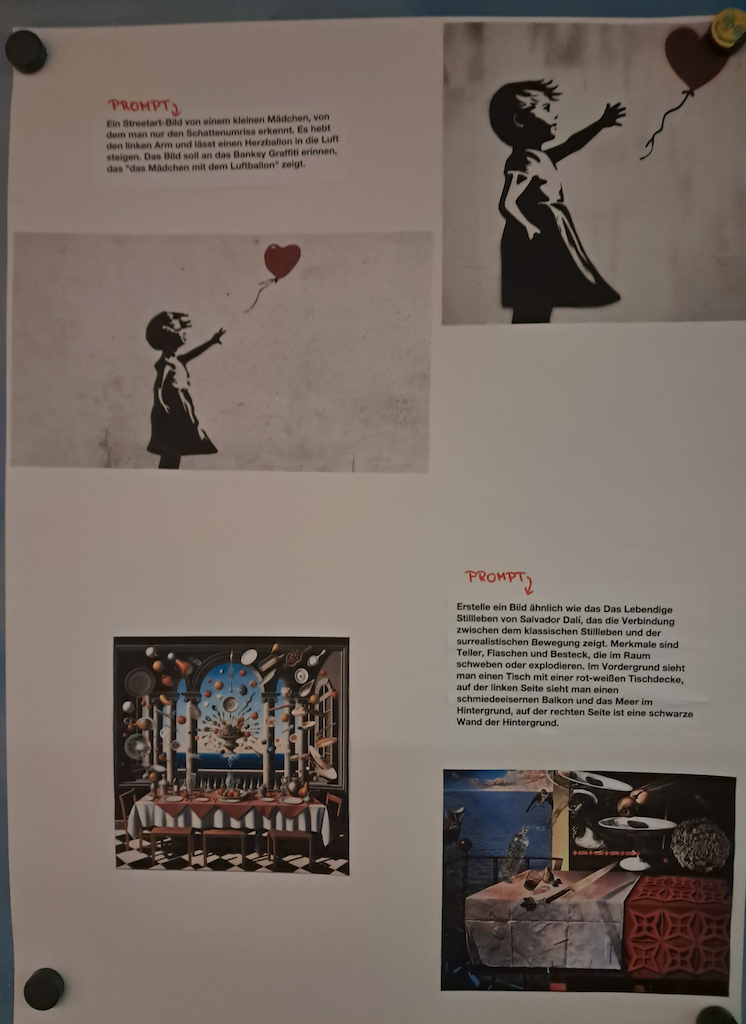
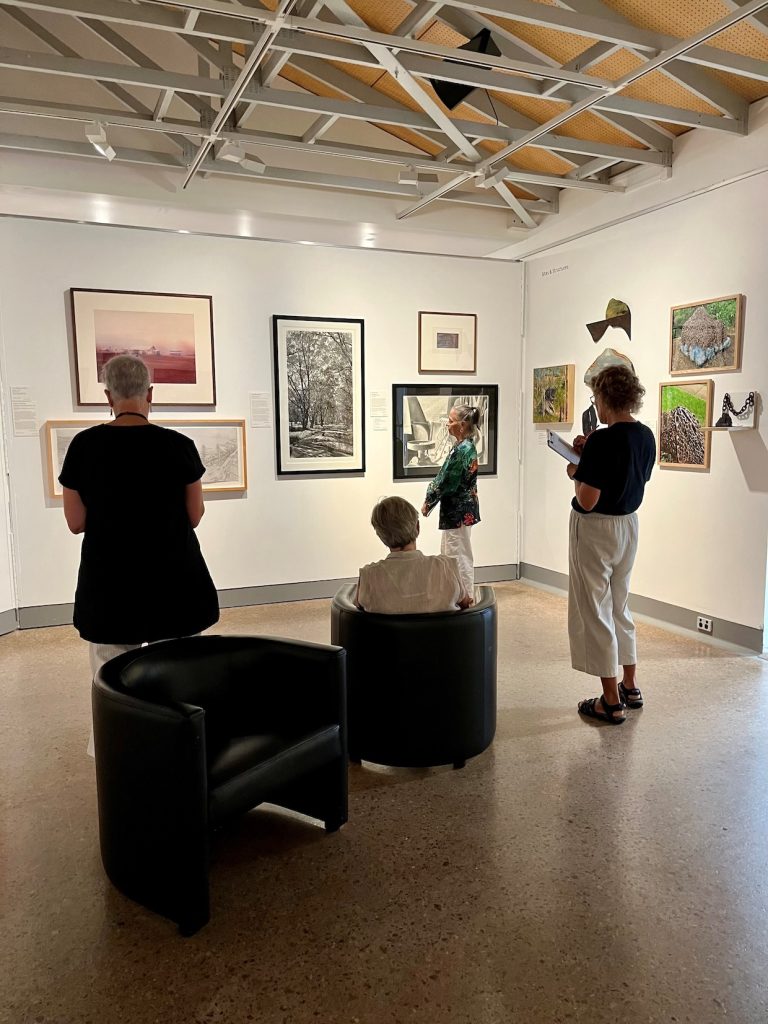
While the originally scheduled artist talk had to be canceled due to personal reasons of the artist, the team thoughtfully adapted the event. They provided seating within the gallery space so visitors could independently spend time quietly viewing the works on display. Concordia also published tips online about how to look slowly at art, which many guests reviewed ahead of their visit. Additional prompts at the venue helped guide individual reflection and deepen the viewing experience.
Promotional graphic for Concordia’s Slow Art Day. (Courtesy of Concordia)
To conclude the day, visitors were invited to a screening of The Mirror by filmmaker Andrei Tarkovsky — a contemplative cinematic work that echoes the principles of Slow Art Day.
Photos from the exhibition:
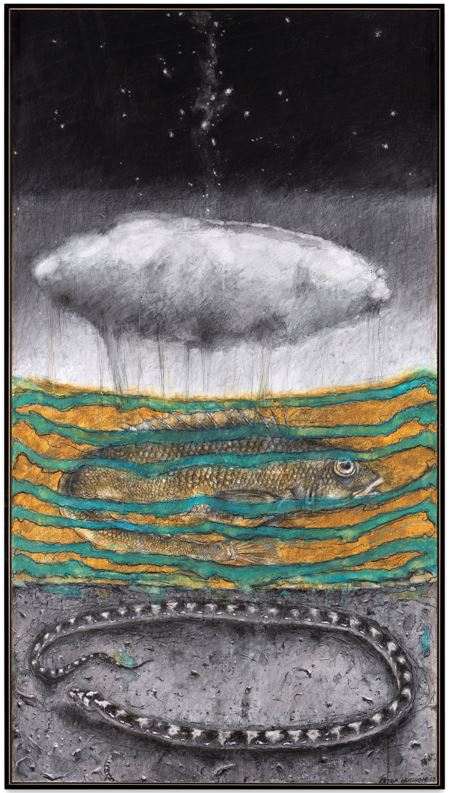
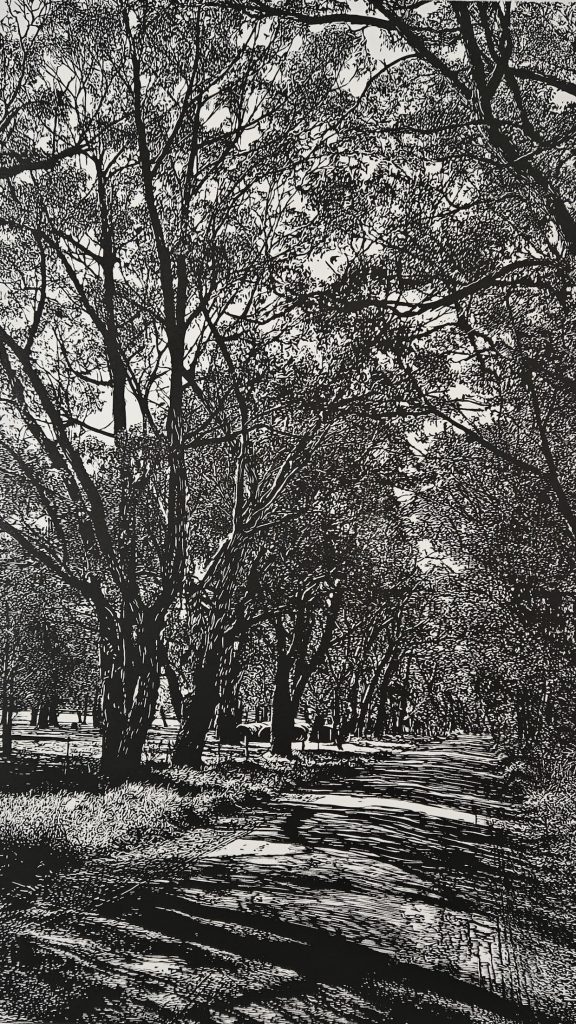
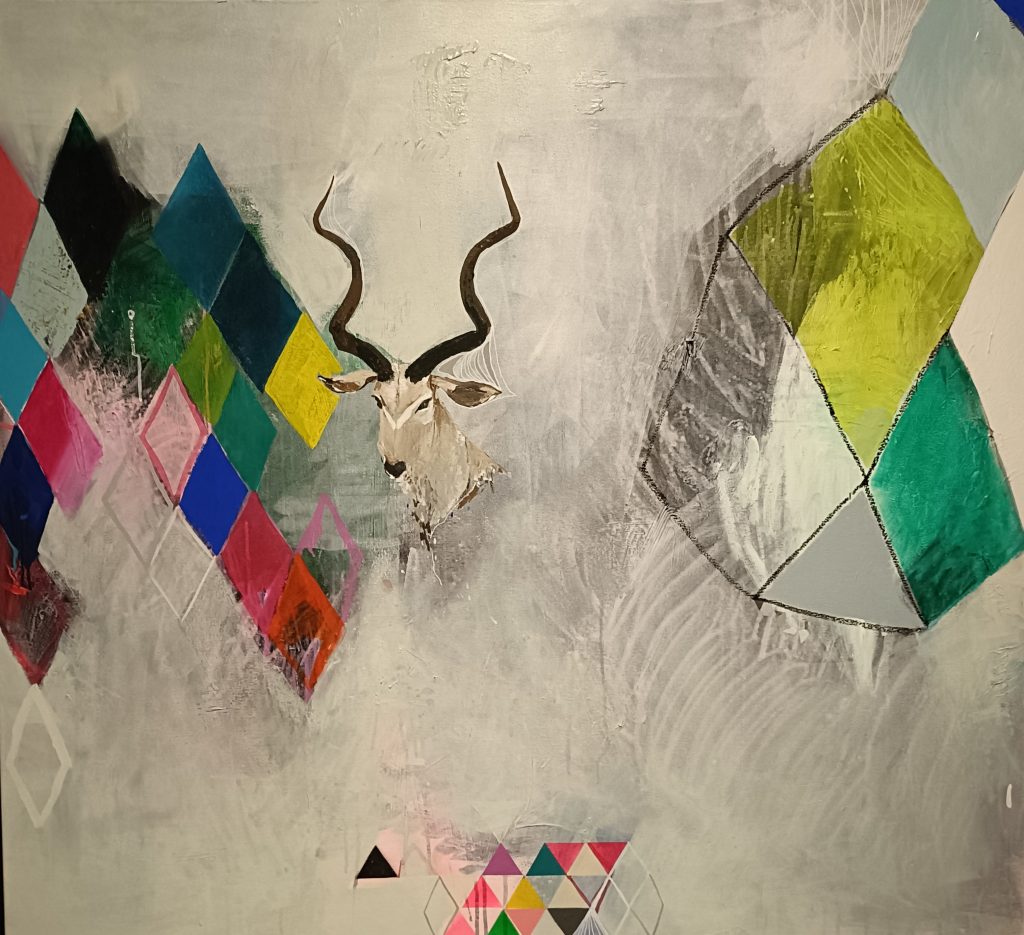
Alexandra Leykauf – All together now, video.(Photo courtesy of Concordia)Alexandra Leykauf – Drie Stenen II. (Photo courtesy of Concordia)Sara Rajaei – Veronica and Chantur.(Photo courtesy of Concordia)
We at Slow Art Day HQ applaud Concordia for turning unexpected changes into an opportunity to highlight the power of self-guided reflection and film. We look forward to seeing what they do for Slow Art Day 2026.
For their third Slow Art Day, RiverBrink Art Museum, located in Queenston, Ontario (Canada), invited visitors to slow down and deepen their connection with three selected artworks from their permanent collection. Guests were welcomed into the gallery and encouraged to sit quietly with each artwork, observing closely for five minutes before joining a facilitated group discussion led by Programming and Curatorial Assistant Moyu Chen.
Featured works included:
“Effet de Pluie, Pont Aven” by Gustave Loiseau (n.d.)
“Portrait of Frances Davis” by Francis Cotes (c. 1760)
“Settlers’ Cabin in the Foothills [Early Canadian Settler]” by Cornelius Krieghoff (1859)
“Effet de Pluie, Pont Aven” by Gustave Loiseau.(Photo courtesy of RiverBrink Art Museum)“Portrait of Frances Davis” by Francis Cotes.(Photo courtesy of RiverBrink Art Museum)“Settlers’ Cabin in the Foothills [Early Canadian Settler]” by Cornelius Krieghoff.(Photo courtesy of RiverBrink Art Museum)
Participants reflected on visual details, brushwork, subject matter, and emotional tone. The museum provided extra seating to ensure an accessible and comfortable environment for slow looking, and a helpful handout (featured below) with observation questions created by the museum team.
Gallery setup for Slow Art Day at RiverBrink Art Museum, featuring “Effet de Pluie, Pont Aven” by Gustave Loiseau.* (Photo courtesy of RiverBrink Art Museum)
We at Slow Art Day HQ love the art, the simple design and the ongoing partnership with RiverBrink. We look forward to what they come up with for Slow Art Day 2026.
For their second year participating in Slow Art Day, Moderna Museet Malmö once again hosted a deeply reflective and engaging event that beautifully combined meditation with slow looking.
In the vibrant exhibition Vivian Suter – I Am Godzilla, participants gathered for a guided meditation session led by Ana María Bermeo, an artist, museologist, and certified meditation teacher. Through simple breathing and mindfulness exercises, Bermeo encouraged participants to slow their pace, immerse themselves in Suter’s rich visual world, and reconnect with their own inner experiences.
Slow looking and meditation surrounded by expressive, immersive works in the Vivian Suter exhibition. (Photo: Susanne Lindblad/Moderna Museet Malmö)
No prior experience with meditation was required — only a willingness to pause, breathe, and look slowly.
Attendees reported embracing the moment of silence and reflection, letting go of performance and expectation, and allowing themselves to experience both the art and their sensory impressions in a deeper, more contemplative way.
Participants meditating amidst the colorful canvases of the Vivian Suter exhibition at Moderna Museet Malmö.(Photo: Susanne Lindblad/Moderna Museet Malmö)
The bold, colorful canvases of Vivian Suter’s exhibition created a powerful backdrop for the session. For us at Slow Art Day HQ, it is particularly striking to witness participants seated quietly in a circle around these vibrant works, each deeply absorbed in silent meditation and reflection.
We are so grateful to Moderna Museet Malmö and to host Susanne Lindblad for continuing to be a valued part of the Slow Art Day movement. We can’t wait to see what they create for Slow Art Day 2026!
On April 15, Corridor Contemporary, located in the vibrant Fishtown neighborhood of Philadelphia, PA, hosted their first Slow Art Day in conjunction with the debut of their exhibition Printed Perspectives.
The location in Philadelphia is a sister gallery to owner Erez Zemach’s main gallery in Tel Aviv, both of which exhibit emerging and established Israeli and international artists. They showcase a range of contemporary art from figurative and photorealism to fresh contributions of graffiti and the wider street art vibe.
They kept the design of their Slow Art Day event simple, and recommended that participants choose at least 3 artworks and view them slowly for 5 minutes (perhaps even using a timer). They prompted viewers to consider what other areas of their life might benefit from intentionally slowing down.
Flyer for the event.Main gallery at Corridor Contemporary.Participants slowly viewing a work in the main gallery.
The gallery reported that they had quite a successful event with about 100 visitors attending throughout the day. I had the pleasure of being one of those participants, and was particularly drawn to the work of West Philadelphia artist King Saladeen in his solo exhibition: No Middle Cla$$. I found myself taking in his works for much longer than 5 minutes, and I wasn’t alone. They drew quite an audience.
Ashley Moran with work by King Saladeen.Artwork by King Saladeen.Staircase gallery at Corridor Contemporary.
Corridor Contemporary has three floors of galleries, and I found the small, winding staircase to be a perfect intimate spot to look slowly at skateboards adorned with art by Keith Haring from The Skateroom.
At Slow Art Day HQ, we love to see the breadth of institutions that participate in Slow Art Day, from local galleries such as this to the larger museums. It proves that Slow Art is truly accessible to all. I am particularly delighted to have discovered Corridor Contemporary’s gallery in my own neighborhood, and can’t wait for their event in 2024.
For their Slow Art Day 2023, Sweden’s National Museum (referred to as “Nationalmuseum” in Sweden) offered a full day of all kinds of interesting and creative sessions. Museums around the world take heed – this is a great way to celebrate Slow Art Day.
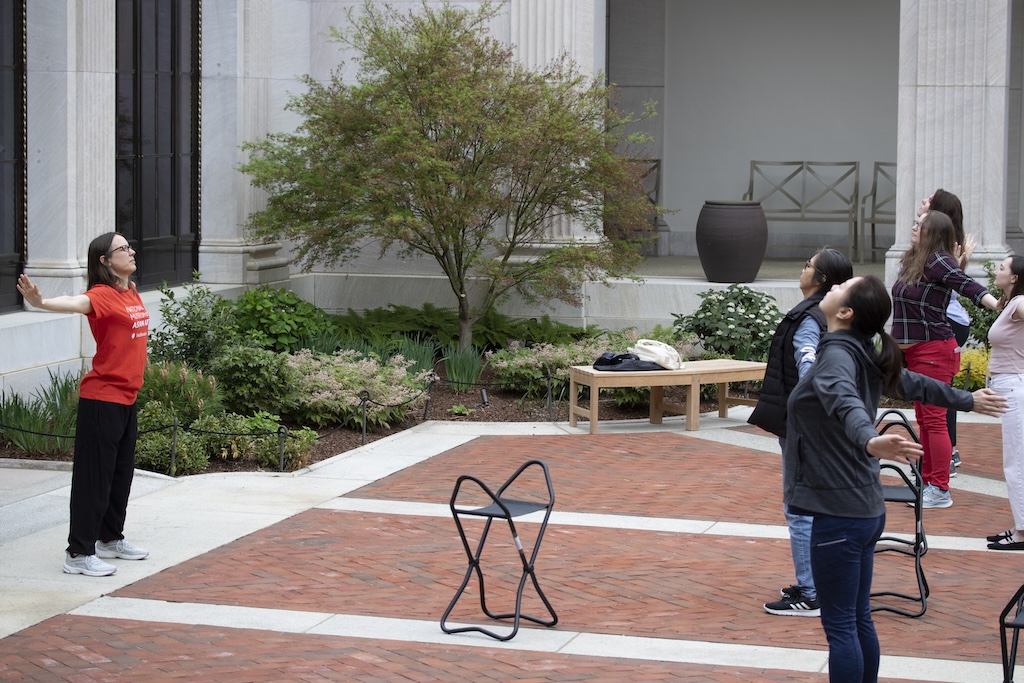
Under the direction of Johannes Mayer who coordinates the public events/programming, Sweden’s Nationalmuseum started Slow Art Day with a slow yoga class amongst sculptures in the sculpture yard, in the morning at 8:30 am before the museum opened. Participants were led by yoga teacher Victoria Winderud and the session ended with a fresh smoothie served in the café beneath.
Wow. We wish we could have been there.
Then, once the museum opened, young visitors (5-11 years old) were invited to go on a slow looking tour of a handful of paintings in the collection, led by museum staff, between 10:30 and 11:15 am. At 2 pm, adults were invited to do the same.
But that was not all.
There was also a storytelling session at the beautiful Strömsalen (a large room with both paintings and sculptures), led by Sara Borgegård, Intendent Pedagog for the museum (roughly – the “Superintendent of Pedagogy”), who told a saga based on one of the sculptures in the room.
Wait. There was more.
All day long, the Nationalmuseum offered “drop-in art-chill” sessions at the sculpture-hall/yard, where visitors could sit or lay down on a yoga mat and listen to a pre-recorded session, slowly observing the beautiful room.
And even that is not all.
Finally, all visitors could borrow a slow-looking guide to explore and discover works of art at their own slow pace.
Wow. Wow. Wow.
What a great design.
See some fabulous photos below.
Slow Art Day yoga with sculptures at Sweden’s National Museum, 2023.Children slow looking at paintings at the National Museum for Slow Art Day,2023 Children slow looking at paintings at the National Museum for Slow Art Day, 2023. Slow looking at an artwork for Slow Art Day 2023 at the National Museum
Slow Yoga (a person in a resting pose behind a half-reclining statue) at the National Museum’s Slow Art Day event.
Slow Art Day yoga with sculptures at Sweden’s National Museum, 2023
The Nationalmuseum team of Sara Borgegård Älgå, Johannes Mayer and Helena Sjödin Landonthere tell us they are looking forward to Slow Art Day 2024, especially as they continue to receive such great feedback from visitors (note: 2023 was their fourth Slow Art Day). Further, since Slow Art Day usually happens around Easter and many tourists are in town, they plan to offer some of the programs in English as well as Swedish, to make it accessible to even more people.
Wow. We can’t wait to see what they come up with for Slow Art Day 2024.
– Phyl, Johanna, Ashley, and Jessica Jane
P.S. The Slow Art Day team has decided to ask the Accademia Gallery of Florence if they would host a yoga session around the statue of David. Right? Let’s all go!
Executive Director Ross Mitchell at Glen Foerd in Philadelphia, PA reported that they had a very successful third Slow Art Day, featuring four works of art for an hour and a half of slow looking, followed by a group discussion.
“An Archive of Desire” by Jenifer Johnson (2020, Mixed Media, Porcelain. American)
“The Virgin and Child with the Infant St. John the Baptist” by Girolamo da Santa Croce (1480-1556, Tempera on wood. Venetian)
“The Letter” by Hobson Pitman, (1899-1972, Oil on Canvas. American)
“Lady Russell” by Sir Peter Lely, (1617 – 1680, Oil on Panel. Dutch, Active in England)
The following prompts were printed out and provided to partcipants to consider during their slow looking:
Look not only at what is pictured, but how it is pictured.
What kind of colors has the artist used? Are they bright, muted, or somewhere in between?
Can you see how the color has been applied or is the color smooth and blended?
Is there a sense of deep, moderate, shallow, or indeterminate space? Is that space consistent throughout the picture?
Is space clear and well defined or atmospheric? What about how the picture was painted gives it that quality?
Is there the suggestion of a directional light source, of light coming from a one side or the other?
Can you see lines anywhere, whether painted lines or strong edges created by color-to-color areas? Where are lines used and how?
What other observations can you make?
How is the installation piece different from the paintings?
What is the unifying theme of the installation?
Glen Foerd participated in a Philadelphia-wide Slow Art Day along with these other museums:
For their 4th Slow Art day, the Art Gallery of St. Albert, Canada had 44 visitors who took part in slow looking while viewing their current exhibitions “Connected Currents” by Kelsey Stephenson, and “LandEscape” by Crystal Lee Clark.
Exhibition view of “Connected Currents” by Kelsey Stephenson.
The gallery also provided a free art activity for all ages where visitors could create a collage bookmark inspired by Connected Currents. Younger guests were encouraged to try an iSpy activity carefully looking around the gallery to find smaller sections of the different art pieces on display.
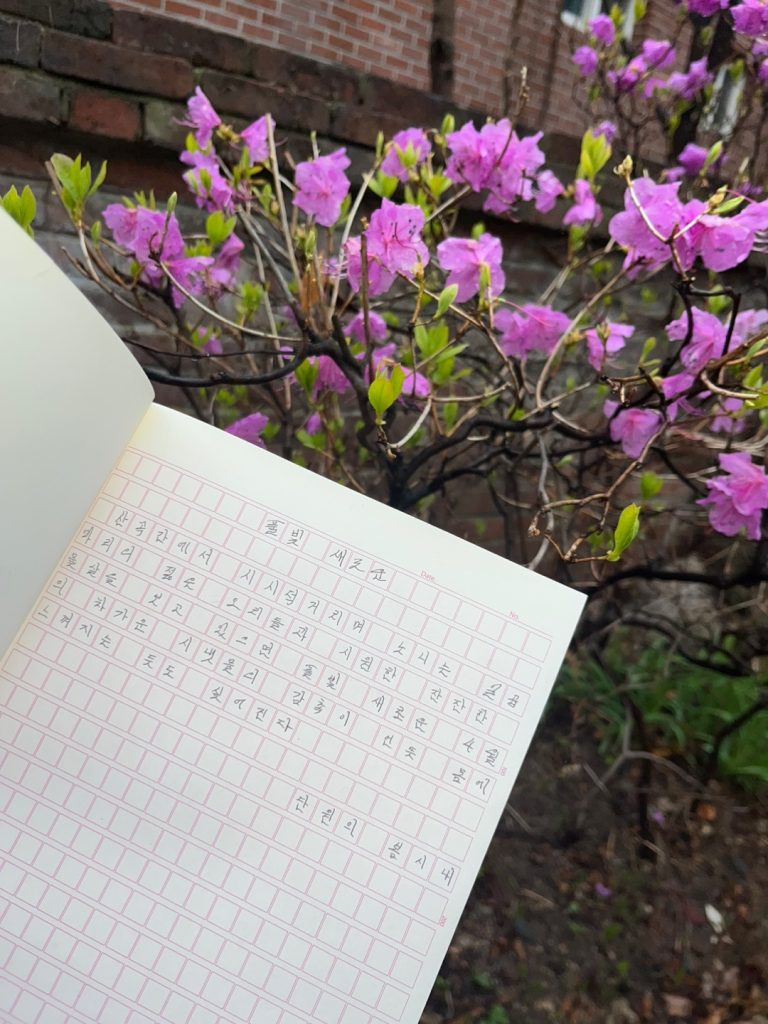
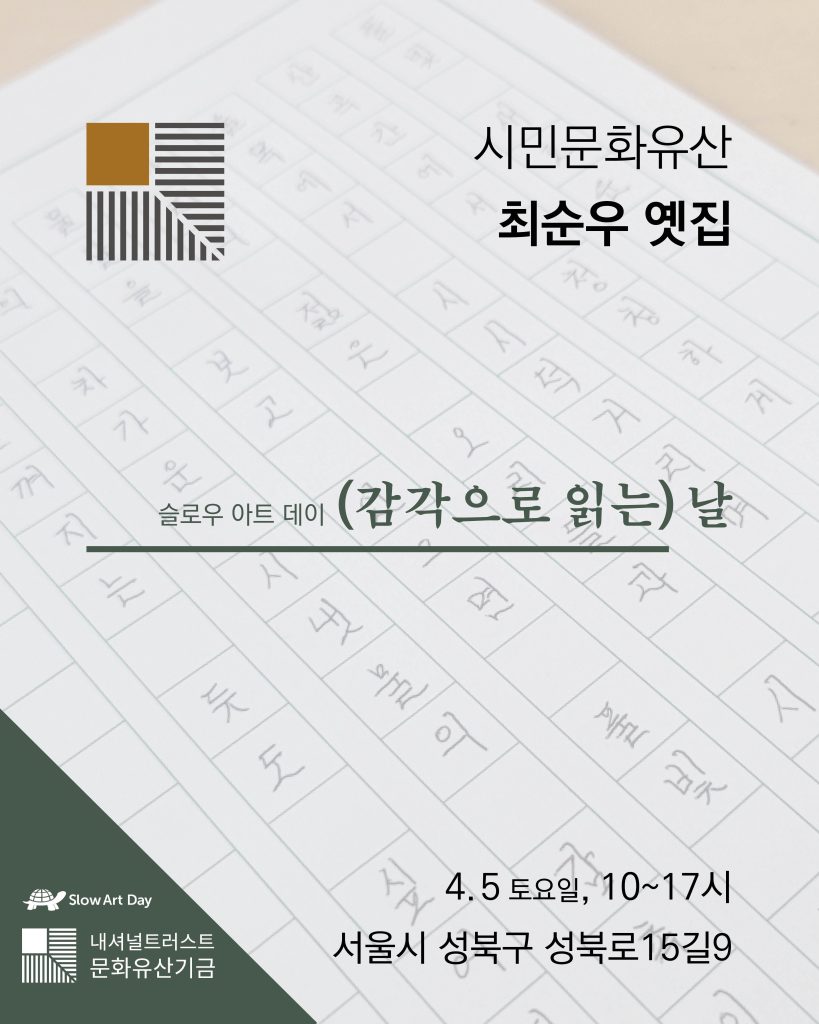
Ran Hee, the manager of the Choi Sunu House Memorial Museum in Seoul, Korea, hosted their (and Korea’s) first Slow Art Day on April 15 with the theme “Neurim & Nurim (느림 그리고 누림)”, which translates to “Slow and Enjoy”.
The event was jointly organized by the National Trust Cultural Heritage Foundation and Ewha Womans University Graduate School of Education participants majoring in art education, Kim Han-sol, Han Yu-jin, and Heo Bona.
Choi Sunu (1916~1984) was an eminent art historian and museum professional who served as the fourth director of the National Museum of Korea until his death. He devoted his life to define and propagate the beauty of Korean art and architecture through exhibitions and writings. The Choi Sunu House, where he lived from 1976 to 1984, is an expression of his aesthetics of simplicity and elegance, and has been open to the public since 2004.
Ran Hee and team created a three-part event:
First, curator Song Ji-young gave participants an introduction to Choi Sunu and his house.
Next, Bona Heo, Ewha Womans University graduate student, Yoo Jin-han, and Hansol Kim handed out question cards with prompts for slow looking (and talked about the slow looking movement).
Last, Professor Han Ju-yeon hosted a video viewing session and discussion with attendees (scroll down to see photos, as well as audio and video excerpts).
Visitors listening to the introduction of the Slow Art Day event.Curator Song Ji-young introduces the event.Participant contemplating the question cards.Flyer for the event.
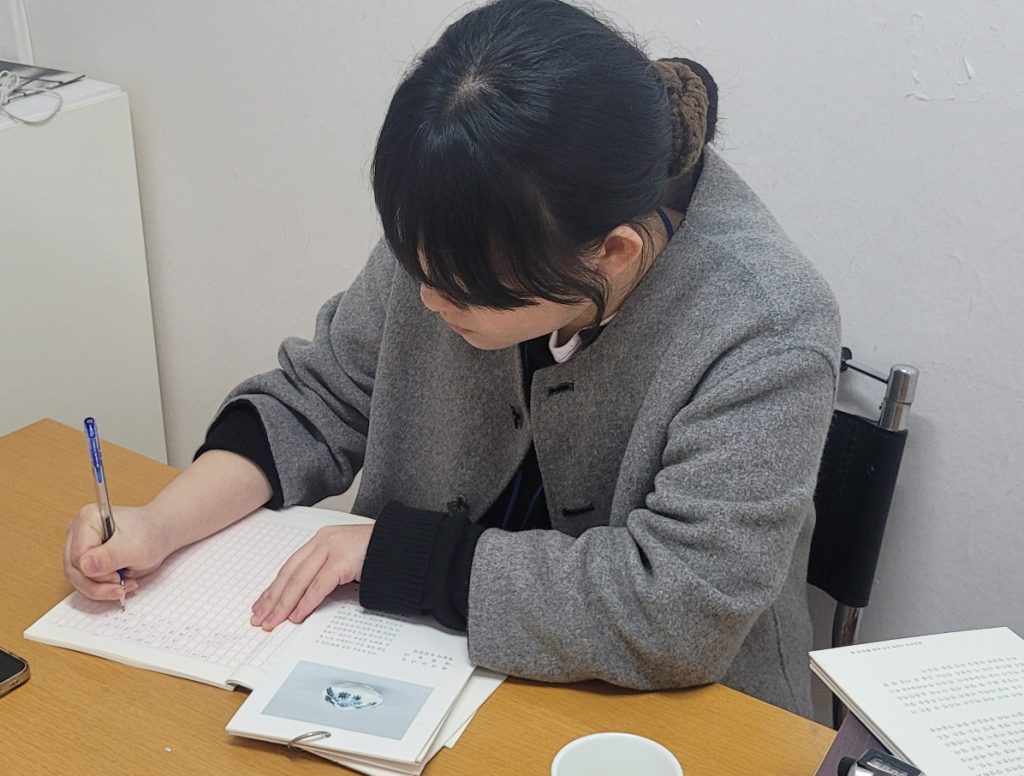
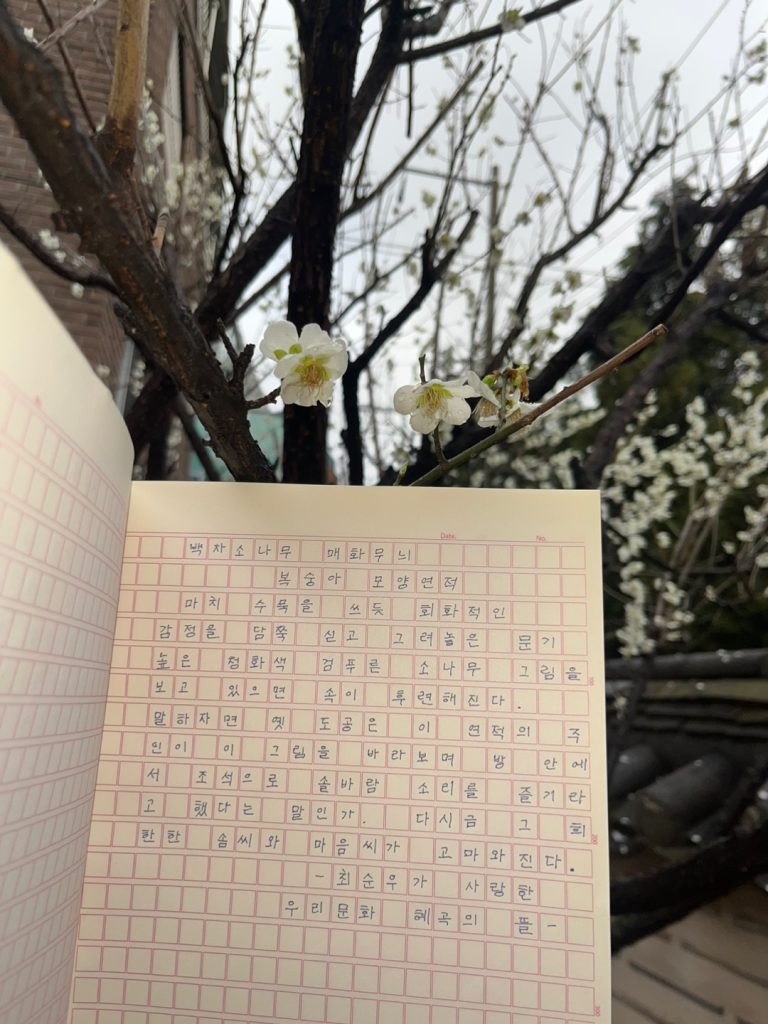
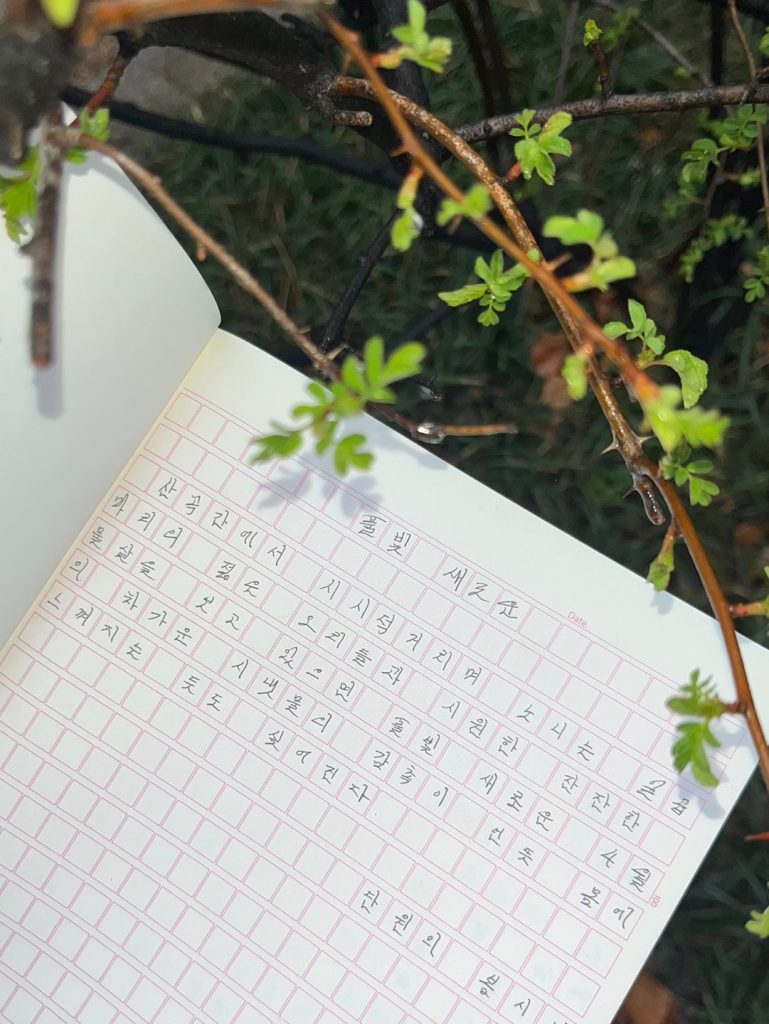
The hosts prepared a few memorable excerpts from Choi Sunu’s works alongside a video. Participants were also encouraged to write a short note on postcards about their experience.
Slow Art Day experience cards.
Below are a few links to audio and text excerpts of Choi’s works (in Korean):
Choi Sunu, “Fruits More Beautiful than Flowers”
Choi Sunu, “The Empty Branch of Mid-Winter”
Choi Sunu, “Light Green Radish”
We at HQ are glad to welcome the first Korean museum to the slow art movement, and look forward to seeing what the Choi Sunu House designs for Slow Art Day 2024.
– Ashley, Johanna, Jessica Jane, and Phyl
P.S. You can also follow Choi Sunu House on Instagram.
The Museums at Washington & Lee University in Lexington, VA held their first Slow Art Day this year, led by Director of Museums Isra El-beshir and student curator Posi Oluwakuyide, and focused on “The Root of the Matter,” an exhibit featuring the contemporary art of Sharon Norwood.
A conceptual artist of Caribbean descent, Norwood aims to provoke an honest conversation about race, beauty, and differences.
The Root of the Matter V, 2016 Digital Collage by Sharon Norwood. Courtesy of the Museums at Washington and Lee website.Slow looking participant. Courtesy of the Museums at Washington & Lee University Instagram.
As you can see, she uses the curly line to express identity and cultural relationships through various art forms, including ceramics, drawings, paintings, installations, and videos.
We are happy to welcome The Museums at W&L to our movement, and very much look forward to seeing the art they focus on for their second Slow Art Day in 2023.
– Ashley, Johanna, Jessica Jane, Robin, and Phyl
P.S. Below is the digital flyer used to promote the event (note their use of tinycc in their print marketing, which makes it easier for readers to type in long urls – something we recommend other educators consider copying for their print materials).
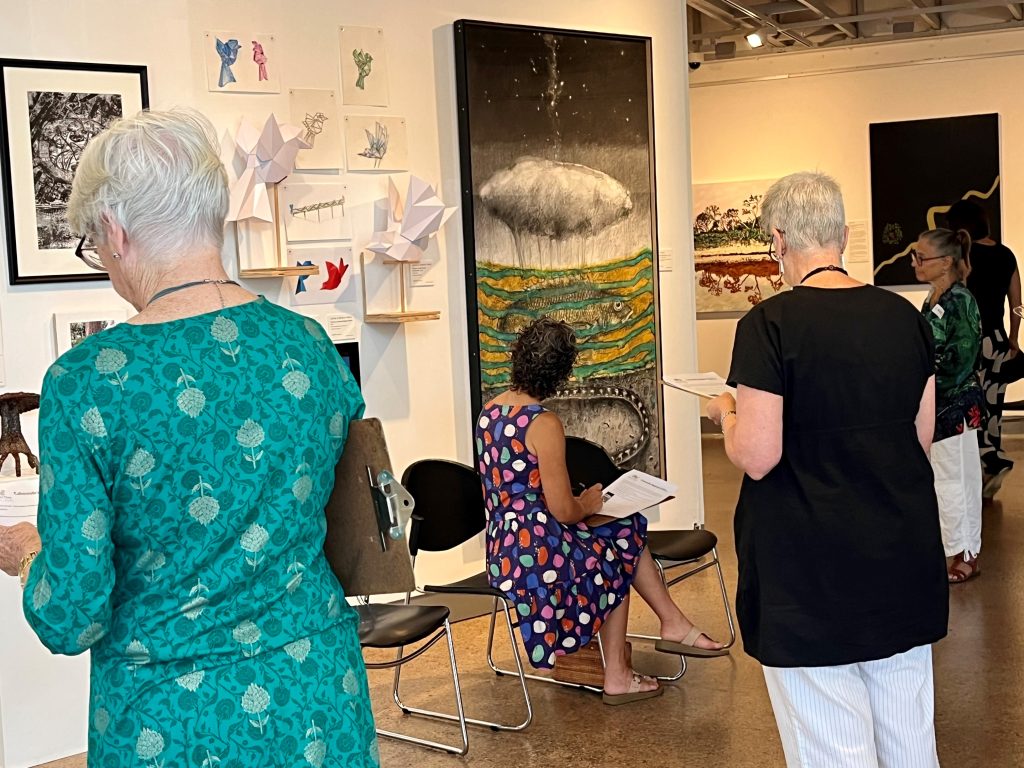
For their first Slow Art Day, Mindful Art hosted two days of mindfulness and slow looking at the Musée des Beaux Arts d’Orléans in Orléans, France. Organizer Marjan Abadie led the hybrid in-person and online event, which had 129 participants in total.
The Mindful Art Experience is an initiative by the Mindfulness Institute in Brussels, Belgium. Below is a website banner they used to promote the event.
Marjan Abadie leading participants through slow looking. CREDIT: Marjan AbadieSlow Art Day participants. CREDIT: Marjan Abadie
We look forward to what Marjan Abadie comes up with for Slow Art Day 2023.