Two-Day Slow Art Journey in San Francisco

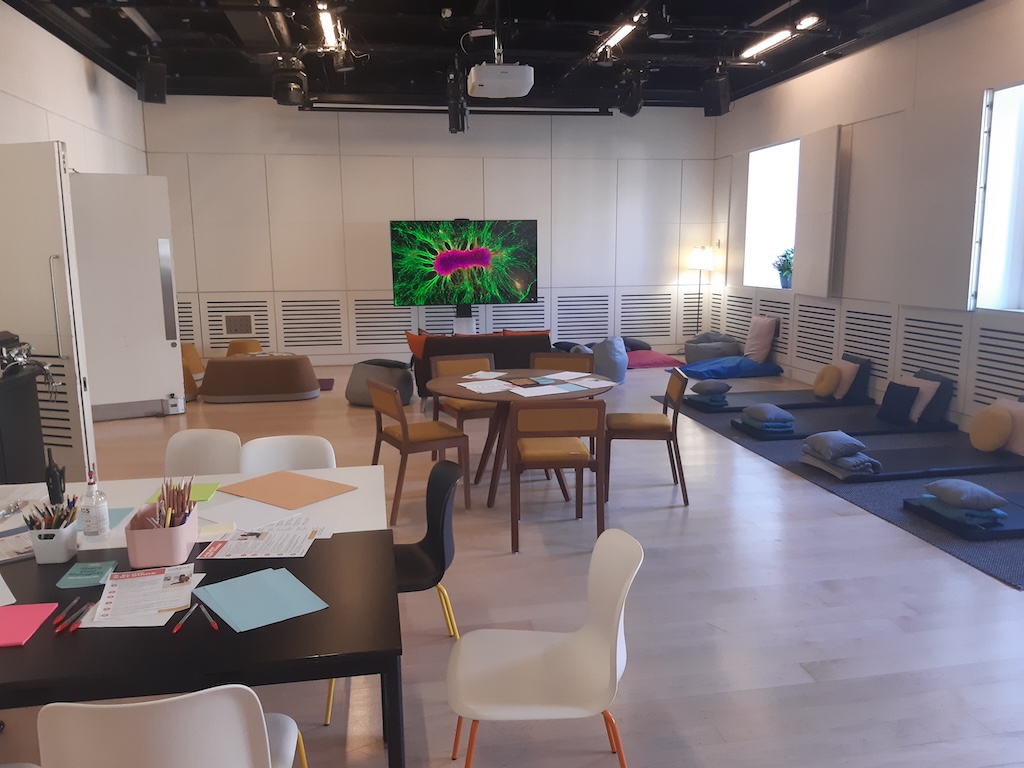
For Slow Art Day 2025, Bay Area participant Div hosted a unique, two-day experience that blended group slow looking at museums with individual ature observation, photography, and handmade art. The gathering, titled “Nowhere Div – Slow Art Day – San Francisco,” invited participants to slow down and reconnect with art through both creative practice and mindful observation.

Div’s personal experience unfolded over two days and across several locations in San Francisco, beginning with a slow walk through parks and gardens near Golden Gate Park and a reflective visit to the de Young Museum.

Div documented a series of seven “slow moments” during the journey, each centered on noticing beauty and emotional resonance in everyday surroundings. These moments included quiet reflection among the tulips at the Queen Wilhelmina Garden, a feeling of awe along Ocean Beach, and time spent with artworks at the de Young Museum. The walk continued through several locations in and around Golden Gate Park, including the Rose Garden, the Japanese Tea Garden, the Conservatory of Flowers, and the San Francisco Botanical Garden. You can read more about Div’s personal journey on their blog post.
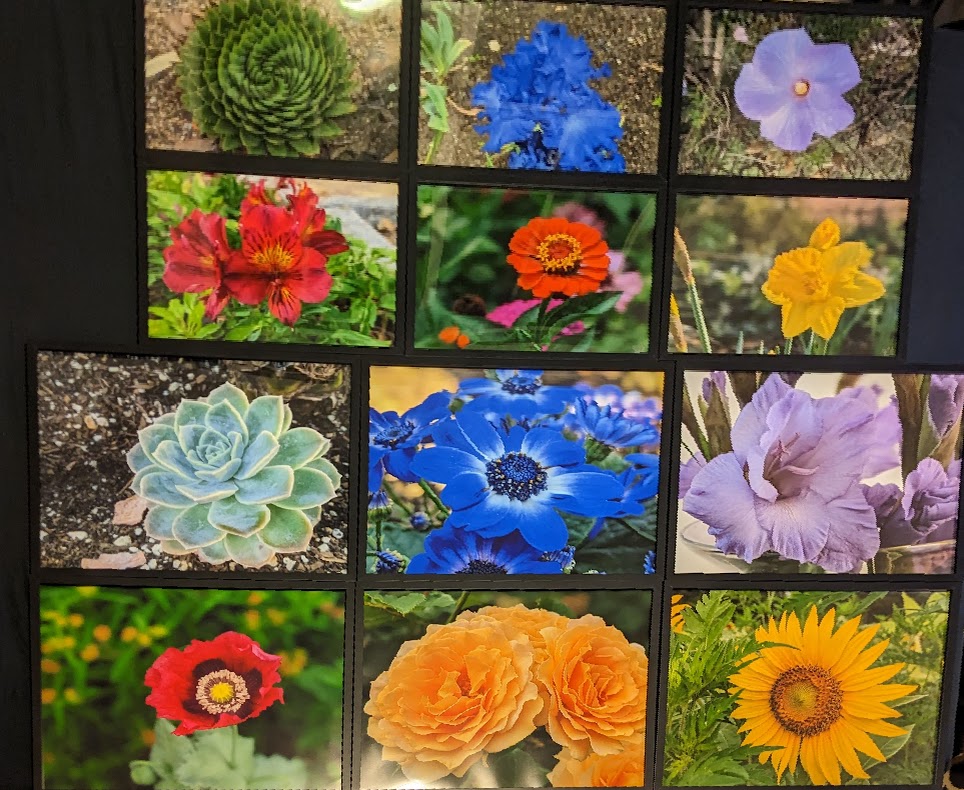
Each stop became an opportunity to pause and look carefully. Flowers, trees, and landscapes were photographed and paired with short reflections. Together, these observations formed a contemplative visual journal inspired by the spirit of Slow Art Day.

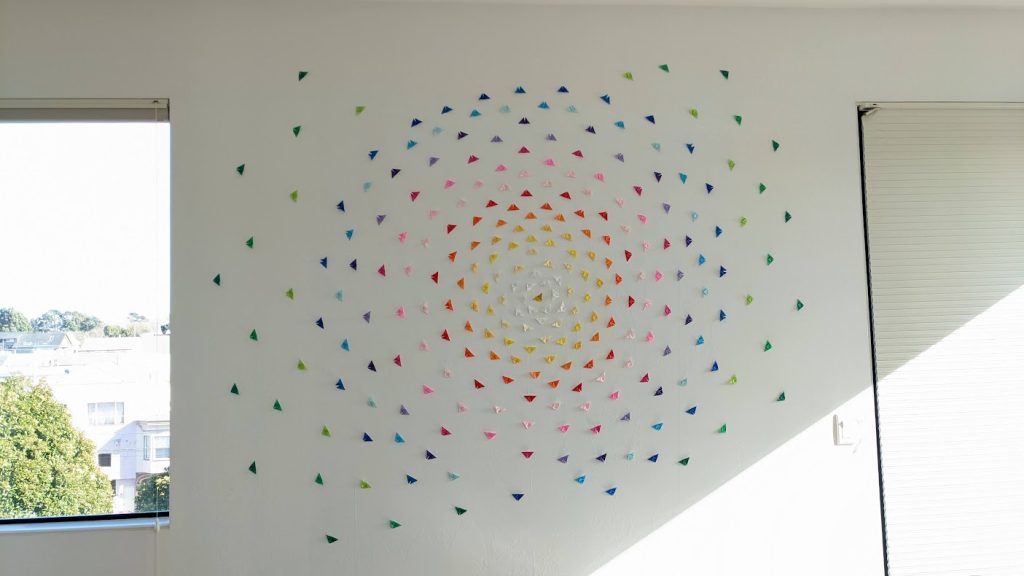
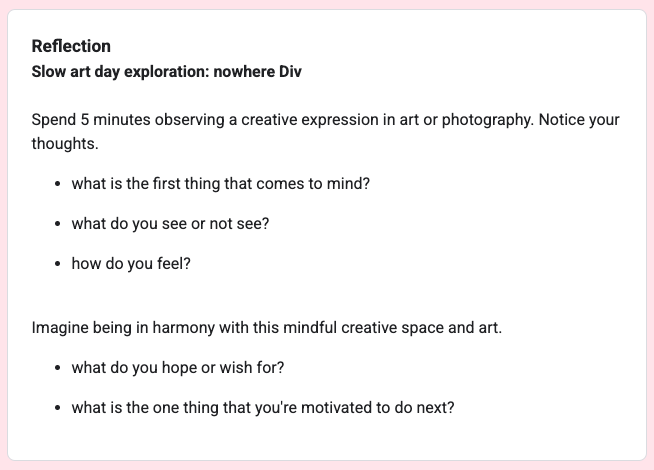
The following day, Div hosted a small community gathering in the Bayview neighborhood of San Francisco. Participants were invited to spend time with handmade butterfly origami mandala wall art and floral photography created by the host. The session included prompts encouraging visitors to reflect on the experience of slow looking and to consider how spending more time with an artwork changes perception and emotional connection.
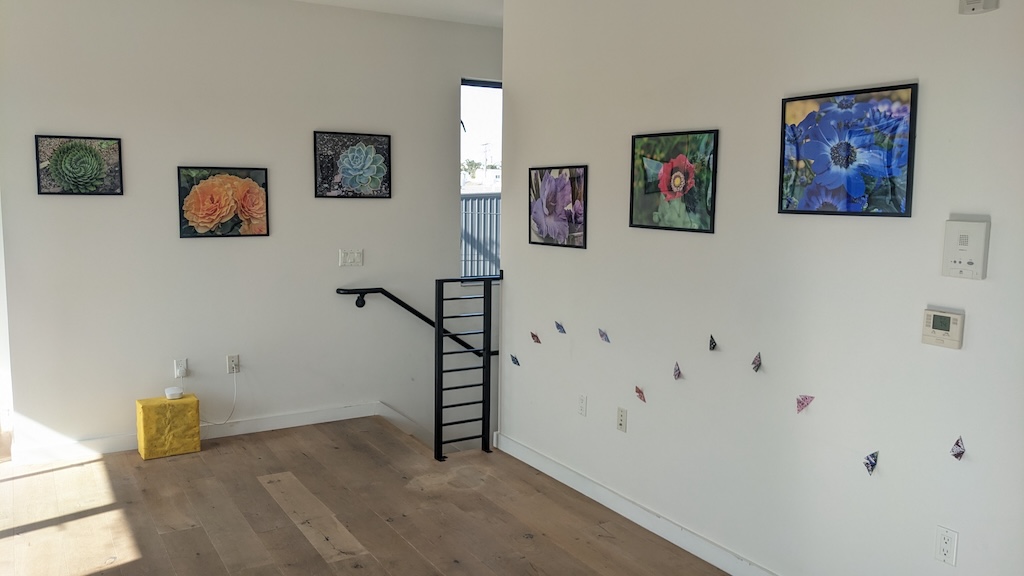
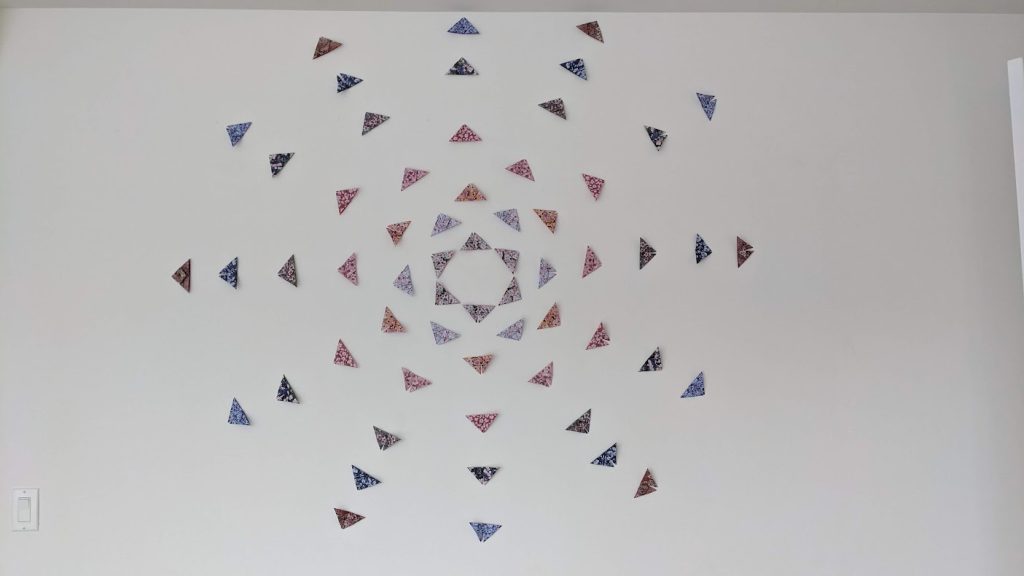
By combining museum visits, nature photography, and handmade artwork within a personal gathering, Div created a thoughtful example of how Slow Art Day can extend beyond formal institutions into everyday life. The experience demonstrated that slow looking can happen anywhere—from galleries and gardens to community spaces and personal creative practice.

We at Slow Art Day HQ are grateful to Div for sharing this reflective and deeply personal approach to Slow Art Day and look forward to what they come up with for Slow Art Day 2026, which is coming up April 11, 2026!

— Ashley, Johanna, Jessica Jane, and Phyl

P.S. If you have not yet registered your museum of gallery for Slow Art Day 2026, please do.
Multisensory Slow Art Day at the House of European History

For Slow Art Day 2025, the House of European History in Brussels, Belgium, launched a new program called “Slow Looking Saturday,” a guided series designed to accompany the museum’s temporary exhibition Presence of the Past: A European Album, which explores documentary photography and how Europeans engage with memory, history, and the legacy of the past.

The inaugural session, held on April 5 for Slow Art Day, focused on a single photographic project: “Our Family Garden” by Bosnian artist Smirna Kulenović. Participants gathered for a one-hour facilitated slow looking experience led by Pauline Gault, Informal Learning Project Manager at the museum. The session was designed to help visitors deeply explore one image and its many layers of meaning.

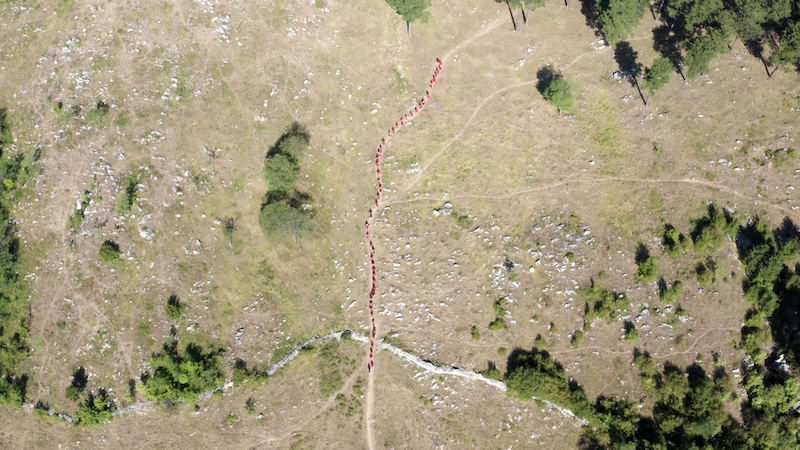
“Our Family Garden” documents a remarkable act of healing through nature. In the project, calendula flowers are planted in former trenches used during the Siege of Sarajevo, transforming spaces once associated with violence into places of growth and remembrance. The Slow Art Day session took place just one day before Sarajevo’s city day, when people now gather to care for these gardens.

Drone view of the calendula-planting performance ‘Our Family Garden’ organized by Smirna Kulenovic and filmed by Jasmina Omerika, Bosnia and Herzegovina, 2021.
Smirna Kulenović, A grandmother, mother and daughter prepare to plant flowers in the former trenches from which Sarajevo was besieged between 1992 and 1996, Bosnia and Herzegovina, 2023.

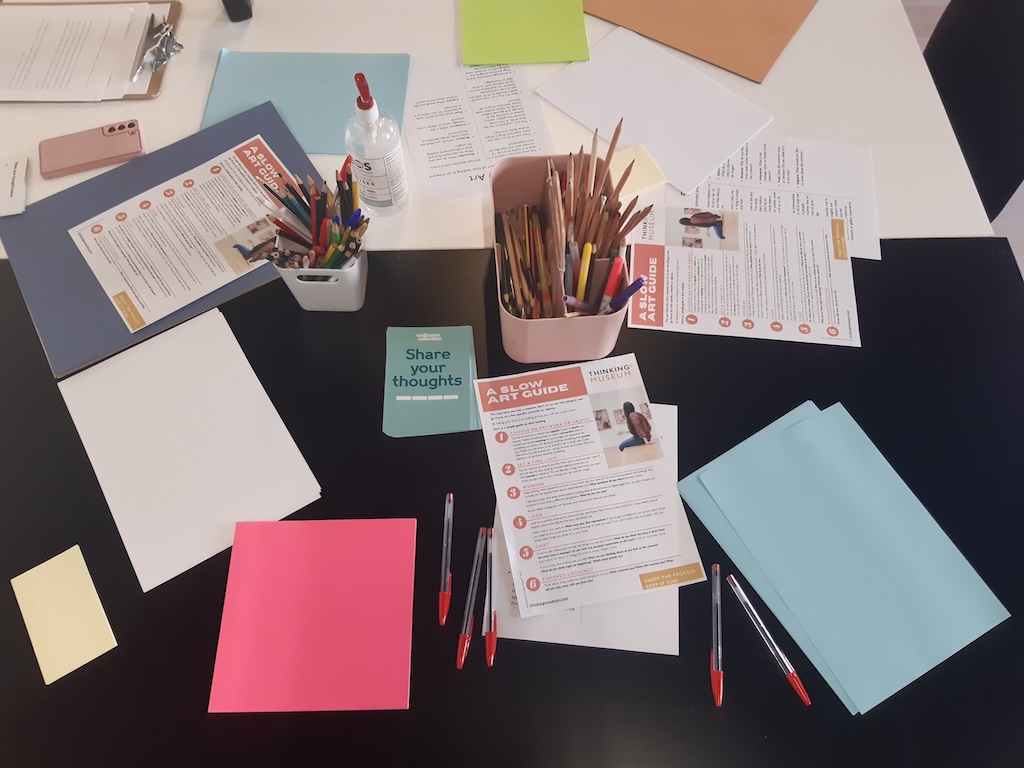
To guide the slow looking experience, Gault incorporated educational frameworks including Project Zero Visible Thinking routines from the Harvard Graduate School of Education and the Thinking Museum® Approach developed by museum educator Claire Bown, author of The Art Engager: Reimagining Guided Experiences in Museums. Participants engaged in several structured activities including Memory Draw, Engage & Imagine, and 3–2–1 Reflection, each designed to deepen observation, interpretation, and conversation.

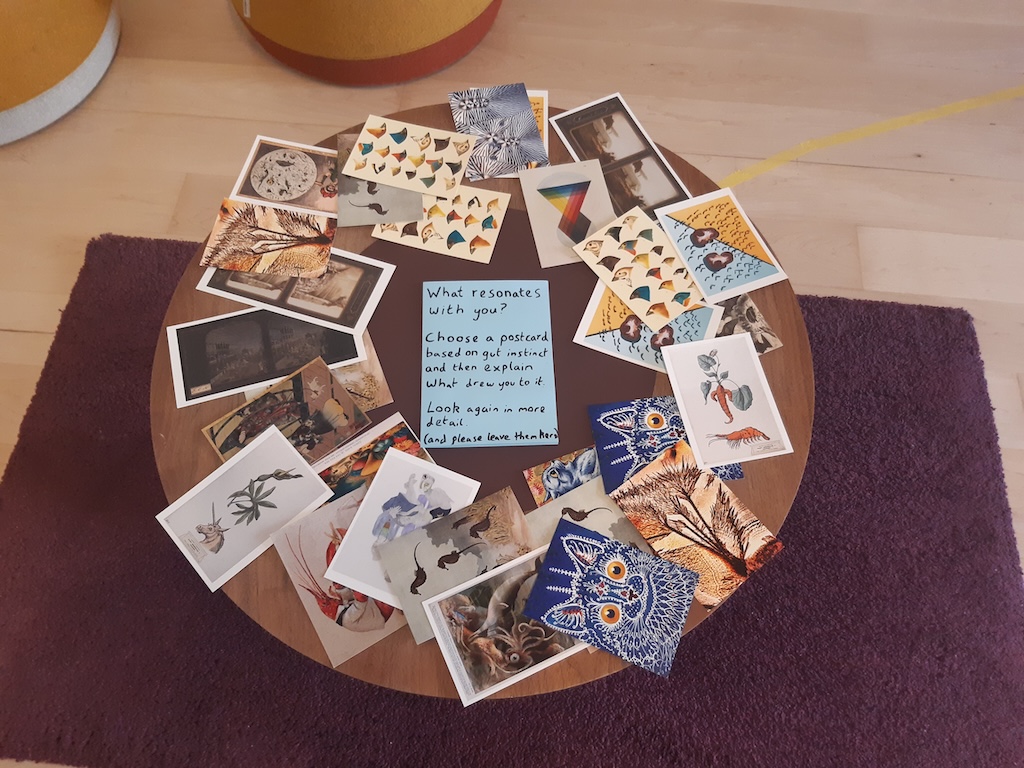
The session also activated the sense of smell: dried calendula flowers were present in the room, allowing participants to connect physically with the plant at the center of the artwork. During the closing reflection exercise, visitors wrote their thoughts on the back of specially designed postcards featuring the artwork. These served both as reflection tools and souvenirs for participants to take home.

Feedback from participants was very positive. Many remarked that focusing on a single photograph allowed them to notice details and meanings they would have otherwise overlooked.

We at Slow Art Day HQ are delighted to see the House of European History launch an entire learning series from their Slow Art Day program. Special thanks to Pauline Gault and the Learning & Outreach team for developing this thoughtful approach, and we look forward to hearing about their event for Slow Art Day 2026.

— Ashley, Johanna, Jessica Jane, and Phyl

Eighth Slow Art Day at Habitat for the Arts, Jasper, Alberta, Canada

On April 5, 2025, Habitat for the Arts in Jasper, Alberta, Canada hosted another meaningful Slow Art Day at the Jasper Museum, continuing a tradition they have explored over eight years. Each year is different, and this year’s gathering centered on heritage photography and the way art captures and stills time.

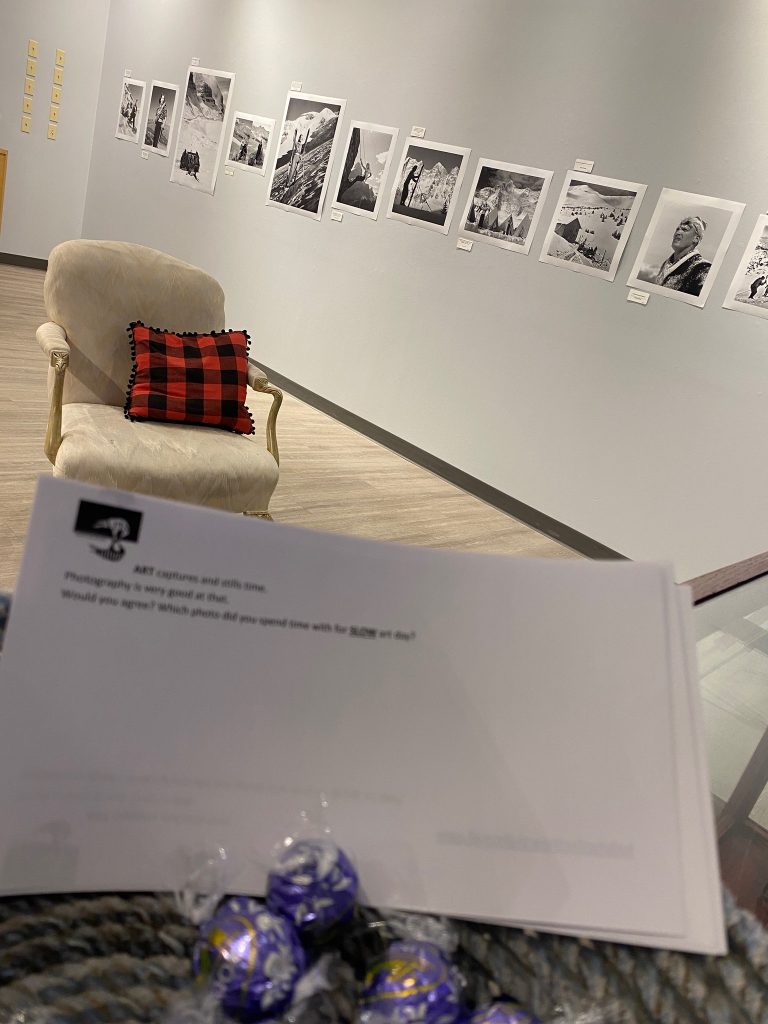
The focus of the day was a photography exhibition featuring the work of Harry Rowed — images of people and places in Jasper National Park from the 1940s through the 1960s. The black-and-white still images offered participants a window into earlier generations, inviting them to consider memory, place, and continuity.

The morning program began with a dedicated half hour of slow viewing inside the exhibition. Participants were given a small piece of paper to carry with them as they moved through the gallery. They were invited to reflect on a simple but powerful question: Which image captured you? Which image made you stop and truly spend time with it?

After the quiet viewing period, guests gathered for tea and cookies — and even chocolate — creating a relaxed and welcoming atmosphere for conversation. The structure of the hour allowed for both solitude and shared reflection. The museum space, with comfortable seating placed among the historic images, encouraged visitors to linger.

Photography proved to be an especially fitting medium for Slow Art Day. As Habitat for the Arts shared, still images are perfect for capturing a piece of time. The photographs of Harry Rowed moved beyond documentation into storytelling. They carried gestures, landscapes, family groupings, and expressions that bridged generations.

Two reflections stood out from the discussion.

One participant shared, “It struck me witnessing the ties of family and how the love of nature and exploration crossed generations.”

Another reflected, “There is something so exact and familiar in spending time with the person in the photo. You feel almost as if you might know them, or have met them somewhere before despite the division of time.”

According to the Habitat for the Arts team, these responses captured the essence of the day.

We are grateful to Habitat for the Arts for continuing to celebrate Slow Art Day in Jasper and look forward to what they come up with for 2026.

– Ashley, Johanna, Jessica Jane, and Phyl

Multiple Paths To Slow Looking at Wellcome Collection

For their fourth year participating in Slow Art Day, Wellcome Collection in London hosted a full day of guided and self-guided slow-looking experiences across the museum. Wellcome Collection is a free museum that explores human health through the intersections of art, medicine, and science. Building on the range of facilitated sessions introduced in previous years, the 2025 program offered visitors multiple ways to engage slowly with artworks, objects, and ideas.

The Wellcome Collection team led five guided slow-looking sessions, each facilitated by a different staff member and focused on a distinct body of work.

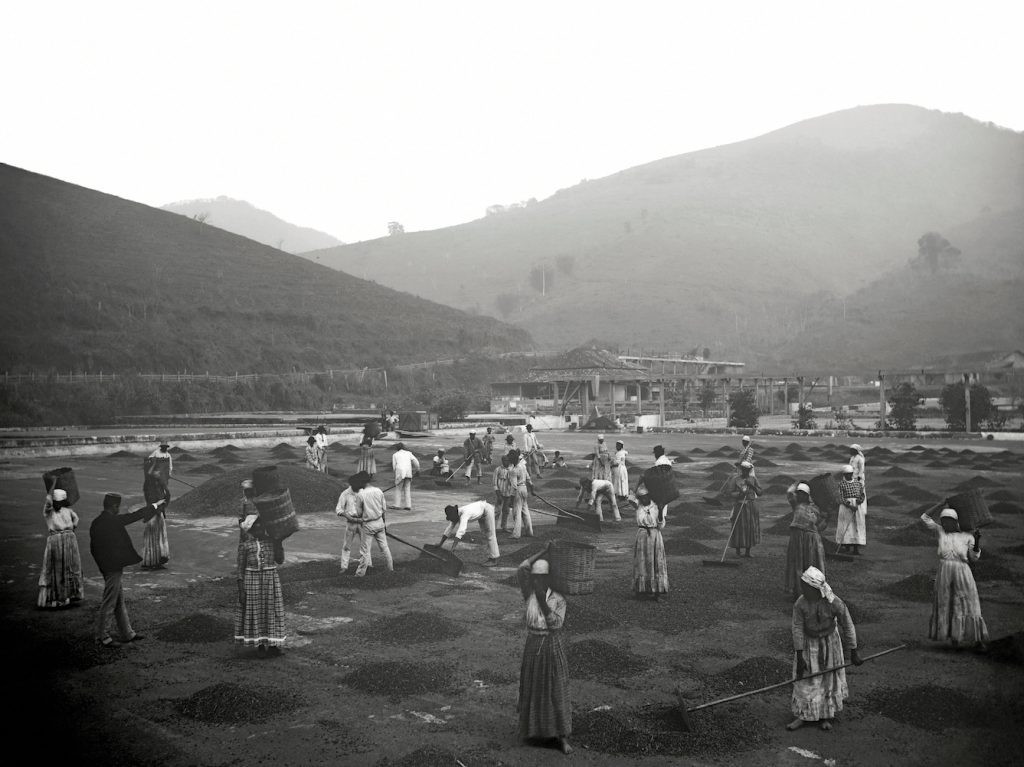
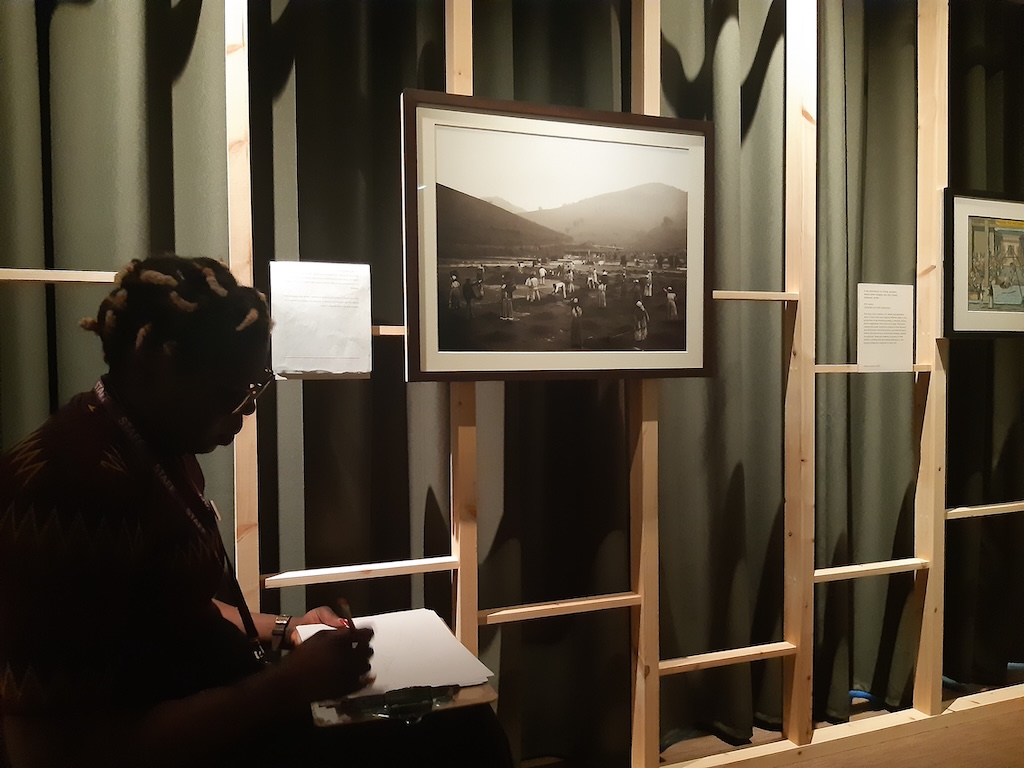
Isabelle Gapomo guided participants in close observation of a photograph by Marc Ferrez from the Hard Graft exhibition, titled ‘Escravos em terreiro de uma fazenda de café na região do Vale do Paraíba’ (c.1882), examining how plantation labor was depicted by early photographers and how those images are experienced today.

‘Escravos em terreiro de uma fazenda de café na região do Vale do Paraíba’ (c.1882). Marc Ferrez.

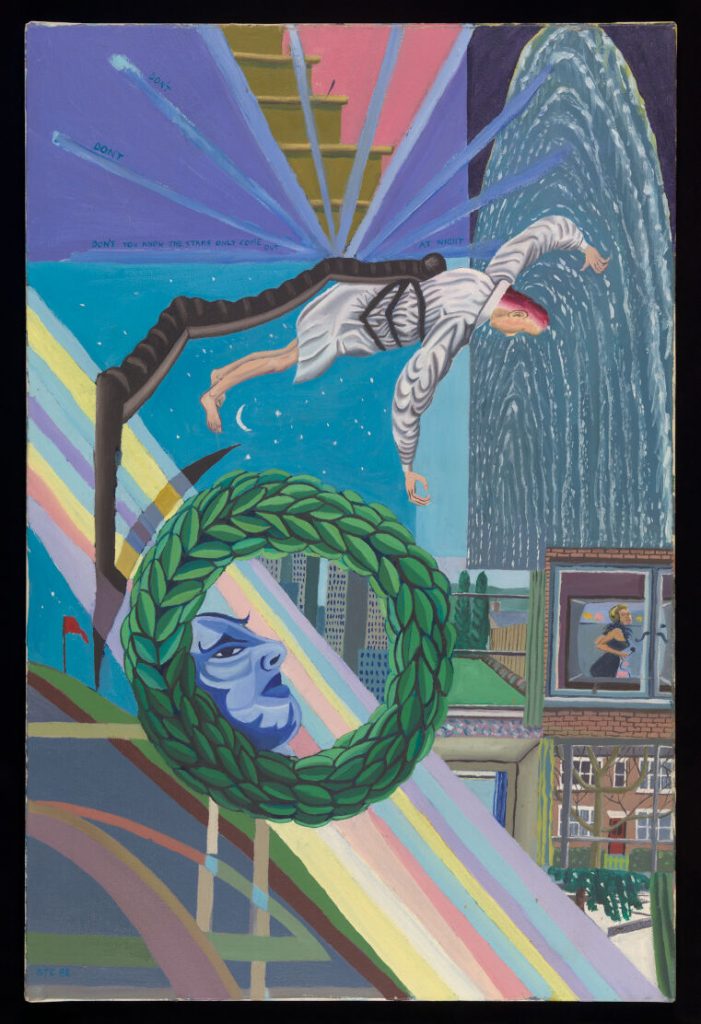
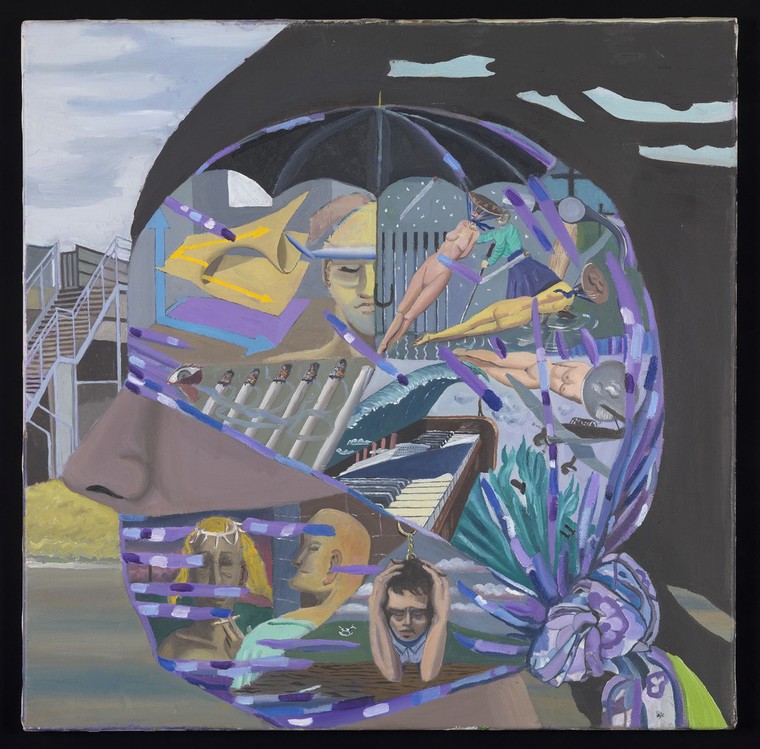
Griff Davies led a session centered on the dream-inspired paintings of Bryan Charnley, using the imagery to prompt discussion around mental health.

“The Stars Only Come Out at Night” by Bryan Charnley.
“Nail Schizophrene” by Bryan Charnley.

Sana Siddiqui reprised her popular session last year and used vintage food advertisements to evoke memory and sensory response.

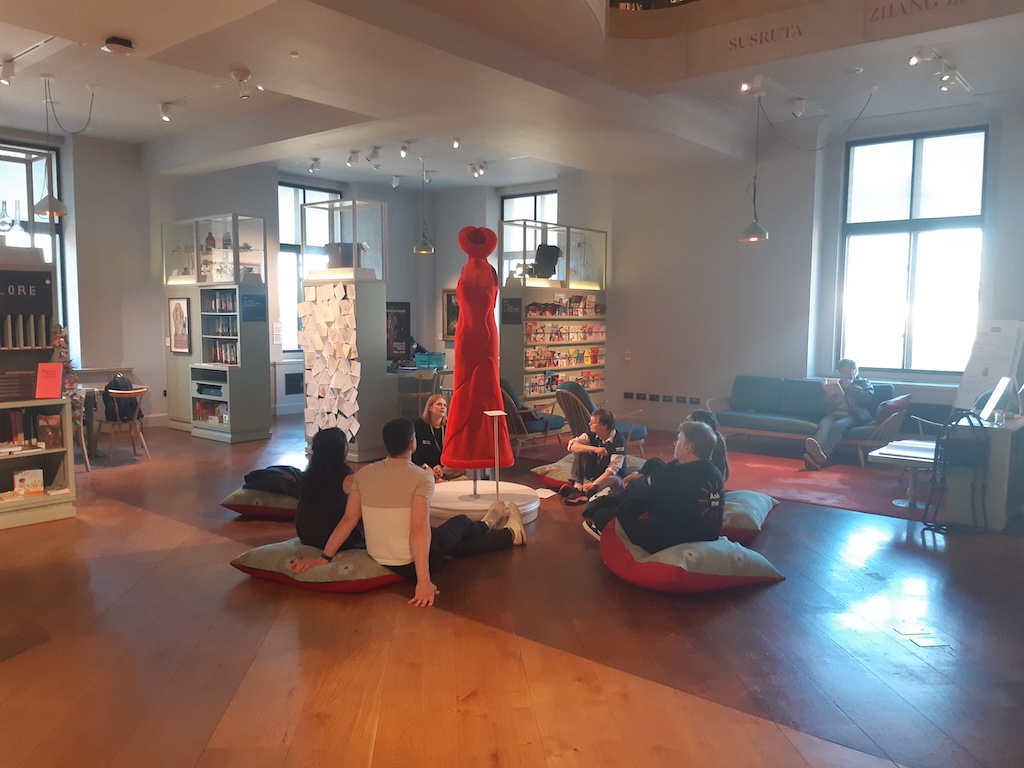
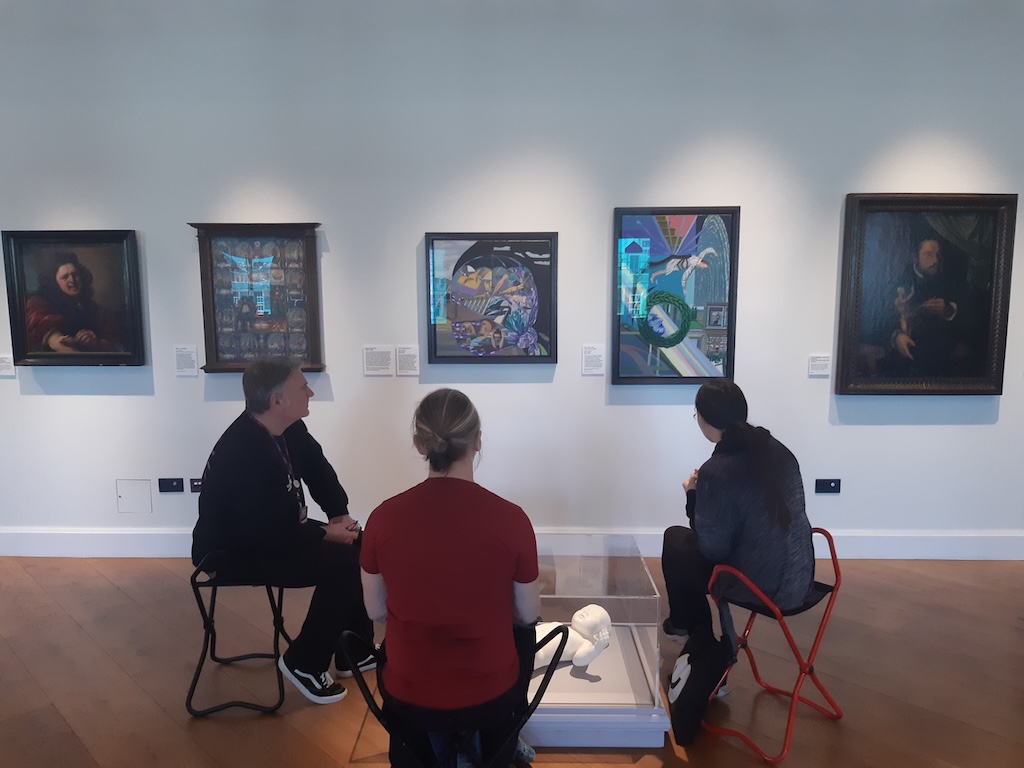
In the Reading Room, Isabel Greenslade gathered participants around “Closing Neural Tube Dress,” a sculptural garment that encouraged reflection on abstraction.

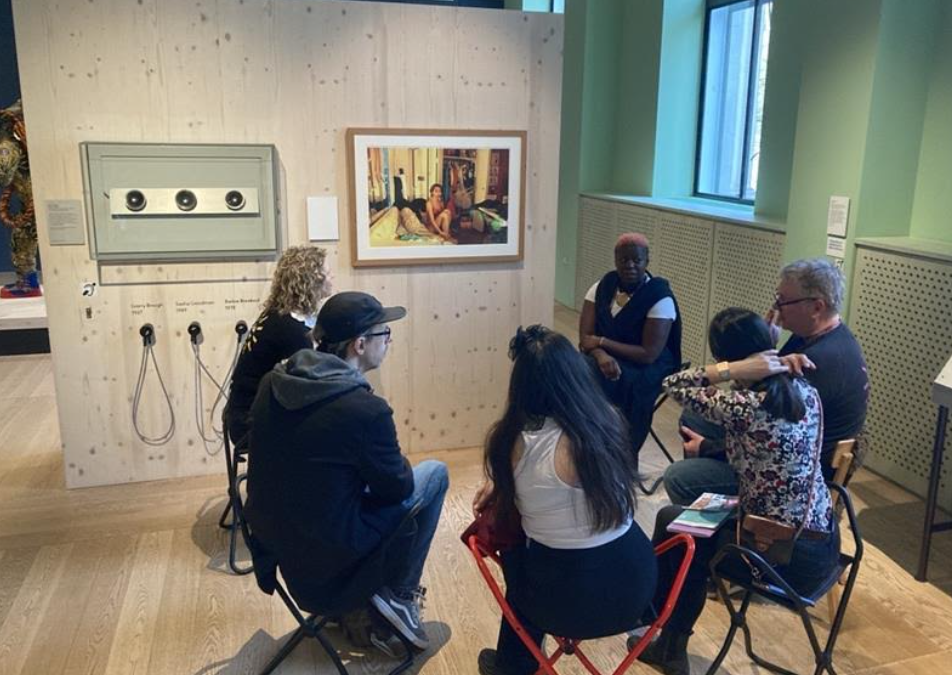
Participants slow looking at the “Closing Neural Tube Dress“.

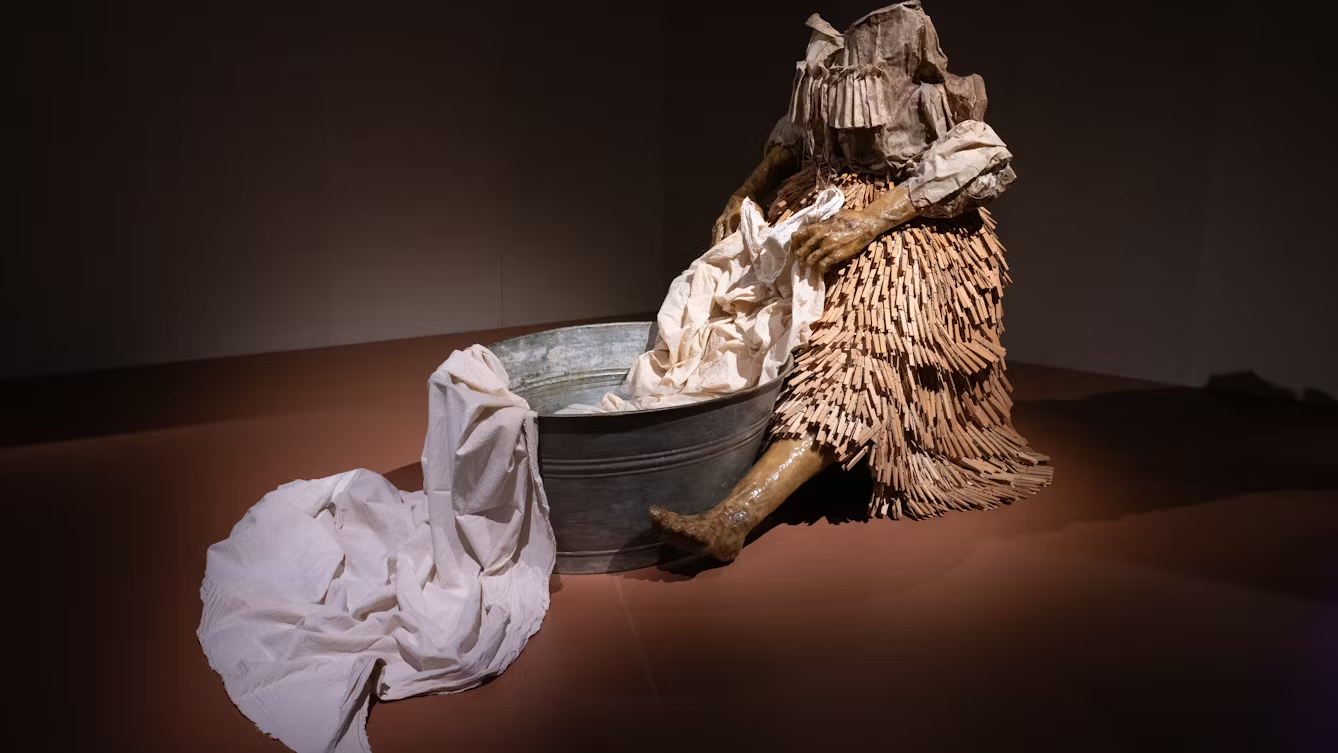
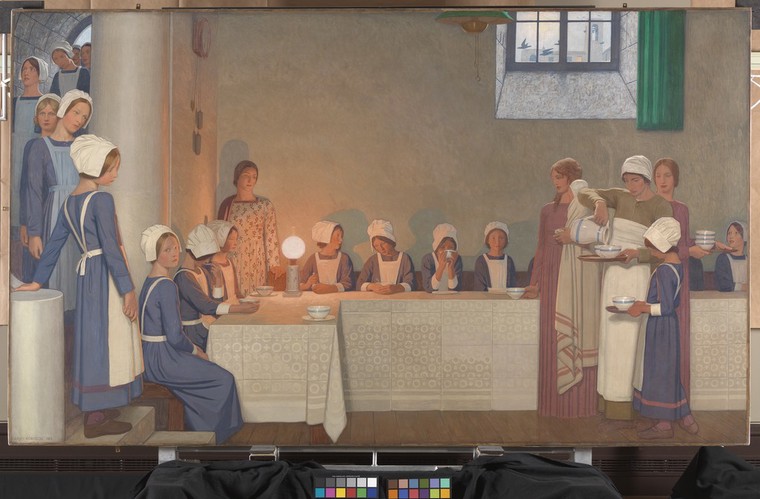
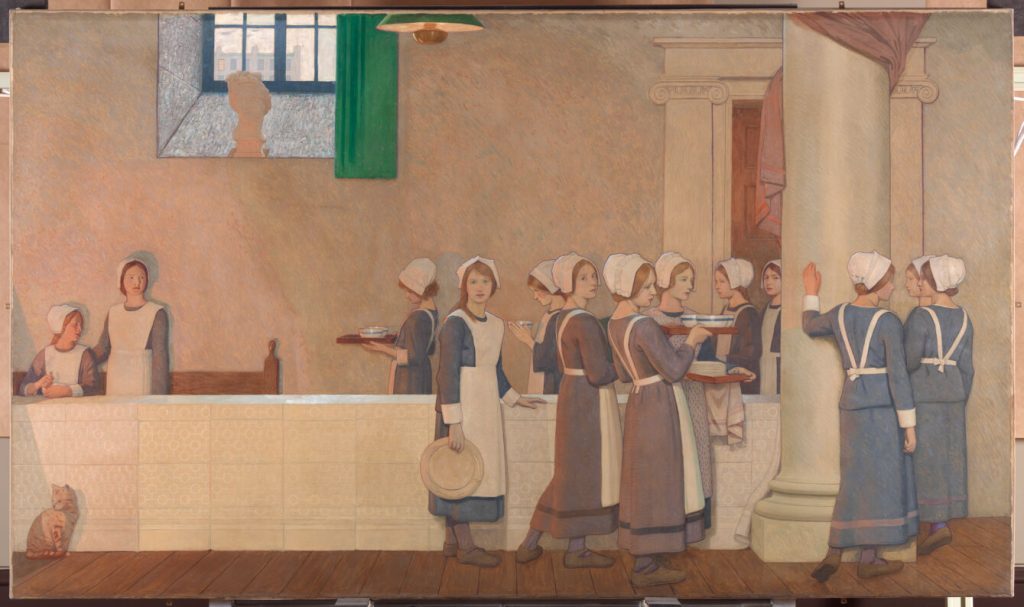
Jake Blackavar led a session that moved through multiple floors of the museum, selecting a sculpture, a video work, and a pair of paintings to explore how different media and gallery contexts shape the slow-looking experience.

“Washerwoman” by Shannon Alonzo.
“Orphans” (left) by Frederic Cayley Robinson.
“Orphans” (right) by Frederic Cayley Robinson.

In addition to the guided sessions, the museum designated a room as a Slow Art Day hub where tours began and visitors could drop in to learn more about the event. In this space, visitors were invited to practice slow looking independently using a rotating screen of images from Wellcome Collection’s holdings, which changed every ten minutes.

What a thoughtful and well-designed program. Wow.

We at Slow Art Day HQ thank Jake Blackavar and the entire Wellcome Collection team for continuing to lead the way in producing meaningful and multi-dimensional experiences.

We eagerly look forward to what they come up with for Slow Art Day 2026.

– Ashley, Johanna, Jessica Jane, and Phyl

P.S. Follow Wellcome Collection on their Instagram and Facebook

Photography in Thessaloniki, Greece

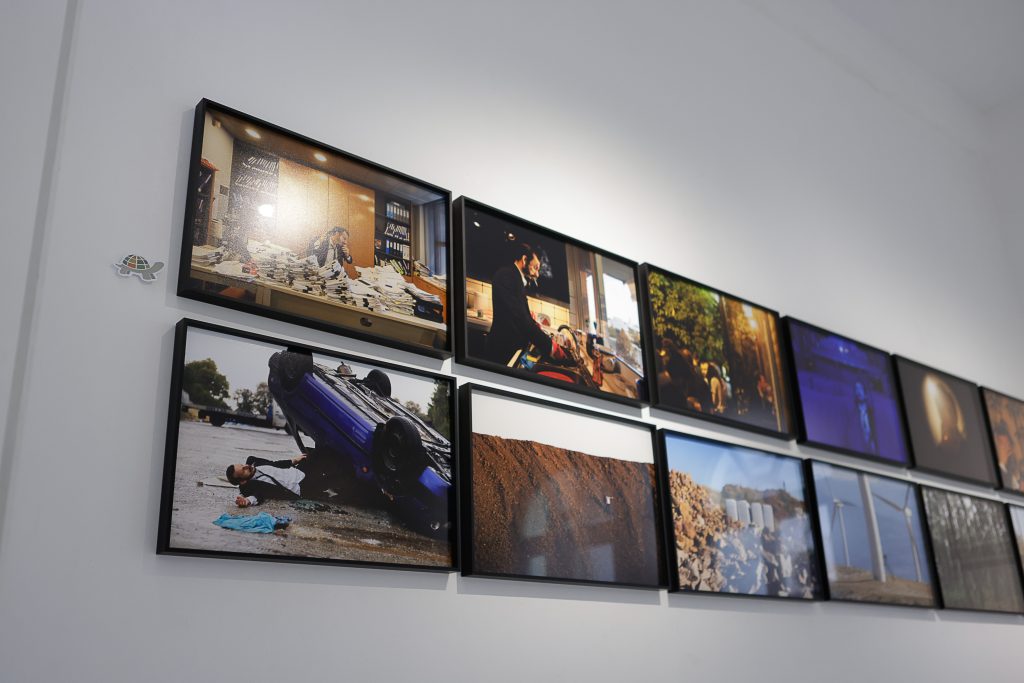
For Slow Art Day 2025, Pinakotheke Gallery in Thessaloniki, Greece hosted a slow looking event focused on the photographic exhibition “ABSORBED (Damn, I miss snowboarding)” by Theodoros Vranas.

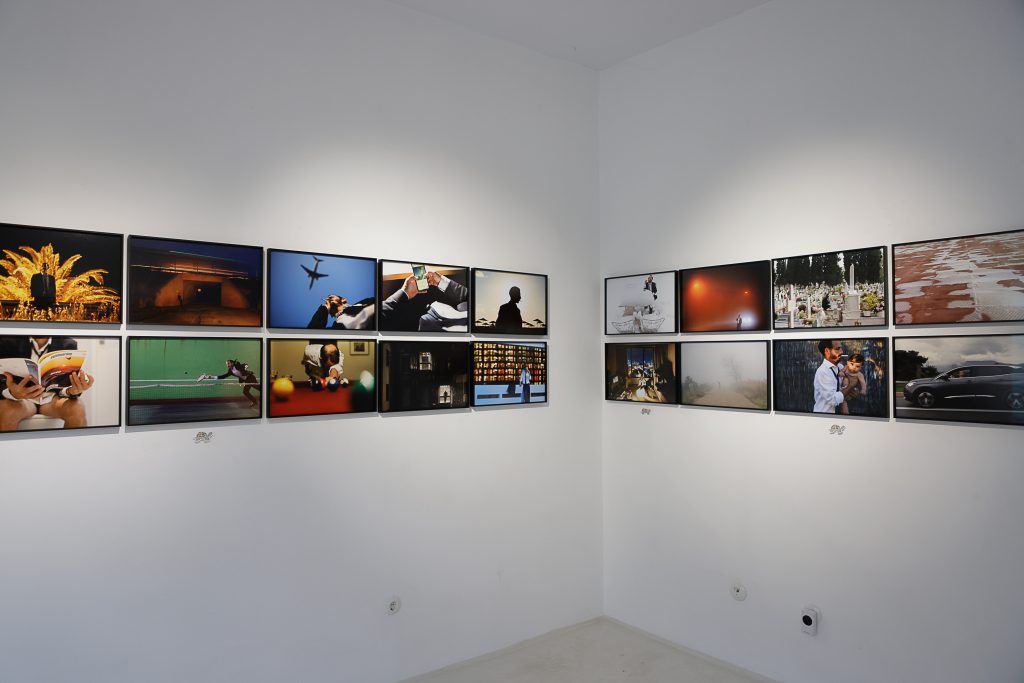
The exhibition presented a series of photographic works in which the artist explores questions of self and psychology, placing moments of human deadlock within landscapes of overwhelming beauty. Visitors were invited to observe a limited number of works closely and reflect on their experience.

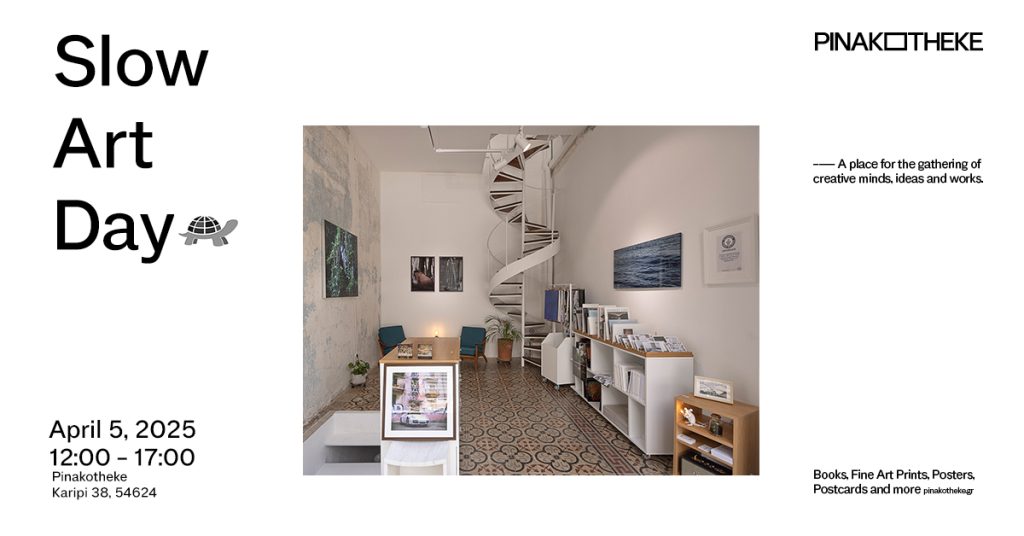
Pinakotheke is a creative project by photographer Stefanos Tsakiris, based in the center of Thessaloniki, and dedicated to promoting photographic work through exhibitions, printing techniques, workshops, and events.

We thank Stefanos and the team at Pinakotheke for participating in Slow Art Day 2025, and look forward to seeing what they come up with for Slow Art Day 2026.

– Ashley, Johanna, Jessica Jane, and Phyl

P.S. – Check out Pinakotheke on Instagram.

Slow Looking Art Swap at Creative Arts Workshop in New Haven, CT

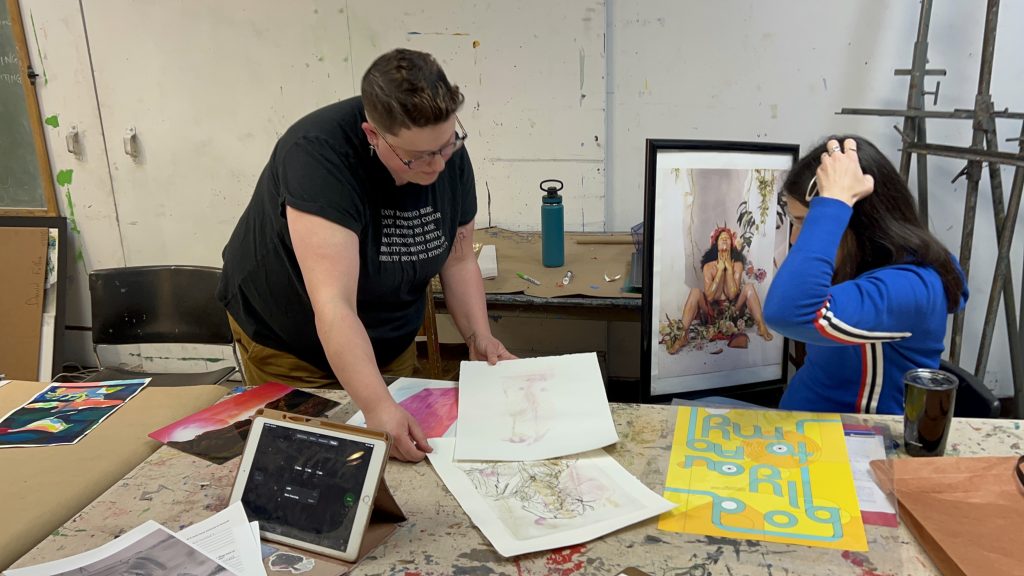
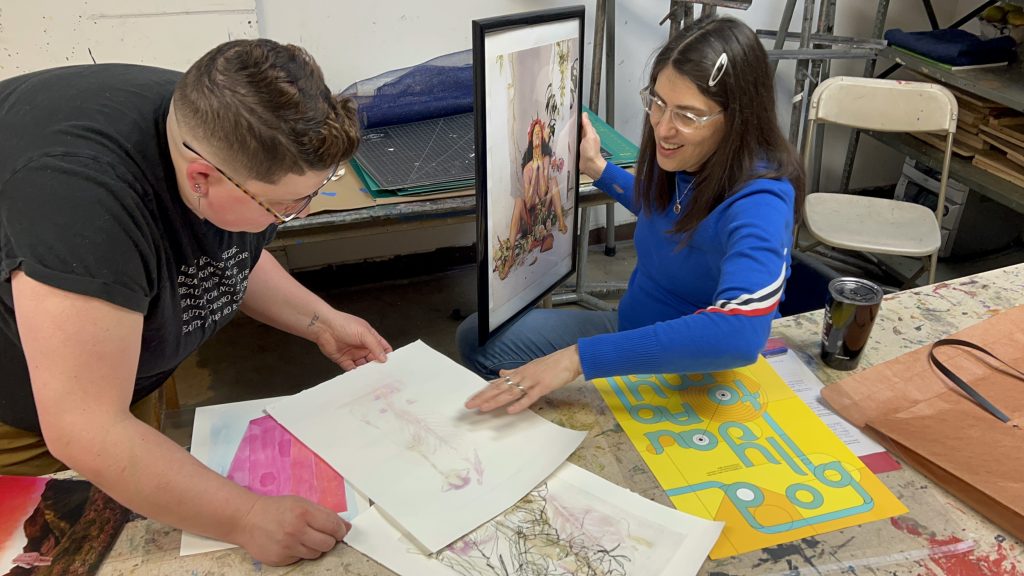
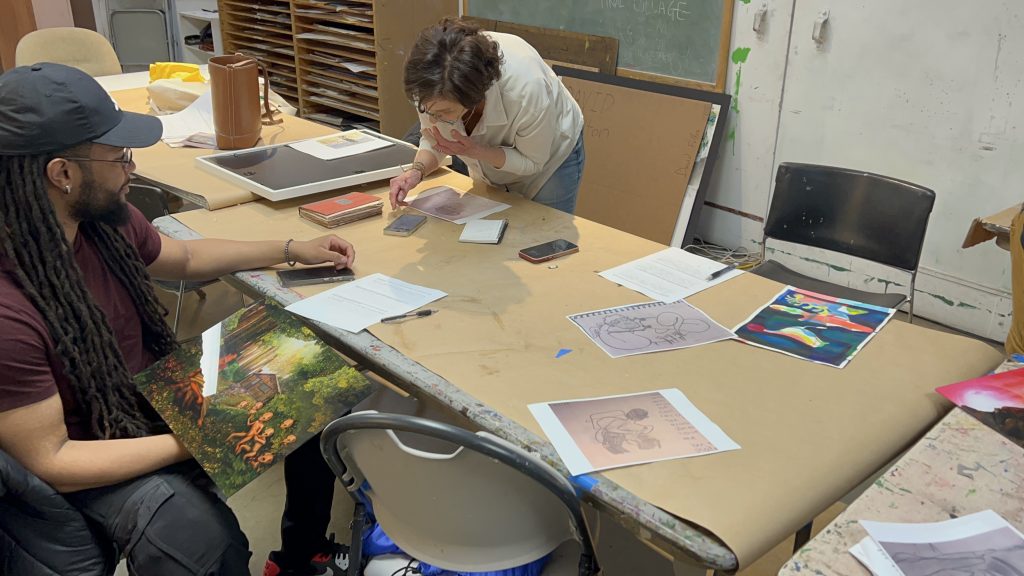
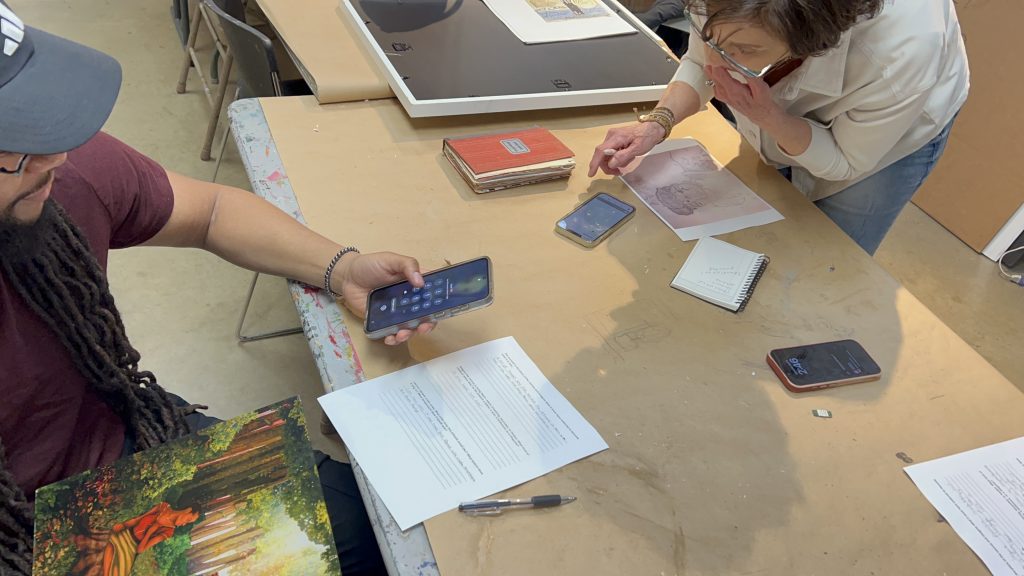
For their first Slow Art Day, the Creative Arts Workshop, a community art school in New Haven, Connecticut, hosted a slow-looking art swap – where the artists were the participants – facilitated by Dymin Ellis, poet, digital artist, musician, and community organizer. Artists ranging from youth to adults participated in the event, each contributing multiple original pieces including photography, altered books, digital art, and embossed prints. 

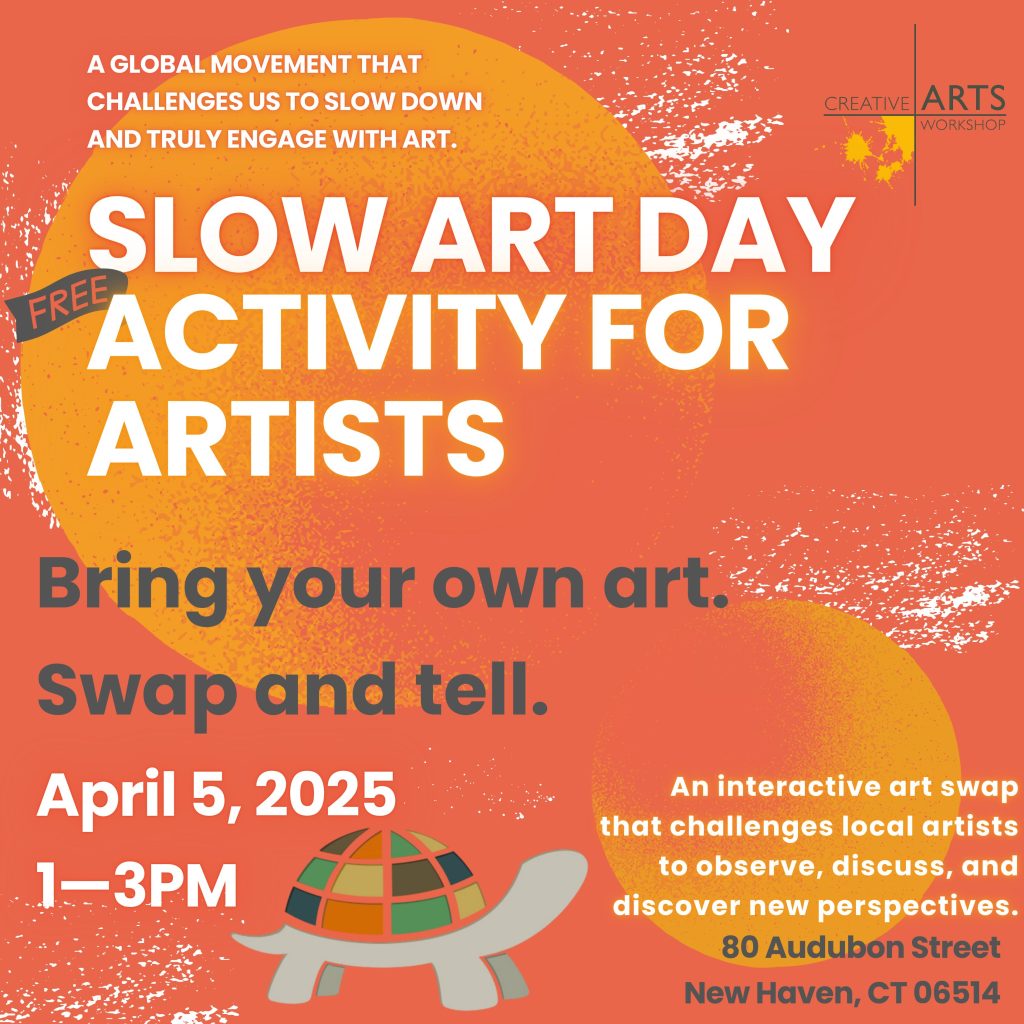
Instagram post advertising the event.

Dymin Ellis led the group through a series of three exercises designed to deepen their engagement with one another’s artworks, and started by asking participants to share their names, artistic disciplines, and the titles of the works they brought. They were then asked to exchange their art work but keep them face down until the exercises began. 

  • First, each artist was asked to share their piece for 10-seconds only.
    • Each participant was then asked to share a single word inspired by what they saw. 
    • They repeated the 10-second viewing a second time engaging all 5 senses, and were then asked: “What do you see? smell? feel? hear? taste?” 
  • Next, participants were asked to look at the same work for 1 minute. They were then asked if they had an emotional reaction to the art.
  • Finally, Ellis facilitated a ten-minute slow-looking session, introducing the following prompts every two minutes. Participants were asked to write their responses and share in a group discussion afterwards.
    • What if this artwork were a portal to a dream—whose dreamworld would it lead to, and what would greet you on the other side?
    • Who do you imagine this artwork remembers? Whose hands, eyes, or stories does it carry forward?
    • Put yourself in the place of the canvas and imagine what it must have endured to become what it is now.
    • Imagine the canvas is living flesh—warm, breathing, wounded, or healed. What kind of creature wears this? Is the artwork a tattoo, a scar, a birthmark, or a disguise?
    • Let your senses cross wires. What color does this artwork smell like? What texture does it sing in? What temperature does it speak with?

The session concluded with a collective reflection on the experience, where participants shared what stood out most and how they might apply slow-looking practices in the future. 

Dymin reported that the discussion was “intimate, reflective, and at times, magical,” and highlighted how the art-swap format created deep reciprocal learning and such a collaborative spirit that some attendees chose to gift their artwork to others.

At Slow Art Day HQ, we are delighted to hear of the unique art-swap format that the Creative Arts Workshop introduced for their Slow Art Day event, and love hearing how it has helped build slow looking into the local artist community. We look forward to seeing how the Creative Arts Workshop continues to innovate for Slow Art Day 2026.

– Ashley, Johanna, Jessica Jane, and Phyl

P.S. Stay connected with Creative Arts Workshop on Facebook and Instagram.

Slow Art Day 2025 at Sawdust Art Festival in Laguna Beach

The Sawdust Art Festival in Laguna Beach, California, celebrated Slow Art Day on April 5, 2025, as part of their three-day Spring Fling pop-up show. The event was organized by host and artist Hedy Buzan, a founding host of Slow Art Day – and a longtime artist-presenter at the Sawdust.

Featured Works:

  • Sager-fired ceramic vessel
  • Stoneware cylinder
  • Two photographs
  • Bronze and enameled dragonfly sculpture
  • Watercolor painting of a neon sign and building
  • Two acrylic paintings
  • Two blown glass artworks

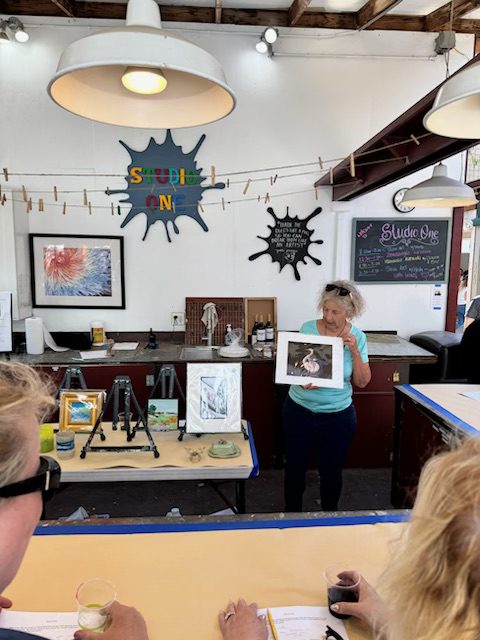
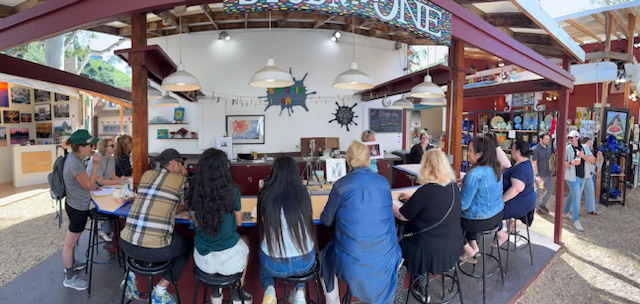
Participants gathered around the counter in Studio One, enjoying coffee during the morning session and wine during the afternoon gathering. Each session began with Hedy Buzan introducing five artworks by different artist, briefly discussing how each was made. Participants chose objects to closely observe in silence for five minutes, guided by the below prompts encouraging reflection on elements such as line, shape, texture, and personal emotional responses.

After individual reflection, attendees exchanged their objects, shifting between two-dimensional and three-dimensional works, allowing everyone to engage with a diverse range of artistic forms. This exchange was followed by a lively group discussion, facilitated by Hedy, who guided conversations by offering positive feedback and insights.

Participants engaging in lively discussion at Studio One. Photo courtesy of Hedy Buzan.

We express heartfelt thanks to Hedy Buzan and the entire Sawdust Art Festival team for their thoughtful planning and enthusiastic facilitation of Slow Art Day 2025. We look forward to what Hedy comes up with for Slow Art Day 2026.

– Ashley, Johanna, Jessica Jane, and Phyl

P.S. Stay connected with Sawdust Art Festival via their Facebook page and Instagram.

House of European History Slow Art Day 2025

Slow Art Day 2025 is coming up April 5 – with hundreds of museums, galleries, churches, sculpture parks and other venues (be sure to register your museum, gallery, church, hospital, sculpture garden or other venue).

One of these locations this year will be The House of European History in Brussels, which is focusing on “Our Family Garden” by Smirna Kulenović, a citizen-led photographic project designed to heal collective trauma from the Bosnian War.

And we are happy to report that their Slow Art Day event will launch Slow Looking Saturday, a monthly guided experience that will focus on a different image from the exhibition, examining topics such as commemorations, historical re-enactments, and personal legacies.

These sessions will continue monthly through the end of the exhibit in November 2026.

We at Slow Art Day love seeing this.

Our goal since day one has been to inspire museums and other venues not only to participate in the annual event, but to create year-round programming that helps visitors slow down.

We’ll note that The House of European History worked with Claire Bown to develop this program. Claire is author of The Art Engager: Reimagining Guided Experiences in Museums.

We are glad to see the House of European History’s year-round commitment to Slow Art Day and look forward to getting updates on their progress.

Have a great Slow Art Day 2025.

Best,

– Phyl

P.S. Slow Art Day 2025 is coming up – be sure to register your museum, gallery, church, hospital, sculpture garden or other venue.

Slow Art Day at Wellcome Collection in London

For their second Slow Art Day, Wellcome Collection in London, England, hosted four different slow looking sessions which included unlocking food memories, writing object labels, and slow looking at works in the Reading Room. Wellcome Collection is a free museum that explores human health through the lens of art, medicine, and science.

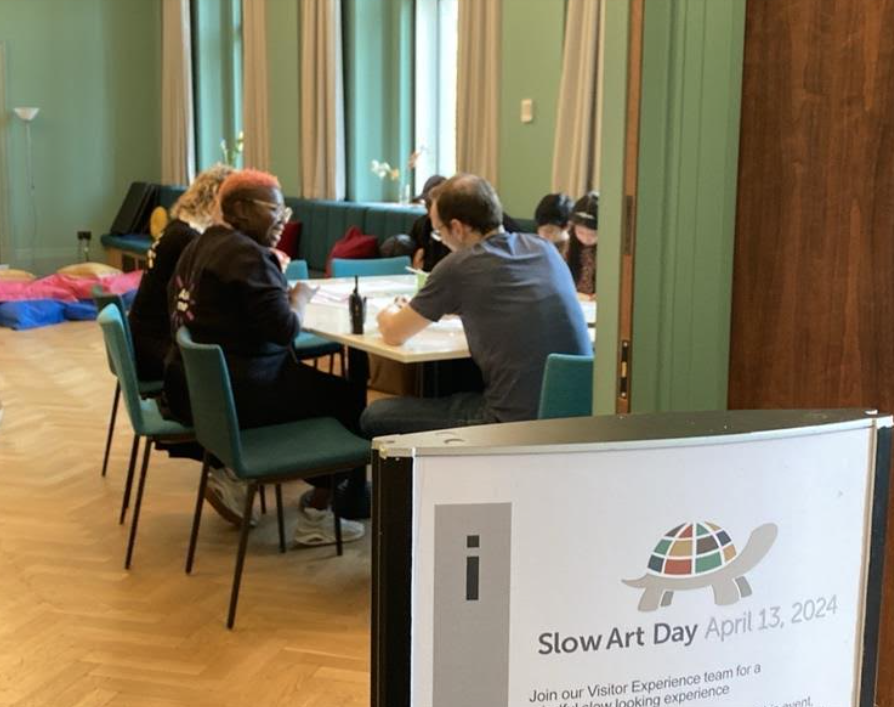
Signs inviting to the Wellcome Room.

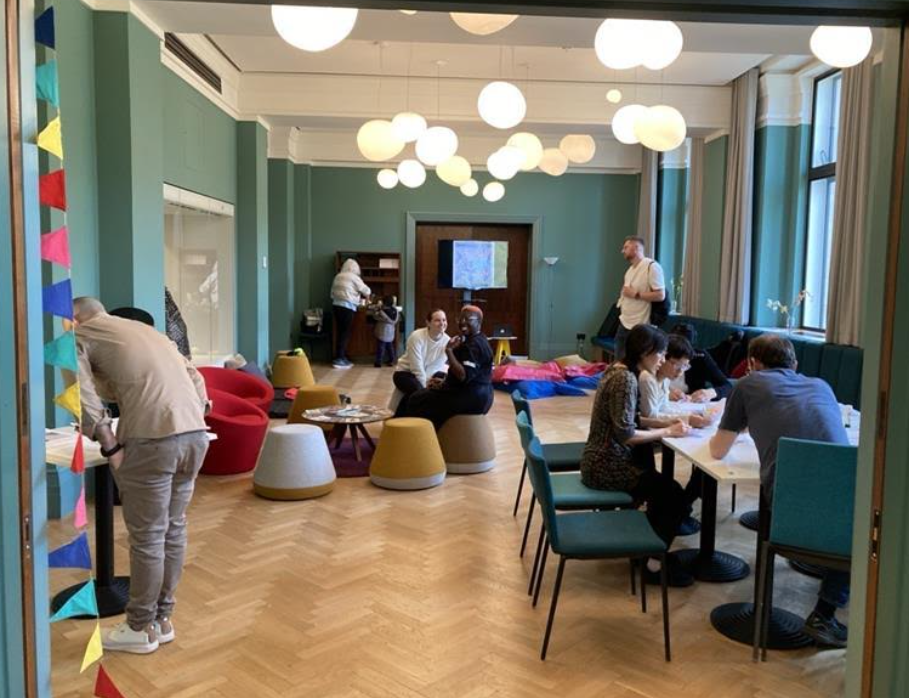
Slow looking participants in the Wellcome Room.

The first session focused on two photographs of women amidst global crises, which illustrated how pandemics and infectious diseases affect the human experience. The exchange that followed with the participants was filled with deep, personal, and emotional testimonies.

The second session, led by Rosie Wassi, one of the Wellcome Collection team, explored the effects of environmental breakdown.

Discussion in front of Kia LaBeija’s self-portrait in the Infection (in this case HIV) Section of the Being Human gallery at the Wellcome Collection.

On a lighter note, the third session invited attendees to label objects from the Handling Collection, which helped to bring gallery employees and visitors closer together. Sana Siddiqui, one of the Wellcome Collection team, also reignited memories and senses through a selection of old food advertisements.

The day concluded with Wellcome Collection’s Slow Art enthusiast, Dickon Moore, leading a slow looking session of the eight-minute film “White” by Daniella Dean, which explored the impact of colonization on New Zealand’s fauna and flora.

A series of prompts were used for the slow looking sessions:

  • What do you see? Colors? Textures? Patterns? Shapes?
  • What do they symbolize? Why were these particular choices made?
  • What do you think the artist wanted to convey through their choices?
  • How does this resonate with you and your experiences? Does it trigger any emotions?
  • Can you tell a story about this object?
  • Based on all that has been discussed, what would you name or title this work?

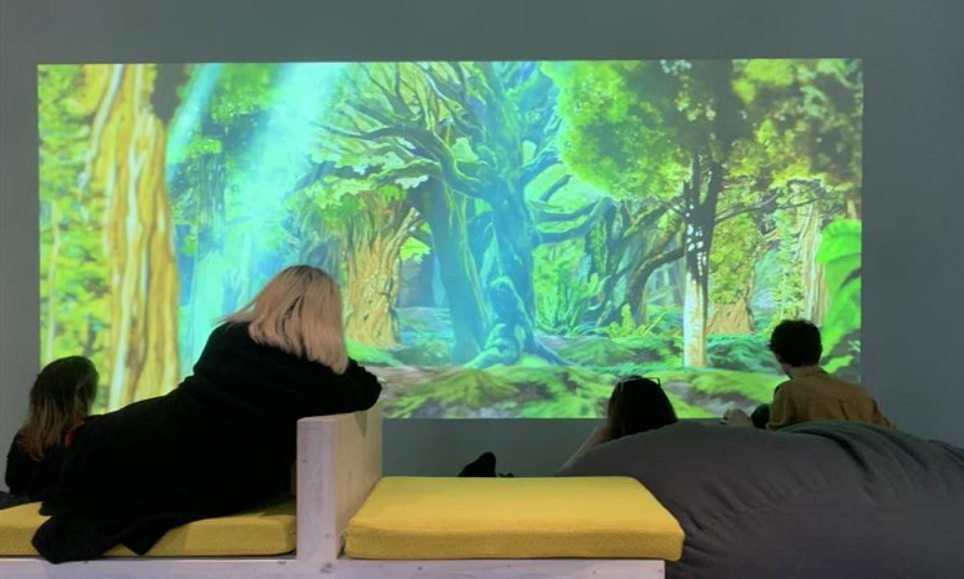
Throughout the day a Slow Art slideshow, art materials, and books were also available to all visitors in the Wellcome Kitchen.

Dickon Moore leading slow looking at the film “White” from Danielle Dean.

Slow drawing.

All sessions were facilitated individually or in pairs by the following Wellcome Collection team members: Jake Blackavar, Sana Siddiqui, Rosie Wassi, Isabel Greenslade, Isabelle Gapomo, Griff Davies, and Dickon Moore.

The event was well received, and Wellcome Collection provided several participants’ feedback in the file below:

At Slow Art Day HQ, we love the variety of sessions at Wellcome Collection, and are excited for whatever they come up with for Slow Art Day 2025.

-Johanna, Ashley, Jessica Jane, and Phyl

P.S. Slow Art Day 2025 is coming up on April 5. If you have not done so, please register your museum, gallery, church, sculpture park here: https://www.slowartday.com/be-a-host/

Seventh Slow Art Day in Belmont, NC

While Slow Art Day is often held in large or regional museums, we also love to celebrate when smaller towns and studios join together to host slow looking.

As such, we’re happy to report that Belmont, NC, a small city of about 10,000 people, held their 7th Slow Art Day in April 2024.

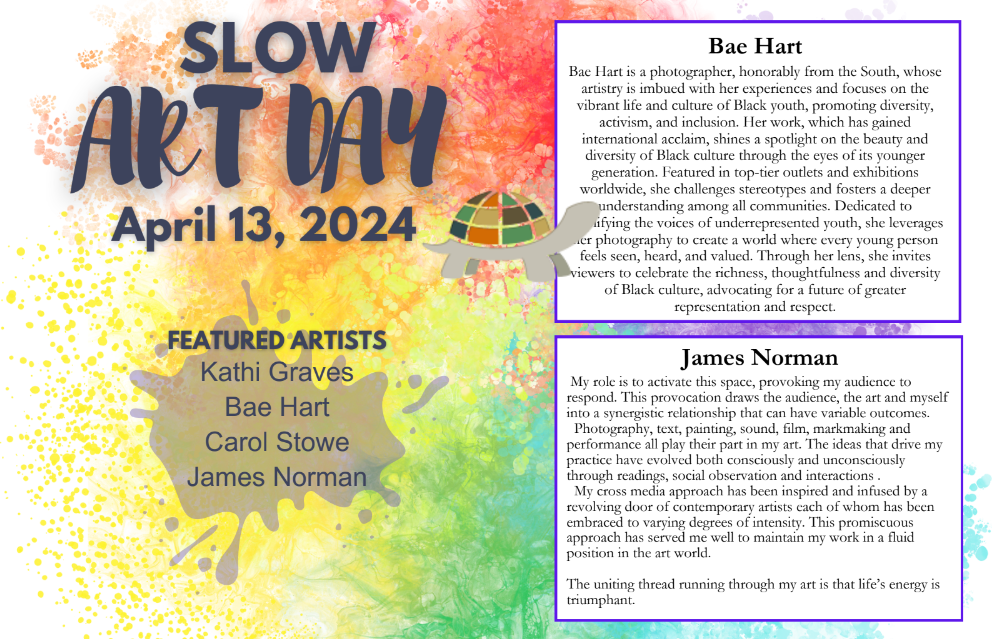
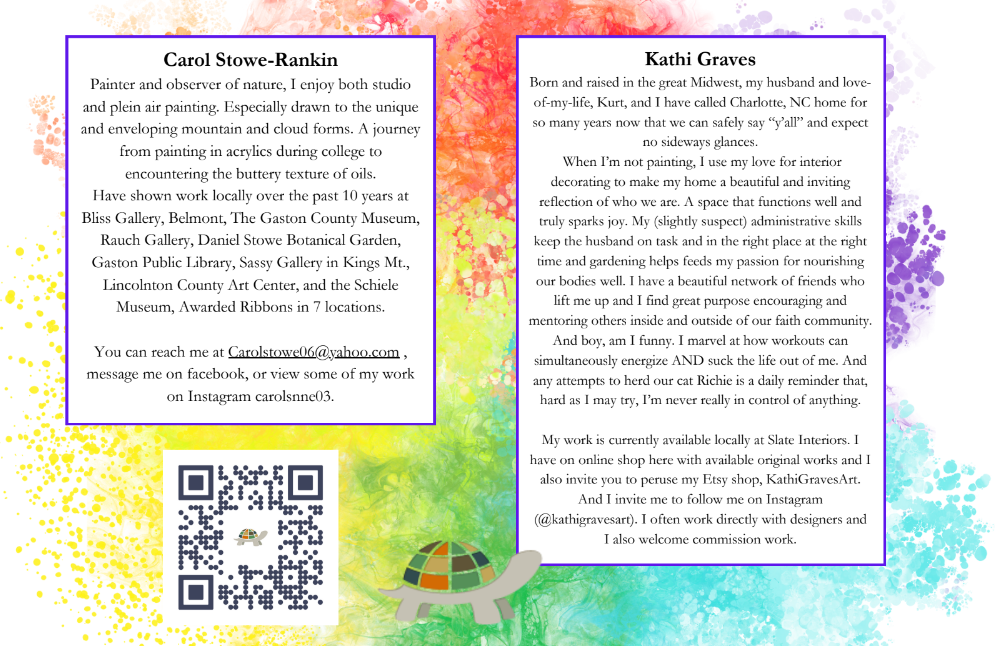
To make it happen The Downtown Belmont Development Association in Belmont, NC, partnered with longtime host and local art center, Art by J Studios, which designed an event to focus on four local artists:

  • Kathi Graves
  • Bae Hart
  • Carol Stowe
  • James Norman

Below is their innovative and fun flyer (feel free to copy).

Slow Art Day flier with profiles of the four featured artists

Both the morning and afternoon sessions were held at Art by J, a children’s art school, which is housed in an old mill down the hall from renowned artist Juan Logan.

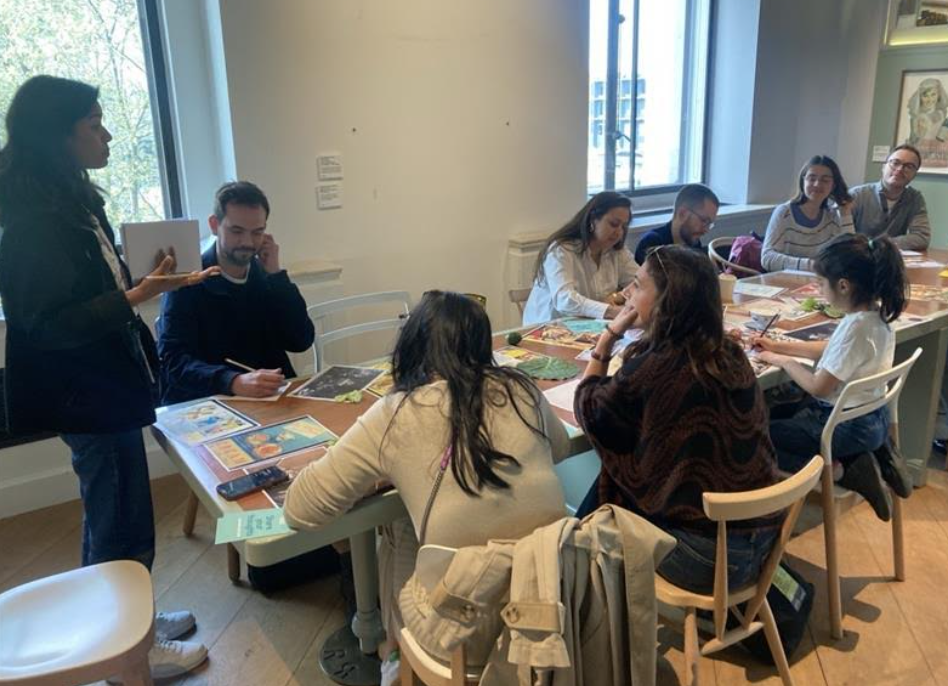
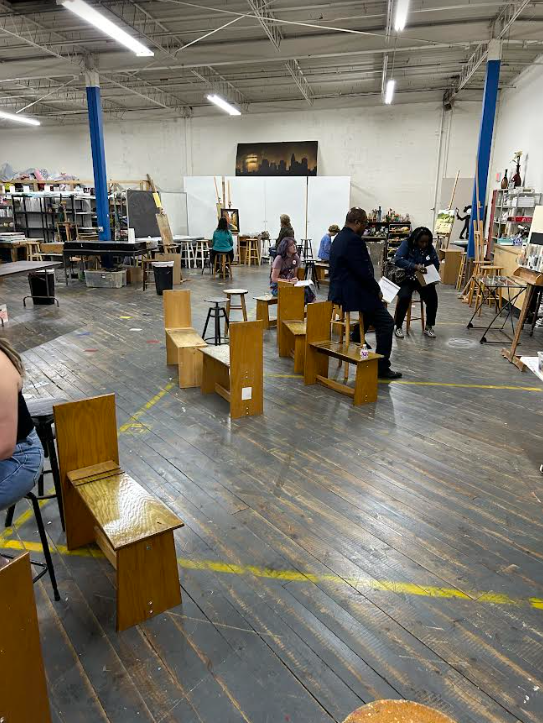
Slow Art Day participants at one of the two sessions at Art by J.
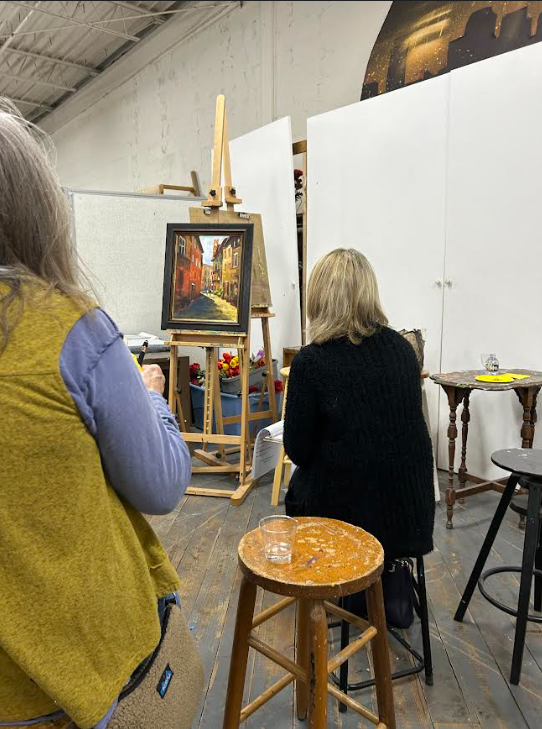
Participants engaging in slow looking.
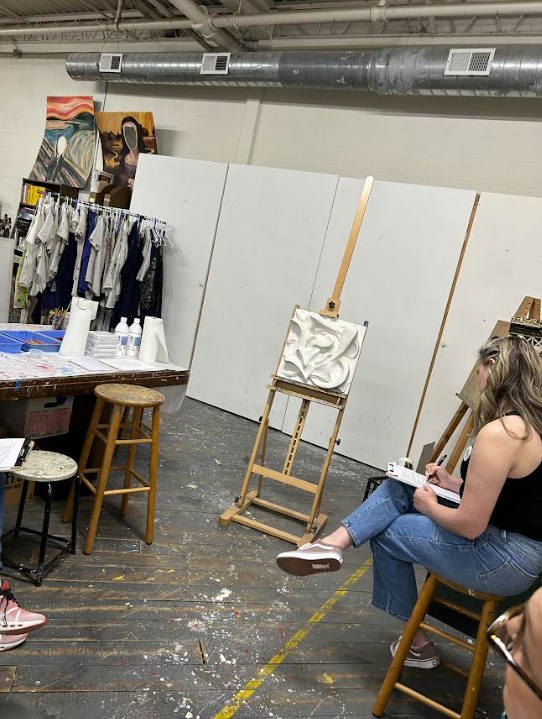
Writing and reflecting during one of the Slow Art Day sessions.

On Slow Art Day, guests were greeted by Jeaniene Dibble, the owner of Art by J, who gave them a Slow Art Day pin (we don’t have a photo of the pin – though we are sure we’d want it!) to wear that she had designed, and handed them a clipboard with paper and a pencil. Normally a chaotic environment with students and classes running, on Slow Art Day the school was serene and contemplative. 

Guests looked slowly at each artwork for 10 minutes and used their clipboards to write down inspirations and answers to prompts that they were given. Next, they engaged in a discussion with three of the artists, Kathi Graves, Carol Stowe, and James Norman, who answered questions and discussed the participants’ thoughts and impressions. Pastries, donuts, and water were also provided.

Amy Bossard, the Design Committee Chair at the Downtown Belmont Development Association, reported that guests and artists were so engaged with each other they could have gone on talking all day long (we hear this all the time and witness it ourselves when we run slow looking events).

Both sessions were very well received, and the Downtown Belmont Development Association and Art by J already look forward to Slow Art Day 2025.

– Johanna, Ashley, Jessica Jane, and Phyl